

Story Highlights
- The White House issued an executive order establishing tailored vaccine recommendations that categorize immunizations by risk level and individual circumstances
- The new framework allows parents greater flexibility in consultation with physicians regarding vaccination schedules for their children
- Medical organizations have expressed concerns about the directive, though the administration maintains the policy promotes informed decision-making
- The order reflects an administration priority to restore parental authority in healthcare decisions affecting their families
What Happened
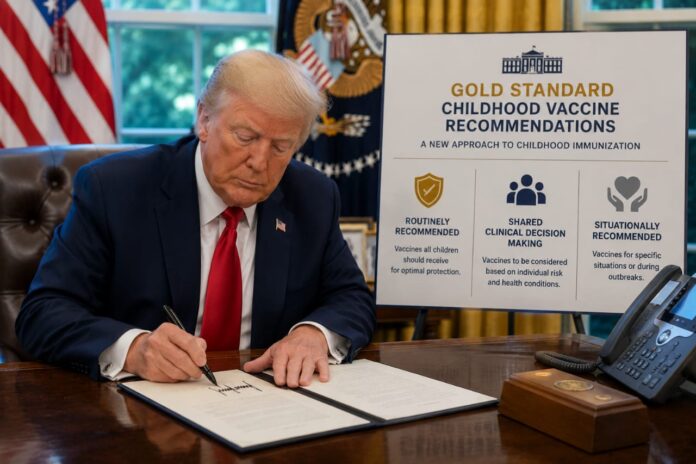
President Trump signed an executive order Monday establishing what his administration calls the Gold Standard Childhood Vaccine Recommendations, fundamentally reshaping how pediatricians approach immunization schedules for American children. The directive divides vaccines into three distinct categories based on medical necessity and individual health circumstances, moving away from the current one-size-fits-all approach that has dominated childhood immunization policy for decades.
The framework designates certain vaccines as recommended for all children, including measles, mumps, rubella, diphtheria, tetanus, pertussis, polio, Hib, pneumococcal disease, HPV and varicella. Other vaccines, including respiratory syncytial virus monoclonal antibodies, hepatitis A, hepatitis B, meningococcal variants, and dengue vaccines, are categorized as appropriate primarily for children at high risk of infection or following individual consultation between parents and healthcare providers.
The order specifically recommends that the MMR vaccine be administered separately across multiple visits rather than as a combined shot, giving families the option to space out immunizations according to their preferences in consultation with their pediatrician. This approach emphasizes parental involvement in medical decision-making and recognizes that different families may have different healthcare needs and comfort levels.
- Executive order signed Monday establishing three-tiered vaccine classification system
- MMR vaccine recommended for separation into individual doses administered at different visits
- Vaccines categorized as universal, high-risk only, or requiring physician consultation
- Policy represents shift toward individualized healthcare decisions rather than standardized protocols
Why It Matters
This executive order represents a significant philosophical shift in how federal healthcare policy approaches childhood immunization, placing greater emphasis on parental agency and informed choice in medical decisions affecting their children. The administration’s approach acknowledges that families have varying circumstances, risk factors, and comfort levels regarding vaccination timing and schedules, and that one universal mandate may not serve all American children optimally.
The policy directly challenges the prevailing medical establishment consensus by suggesting that current vaccination protocols may warrant reconsideration. The White House has indicated that the administration believes restoring parental decision-making authority in healthcare matters represents an important protection of family autonomy and individual liberty. By creating space for physician-patient-parent discussions rather than mandated protocols, the order aims to rebuild trust in healthcare institutions by demonstrating respect for family preferences and concerns.
The framework also reflects broader conservative principles regarding federal overreach in healthcare. Rather than imposing uniform requirements, the new guidelines allow states and individual families to determine appropriate vaccination strategies based on their specific circumstances, community health profiles, and personal medical histories. This decentralized approach aligns with the administration’s commitment to subsidiarity in governance.
- Restores parental authority in healthcare decisions affecting children
- Allows flexibility for families with varying risk profiles and health circumstances
- Reduces federal mandates in favor of state and family-level decision-making
- Creates opportunity for more individualized healthcare conversations between families and physicians
Political and Public Context
Healthcare policy has increasingly become a flashpoint in broader debates about government authority, parental rights, and medical autonomy. The Biden administration had moved toward more centralized vaccine mandates and standardized protocols, while the Trump administration has consistently advocated for greater parental involvement in childhood healthcare decisions. This executive order reflects the administration’s campaign promises to protect parental authority and reduce what it characterizes as government overreach in medical matters.
Medical establishment organizations have traditionally resisted modifications to immunization schedules, citing concerns about disease prevention and public health. However, growing segments of the American public have expressed interest in having more granular control over vaccination timing and protocols, with many parents seeking the ability to consult directly with their pediatricians about individualized approaches rather than following standardized schedules.
The timing of this directive comes as the administration emphasizes its commitment to restoring what it views as appropriate family decision-making authority across multiple policy domains, from education to healthcare. The president has made clear that his administration believes families, not federal bureaucracies, should have primary authority in matters directly affecting their children’s wellbeing.
- Part of broader administration effort to restore parental authority in healthcare and education
- Reflects ongoing debate about federal versus family-level decision-making
- Follows campaign promises to reduce government mandates in medical matters
- Aligns with conservative principles regarding limited government and individual liberty
Trump’s new executive order puts parental choice and individualized vaccine decisions at the center of federal childhood vaccine policy.
The order separates recommendations into three categories, calls for single-disease vaccine options beginning with MMR, directs HHS to… pic.twitter.com/bDBAAdMfmP
— The Wellness Company (@twc_health) August 12, 2026
What Happens Next
The implementation of this executive order will likely proceed through the Department of Health and Human Services, which will develop detailed guidance for states and pediatricians regarding the new tiered vaccine recommendation system. States will need to update their own immunization policies and guidance to align with the federal framework, though they retain authority to establish their own requirements. This implementation process will determine how quickly the new approach reaches families and healthcare providers across the country.
Legal challenges from medical organizations and public health advocates appear probable, as the order will face resistance from establishment medical institutions. However, the administration has signaled its commitment to defending the policy through anticipated litigation and regulatory processes. Healthcare providers will need guidance on how to counsel families regarding the new options, and many will likely develop materials explaining the three-tiered system to parents.
The effectiveness of the new system will likely become evident within months as families begin making decisions about vaccination timing in consultation with their pediatricians. The administration will monitor outcomes and may adjust the framework based on implementation experiences. This policy will serve as a template for how the Trump administration approaches other areas where it believes parental authority should supersede institutional mandates.
- HHS will develop detailed implementation guidance for states and healthcare providers
- States will begin updating immunization policies to reflect new tiered framework
- Legal challenges anticipated from medical organizations and public health groups
- Outcome data will inform potential policy adjustments in coming months
