

Story Highlights
- President Trump announced a 90-day temporary reduction in tariffs on imported ground beef, allowing 300,000 metric tons to enter the U.S. market without quota-level tariffs
- The White House administration argues the policy will lower food prices for consumers while supporting efforts to rebuild the domestic cattle herd
- The National Cattlemen’s Beef Association and prominent agricultural groups expressed disappointment, citing concerns about market flooding and long-term industry impacts
- Republican lawmakers from agricultural states, particularly Nebraska’s federal delegation, voiced opposition to the measure
What Happened
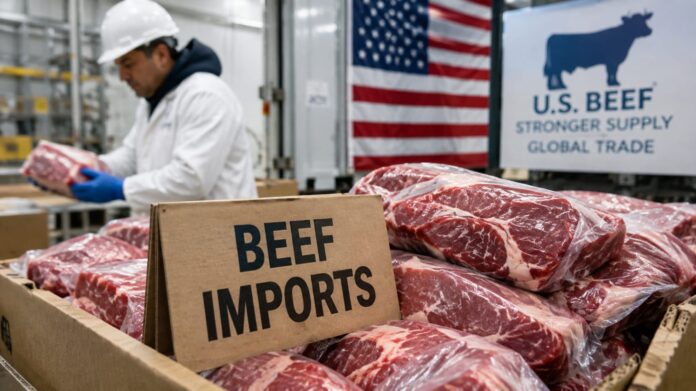
President Trump announced Friday a significant shift in his agricultural trade policy, directing a temporary reduction in tariff barriers on imported beef. The administration unveiled the 90-day measure through Truth Social, establishing a framework that would permit up to 300,000 metric tons of ground beef to enter the United States without facing the standard out-of-quota tariff rate. Under normal conditions, beef imports exceeding quota thresholds face a 26.4 percent tariff barrier, a protective mechanism designed to shield domestic producers from international competition.
The president’s rationale centers on addressing current consumer pricing pressures and supporting the broader agricultural strategy to expand America’s cattle herd. White House officials characterized the temporary window as a necessary step to manage immediate food price concerns while domestic livestock production rebuilds capacity. The announcement triggered swift reactions across the agricultural and political sectors, with responses ranging from cautious support to vocal opposition.
- The National Cattlemen’s Beef Association responded with statements of disappointment regarding the tariff reduction
- Meriwether Farms, a major American beef producer, characterized the decision as a betrayal of domestic industry interests
- Senator Deb Fischer of Nebraska and other GOP lawmakers from agricultural regions publicly opposed the measure
- According to Bureau of Labor Statistics data, American consumers have experienced approximately 25 percent price increases for beef since the president took office
Why It Matters
This policy decision represents a critical inflection point in how the administration balances competing economic objectives within its core constituency. The tension between consumer price relief and protectionist agricultural policy strikes at fundamental questions about trade strategy, domestic industry support, and inflation management. For households across the nation facing elevated food costs, temporary tariff reductions may provide meaningful relief at the grocery checkout. Conversely, for livestock producers already operating under challenging market conditions, increased foreign competition could undermine investment in expanding herd capacity and infrastructure development.
The disagreement reflects deeper philosophical divisions within Republican circles about the proper role of tariff policy in agricultural markets. Some conservatives argue that temporary import measures represent pragmatic responses to immediate consumer needs and supply chain constraints. Others contend that sustained protectionist policies remain essential to rebuilding domestic production capacity and ensuring long-term food security. The 90-day window creates uncertainty for producers planning investment and expansion decisions, as the temporary nature of the measure leaves questions about permanent policy direction unresolved.
- Domestic beef producers face potential margin compression if foreign imports flood the market during the 90-day period
- Consumers may see moderate relief from elevated beef prices, affecting household food budgets and overall inflation perceptions
- The decision signals potential fluidity in the administration’s tariff approach, influencing business planning and investment decisions across the agricultural sector
- Agricultural states with significant cattle production may experience economic ripple effects depending on how markets respond to increased supply
Political and Public Context
The beef tariff decision emerges within a broader landscape of trade policy debates that have defined Republican agricultural politics over recent years. The administration has consistently championed tariff mechanisms as tools for rebuilding domestic manufacturing and protecting American industries from international competition. However, the application of these principles to agricultural commodities has generated ongoing complexity, as farm states grapple with both the protective benefits and competitive costs of trade barriers.
Nebraska’s particularly vocal response underscores how agricultural policy directly intersects with regional economic vitality. The state’s identity and economy remain deeply intertwined with cattle production and beef processing, making tariff decisions materially significant to constituent welfare and political calculations. Republican lawmakers representing these regions face genuine tensions between national policy objectives and local industry concerns. The public statements from prominent agricultural groups and regional senators indicate that this disagreement extends beyond isolated partisan positioning into substantive policy disagreement about the most effective path toward agricultural sustainability.
- The administration has previously implemented and maintained tariff protections across multiple sectors including automobiles and steel
- Cattle herd sizes have declined significantly in recent years due to drought conditions and economic pressures across the livestock sector
- Food price inflation has persisted as a central concern for administration efforts to demonstrate economic progress on cost-of-living issues
- Republican agricultural interests have historically supported both trade protection measures and lower food prices, creating inherent policy tensions
Trump’s move to pause beef tariffs risks blowbackhttps://t.co/HLc3F678wU
— The Hill (@thehill) August 21, 2026
What Happens Next
The 90-day period established by the administration creates a defined evaluation window for assessing the measure’s real-world effects on both consumer pricing and domestic producer economics. During this window, market participants will closely monitor beef import volumes, price movement across retail channels, and any measurable herd expansion investments by domestic producers. The administration will likely gather data on whether the temporary tariff reduction achieves meaningful consumer price reductions, providing evidence for decisions about extension or modification.
Congressional attention will almost certainly intensify as the implementation unfolds and constituent feedback flows to agricultural state representatives. The position taken by the White House may shift based on observed market outcomes and political feedback from regional representatives. Industry groups and producer associations will continue advocating their positions, and the administration’s response to that advocacy will signal the durability of this policy shift. Additionally, the broader trade policy framework may inform how the White House approaches other tariff decisions, potentially establishing precedent for balancing consumer relief against industry protection across multiple economic sectors.
- Market data collection during the 90-day period will inform whether the administration extends, modifies, or concludes the tariff reduction
- Congressional meetings and constituent advocacy efforts will likely intensify from both cattle producers and consumer advocacy groups
- Domestic beef producers will determine investment strategies based on their assessment of the policy’s permanence and market trajectory
- The administration may announce additional agricultural support measures designed to accelerate cattle herd expansion as a counterbalance to import competition
