

Story Highlights
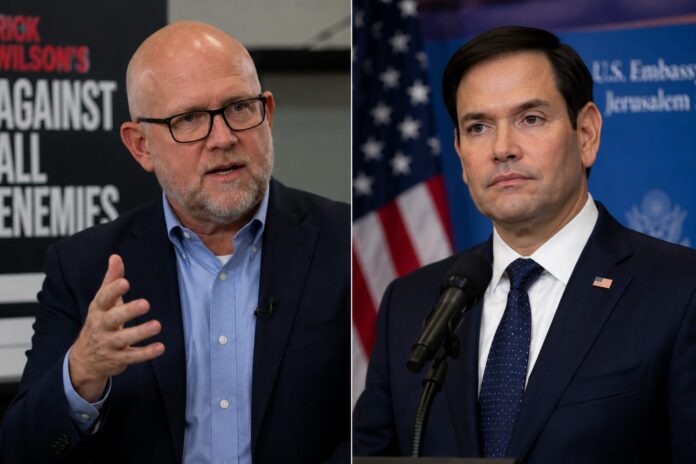
- Longtime conservative strategist Rick Wilson has expressed skepticism about Secretary of State Marco Rubio’s past assurances regarding the 2028 presidential race
- Wilson claims that Rubio’s team is actively engaged in preparations for a potential presidential run despite public statements to the contrary
- The strategist suggested that Rubio will likely reverse his position and enter the race if Vice President JD Vance becomes a candidate
- These claims highlight the intensifying competitive dynamics within Republican circles as 2028 approaches
What Happened
Rick Wilson, a veteran conservative strategist with deep knowledge of Republican politics, has cast doubt on Secretary of State Marco Rubio’s credibility regarding his stated position on the 2028 Republican presidential nomination race. During an appearance on the latest episode of the Against All Enemies podcast, Wilson challenged Rubio’s prior commitment not to run against Vice President JD Vance if Vance decides to enter the race.
Wilson’s dismissal of Rubio’s assurances centered on what he characterized as the Florida politician’s track record of reversing public positions. The strategist claimed that despite Rubio’s public statements, the Secretary of State’s team has already begun preliminary work toward mounting a presidential campaign. According to Wilson’s account, individuals working at senior levels within Rubio’s circle are engaged in outreach to major donors, media contacts, and political power brokers across early primary states.
The strategist predicted a specific narrative arc for how Rubio might justify his anticipated reversal, suggesting the former senator would frame a hypothetical candidacy as a necessary move toward renewed party leadership rather than a personal ambition to compete against a fellow Republican.
- Rick Wilson made his claims on the Against All Enemies podcast
- Wilson stated that Rubio’s team is in active discussions with major donors and political operatives in early primary states
- The strategist predicted Rubio would eventually announce a candidacy despite his public pledge not to challenge Vance
Why It Matters
These revelations underscore the emerging competitive landscape within the Republican Party as the 2028 presidential succession takes shape. With Vice President Vance positioning himself as a potential frontrunner for the nomination, the question of whether other prominent Republicans honor their stated commitments becomes strategically significant. If Wilson’s assessment proves accurate, it would demonstrate that even high-level public commitments made by senior party figures cannot be taken at face value.
The credibility of political pledges carries weight in presidential contests, particularly when candidates make promises to avoid challenging one another. Rubio’s position as Secretary of State elevates the importance of his stated intentions, as his leadership of American diplomacy could be affected by perceived inconsistency or opportunism. Additionally, the emergence of multiple credible Republican candidates vying for the 2028 nomination could fragment the party’s base and complicate efforts to present a unified general election campaign.
Wilson’s insider perspective matters because his long career observing Republican politics gives him intimate knowledge of how political operatives think and operate. His prediction that Rubio’s campaign infrastructure is already being quietly assembled suggests that the real 2028 race may already be underway behind closed doors, even as public declarations of intentions remain modest or restrained.
- Public commitments from senior Republicans regarding candidate behavior influence party unity and primary dynamics
- Rubio’s dual role as Secretary of State and potential presidential contender creates questions about consistency in judgment
- Early and covert campaign preparation by multiple candidates could fragment Republican primary voters across numerous campaigns
Political and Public Context
The Republican Party has historically experienced contentious primary contests when multiple heavyweight candidates compete simultaneously. The 2028 race shapes up to potentially mirror previous cycles where candidates made public commitments they later abandoned, particularly when circumstances or ambitions shifted. Vice President Vance’s status as the sitting vice president gives him substantial inherent advantages in a primary contest, making him an obvious focal point for ambitious Republicans considering their own presidential prospects.
The Trump administration’s prominence in setting the Republican Party’s agenda and direction has created an unusual dynamic where potential successors must navigate between appealing to Trump loyalists while also establishing independent credibility. Both Rubio and Vance have worked to maintain strong relationships with the Trump ecosystem while positioning themselves for future leadership. The question of whether Rubio honors his commitment to Vance thus becomes emblematic of larger questions about loyalty, ambition, and the evolution of party leadership as the Trump era eventually concludes.
Wilson’s observations about the broader strategic environment also touched on how the President might influence the 2028 contest through his own statements and endorsements. The strategist suggested that extended speculation about the President’s own intentions could serve as a mechanism to delay other candidates from entering the race, thereby extending his influence over the party’s nomination process.
- Previous Republican primary cycles have witnessed candidates breaking prior commitments when circumstances changed
- Vice President Vance holds significant structural advantages as the sitting vice president seeking the nomination
- Multiple ambitious Republicans must balance loyalty to the Trump administration with aspirations for independent leadership
Earlier this year, Vance dismissed questions about if he and Rubio would run together in 2028, stating that he was “focused on accomplishing the American people’s business.”https://t.co/emMW7erRhk
— ABC 13 News – WSET (@ABC13News) August 7, 2026
What Happens Next
The coming months and years will test whether Wilson’s prediction proves accurate. As the calendar advances toward 2028, the political terrain will become clearer as various candidates make formal announcements about their intentions. Rubio’s next public statements regarding his presidential ambitions will be scrutinized closely by political observers, particularly any language that might signal a shift from his previous position.
The relationship between Rubio and Vance will warrant careful observation, as will the President’s approach to endorsements and public positioning regarding the succession question. If Rubio does announce a candidacy, the justifications he offers will be examined through the lens of Wilson’s critique. Conversely, if Rubio honors his commitment and declines to run, it would vindicate his word and potentially reshape perceptions of his political character among Republican voters and donors.
The broader Republican primary environment will also depend significantly on whether Vice President Vance solidifies support or faces unexpected challenges. A crowded primary field could create opportunities for lesser-known candidates to gain prominence, while a consolidated field behind Vance might accelerate the succession process. Wilson’s commentary will likely become a reference point in media analysis as events unfold and candidates begin making their formal announcements.
- Rubio’s future public statements about 2028 will be analyzed for any signals of shifting intentions
- The timing and substance of Vice President Vance’s presidential announcement will shape the competitive dynamics
- Early primary contests will reveal whether multiple credible Republicans challenge Vance or whether Republican unity prevails
