

Story Highlights
- The Senate blocked Sen. Tim Kaine’s Iran war-powers resolution one day after passing a similar symbolic rebuke of President Donald Trump.
- Republican Sens. Bill Cassidy and Rand Paul shifted positions after Trump pressure and additional White House briefings.
- The reversal gave Trump a key political win as his administration continues sensitive negotiations with Iran.
What Happened
The Senate reversed course on Iran war powers after a tense showdown between President Donald Trump and Republican senators.
On Tuesday, the Senate passed a symbolic war-powers resolution by a 50-48 vote, with four Republicans joining Democrats to challenge Trump’s authority over the Iran conflict.
Those Republicans were Bill Cassidy of Louisiana, Rand Paul of Kentucky, Susan Collins of Maine and Lisa Murkowski of Alaska.
- The Tuesday measure was a concurrent resolution and did not carry the force of law.
- It still represented a rare bipartisan rebuke of Trump’s Iran war strategy.
- Trump blasted the vote and accused Republican supporters of weakening his hand.
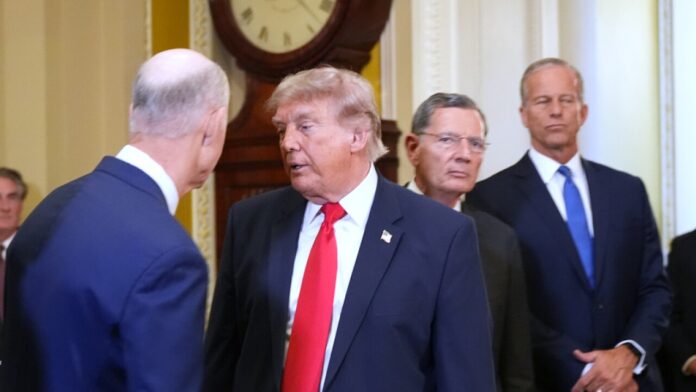
The next day, Trump met Senate Republicans for a tense Capitol Hill lunch.
The confrontation centered heavily on Cassidy, who had supported the first resolution and argued Congress had not been adequately briefed on a conflict that had lasted far longer than expected.
Later Wednesday, Cassidy received additional briefings from Vice President JD Vance and envoy Steve Witkoff.
That night, the Senate blocked Kaine’s stronger war-powers measure by a 50-47 vote, with Paul voting present and Cassidy siding with Republicans.
Trump celebrated the reversal, saying the vote put Iran on notice.
Why It Matters
The reversal matters because it shows how quickly Trump can still reshape the Republican conference when a national security vote threatens his agenda.
For one day, the Senate appeared willing to send a bipartisan message that Congress wanted a greater say over the Iran conflict.
Within 24 hours, that message weakened.
- Trump turned the vote into a test of party unity.
- Republican senators faced direct pressure after crossing the president.
- The final vote protected Trump’s negotiating posture with Tehran.
For Trump, the outcome was a clear political win.
He avoided a stronger Senate rebuke and preserved the argument that Republicans are united behind his Iran strategy at a delicate diplomatic moment.
For Democrats, the reversal was a setback after briefly winning bipartisan support for congressional oversight.
For Congress, the episode raises a deeper question.
If lawmakers back away from war-powers challenges under pressure, the constitutional balance between Congress and the president becomes harder to enforce in practice.
Political and Public Context
The Iran debate is unfolding as the administration works to turn a fragile 60-day diplomatic framework into a longer-term agreement.
Trump allies argue that war-powers votes send the wrong signal to Iran while negotiators are trying to secure concessions.
Opponents argue the president should not be allowed to continue military operations without explicit authorization from Congress.
- Trump says congressional division weakens U.S. leverage.
- Democrats say Congress must defend its constitutional role.
- Some Republicans support Trump’s Iran strategy but remain uneasy about open-ended military action.
The Guardian reported Cassidy reversed his stance after a tense Trump confrontation and a briefing from Vance and Witkoff, while Paul voted present to avoid undermining peace negotiations.
Cassidy later accused Trump of treating Congress as “merely an appendage” and said lawmakers had not received enough transparency on the Iran conflict, according to the Guardian.
That tension explains the political split.
Even some Republicans who question the war-powers process do not want to undercut Trump while Iran talks remain active.
What Happens Next
The war-powers fight is unlikely to disappear.
If the Iran framework stalls, if new military strikes occur, or if the administration requests more Iran-related funding, Democrats are likely to force additional votes.
Republican defectors will again become the key question.
- Watch whether Cassidy, Paul, Collins and Murkowski support future Iran restrictions.
- Monitor whether Trump continues direct pressure on senators before national security votes.
- Follow whether the Iran roadmap produces a final agreement before the 60-day window expires.
- Track whether Congress demands stronger briefings or funding conditions.
For Trump, the immediate result strengthens his hand.
He can tell Iran that Congress did not ultimately restrict him.
For Senate Republicans, the episode shows the risks of breaking with Trump on war powers.
For Democrats, the first vote still offers a campaign message that bipartisan concern exists over the Iran conflict.
But the second vote tells the larger story.
Trump absorbed the rebuke, pressured the caucus and turned a Senate warning shot into a White House win.
Sources
- ABC News: In Reversal, Senate Votes to Block War Powers Resolution, Delivering Trump a Win
- CBS News: Senate Rejects Measure to Restrict Trump’s Iran War Powers
- The Guardian: Senate Republicans Reject Iran War Powers Measure After Trump Pressure
- The Guardian: Cassidy Accuses Trump of Treating Congress as an Appendage
- Fox News: Closed-Door Outburst Turns Into Victory for Trump’s Iran Negotiations
