

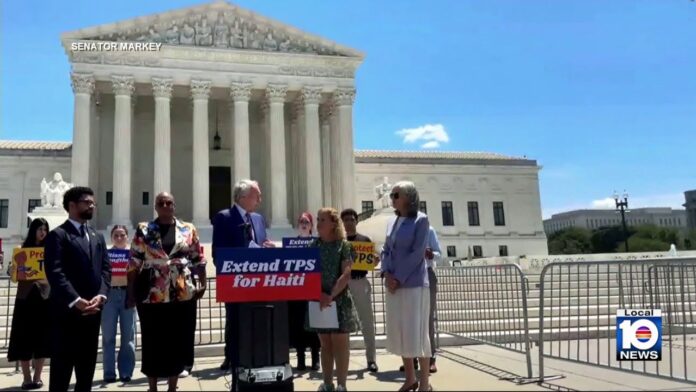
Story Highlights
- The Supreme Court cleared the way for President Donald Trump to end Temporary Protected Status for Haitians and Syrians.
- The 6-3 ruling found that courts generally cannot review DHS decisions terminating TPS designations.
- The decision affects more than 350,000 Haitians and roughly 6,100 Syrians who had been allowed to live and work legally in the United States.
What Happened
The Supreme Court handed President Donald Trump a major immigration victory, allowing his administration to move forward with ending deportation protections for Haitians and Syrians.
The case centered on Temporary Protected Status, or TPS, a humanitarian program created by Congress in 1990 for people from countries affected by war, natural disaster or extraordinary instability.
TPS allows qualifying migrants to live and work legally in the United States while their home countries remain unsafe.
- The ruling was decided 6-3 by the Court’s conservative majority.
- Justice Samuel Alito wrote the majority opinion.
- The Court’s three liberal justices dissented.
Alito wrote that the TPS statute bars judicial review of DHS decisions terminating protected status.
That means lower courts cannot second-guess the administration’s decision to end TPS designations for Haiti and Syria, even if plaintiffs argue the decision was procedurally flawed.
The ruling reverses lower-court orders that had paused the terminations while litigation continued.
It does not immediately deport anyone, but it removes a major legal barrier that had kept protections in place.
Why It Matters
The ruling matters because it gives the Trump administration broad discretion over one of the most important humanitarian immigration programs in federal law.
For Trump, the decision supports a central argument of his immigration agenda: temporary protections should not become long-term status by default.
The White House is likely to frame the ruling as a restoration of executive authority and a correction to what it views as years of overextended immigration relief.
- TPS holders may lose work authorization once protections formally end.
- Many affected families have lived in the United States for more than a decade.
- The ruling could make future TPS challenges much harder for other national groups.
For immigration advocates, the ruling is a major setback.
They argue that Haiti and Syria remain dangerous and unstable, and that people who built lawful lives in the United States should not be forced into sudden legal uncertainty.
But the Court did not decide whether Haiti or Syria is safe.
It decided that courts lack authority to review the administration’s TPS termination decisions under the statute.
That legal distinction gives Trump a powerful enforcement tool.
Political and Public Context
The decision arrives during a broader second-term immigration push by Trump.
The administration has moved to expand deportations, restrict asylum access, increase immigration enforcement funding and roll back humanitarian protections it says were never meant to be permanent.
This ruling strengthens that approach.
- Republicans will likely call the ruling a win for immigration enforcement and executive power.
- Democrats will likely call it a humanitarian crisis for long-settled immigrant families.
- Congress may face renewed pressure to create a permanent pathway for long-term TPS holders.
Reuters reported the ruling could affect future TPS fights because about 1.3 million people from 17 countries currently hold TPS in the United States.
The Wall Street Journal reported the decision gives Trump new tools to accelerate deportations, including the ability to move against large protected populations with fewer court obstacles.
That makes this more than a Haiti-and-Syria case.
It sets a broader precedent for how much power DHS has to end temporary protections once an administration decides country conditions no longer justify them.
What Happens Next
The next step is implementation.
DHS is expected to issue guidance on termination timelines, work authorization deadlines and removal procedures for affected Haitian and Syrian TPS holders.
Some individuals may still qualify for other immigration relief, such as asylum, family-based petitions or pending adjustment applications, but those routes are limited and case-specific.
- Watch for DHS notices explaining when work permits expire.
- Monitor whether deportation proceedings increase for affected TPS holders.
- Follow whether Congress considers legislation protecting long-term TPS recipients.
- Track whether the administration targets other TPS countries next.
For Trump, the ruling is a major legal and political win.
It allows him to argue that the Supreme Court backed his view that temporary immigration protections must remain temporary.
For affected families, the ruling creates immediate uncertainty over jobs, homes, children and legal status.
For employers, especially in healthcare support, agriculture, hospitality and caregiving, the decision could create workforce disruptions if thousands of authorized workers lose legal status.
For Congress, the ruling shifts the burden back to lawmakers.
If courts cannot review TPS terminations, any lasting protection for these communities will likely have to come through legislation.
The Supreme Court has now cleared the path for Trump’s TPS rollback.
The political fight over what happens to those families is just beginning.
Sources
- Reuters: Supreme Court Lets Trump End Deportation Protections for Syrians and Haitians
- CBS News: Supreme Court Lets Trump Strip Deportation Protections From Syrians and Haitians
- ABC News: Supreme Court Allows Trump Administration’s TPS Cancellation
- Al Jazeera: Advocates Warn of Wide-Ranging TPS Ruling Implications
- Wall Street Journal: Supreme Court Gives Trump New Tools to Accelerate Deportations
