

Story Highlights
- President Donald Trump is withholding his signature from a bipartisan housing bill while demanding Congress first pass the SAVE America Act.
- The 21st Century ROAD to Housing Act passed both chambers with overwhelming bipartisan support.
- The standoff gives Trump a voter-ID fight with his base, but it risks blurring the GOP’s housing-affordability message before the midterms.
What Happened
President Donald Trump declined to sign the 21st Century ROAD to Housing Act, tying his signature to passage of the SAVE America Act.
The housing bill had already cleared Congress with unusually broad support, passing 85-5 in the Senate and 358-32 in the House.
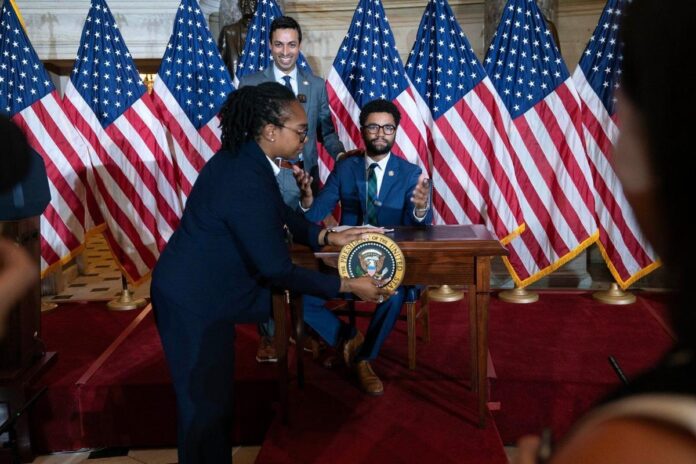
Trump was scheduled to sign the bill during a Capitol Hill ceremony, but he canceled the event and said Congress must first act on the voter-ID legislation he has described as a national emergency.
- The housing bill is aimed at easing affordability pressure and increasing supply.
- The SAVE America Act would tighten federal voting rules with voter-ID and citizenship-proof requirements.
- The SAVE bill has passed the House but remains stalled in the Senate.
Senate Majority Leader John Thune has acknowledged Republicans do not currently have the votes to move the SAVE Act through the Senate under normal rules.
That leaves Trump trying to use other legislation as leverage.
Speaker Mike Johnson has said the housing bill is still expected to move forward, but the delay has already created a political fight over whether Trump is prioritizing election security over housing relief.
Why It Matters
The dispute matters because housing affordability is one of the most important economic issues facing voters.
The housing bill was one of the few major pieces of legislation with strong bipartisan support.
For Republicans, it offered a chance to show action on cost-of-living concerns.
For Democrats, Trump’s delay offers a new argument that the White House is placing a partisan voting fight ahead of household affordability.
- Housing costs remain a top concern for renters and first-time buyers.
- Republicans wanted the bill as a bipartisan governing win.
- Trump wants to force urgency around voter ID and citizenship verification.
The practical problem for Trump is that the housing bill passed by margins large enough to override a veto.
If he vetoes it, Congress may have the votes to enact it anyway.
If he neither signs nor vetoes it while Congress remains in session, the bill can become law without his signature after the constitutional waiting period.
That makes the delay a pressure tactic more than a guaranteed blockade.
Political and Public Context
Trump’s position reflects a broader strategy: no major legislative win without movement on election security.
The SAVE America Act has become a central priority for Trump-aligned Republicans, who argue that proof-of-citizenship and voter-ID requirements are necessary to restore confidence in federal elections.
The White House has promoted the legislation as a basic election-integrity measure.
- Trump wants the Senate to treat SAVE as urgent.
- House conservatives are pressuring leadership to attach the bill to must-pass legislation.
- Senate Republicans face a filibuster problem unless they find another vehicle.
Reuters reported Trump-aligned House conservatives later blocked movement on the defense policy bill, demanding that voter-ID legislation be attached to it.
That move forced House leaders to start the July Fourth recess early and showed that the SAVE fight is now disrupting more than just the housing bill.
The housing legislation itself remains broadly supported.
The Bipartisan Policy Center said the final bill includes provisions restricting large institutional investors from buying single-family homes and other measures aimed at expanding housing options.
What Happens Next
The next test is whether Trump signs the bill, vetoes it or allows it to become law without his signature.
Because the bill passed with such large bipartisan margins, the policy outcome may be less uncertain than the politics around it.
The bigger question is whether Trump’s pressure campaign produces any real movement on the SAVE Act.
- Watch whether Trump signs the housing bill before the deadline.
- Monitor whether House Republicans attach SAVE language to another bill.
- Follow whether Senate Republicans consider procedural workarounds.
- Track whether Democrats turn the delay into a midterm affordability attack.
For Trump, the best outcome is getting both: movement on election security and eventual passage of the housing bill.
For Republicans, the risk is that the fight makes the party look divided on affordability.
For Democrats, the message is clear: Trump delayed housing relief to demand a separate voting overhaul.
For voters, the dispute joins two of the biggest midterm issues — election integrity and the cost of housing.
The standoff may end with the housing bill becoming law, but the political damage or benefit will depend on whether Trump can show real progress on SAVE.
Sources
- ABC News: Trump Refuses to Sign Bipartisan Housing Bill Into Law
- Reuters: Trump Cancels Signing of Bipartisan U.S. Housing Bill
- Reuters: Trump Allies Block House Defense Bill in Push for Voter ID Law
- Bipartisan Policy Center: What’s in the 21st Century ROAD to Housing Act
- White House: The SAVE America Act