

Story Highlights
- President Donald Trump returned to the campaign trail at a Mack Trucks plant in Macungie, Pennsylvania.
- The visit put Trump inside Pennsylvania’s competitive 7th District, held by freshman Republican Rep. Ryan Mackenzie.
- Trump used the stop to refocus voters on manufacturing, jobs and reindustrialization as inflation concerns weigh on Republicans.
What Happened
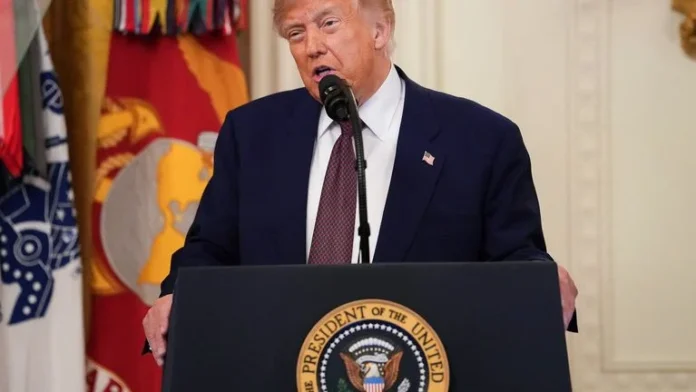
President Donald Trump returned to the campaign trail in Pennsylvania, using a visit to a Mack Trucks facility to sharpen his midterm message around manufacturing and economic revival.
The stop took place in Macungie, in the Lehigh Valley, a politically important region with deep industrial roots and a competitive House race.
Trump used the factory backdrop to argue that his administration is bringing investment, production and blue-collar jobs back to the United States.
- The event marked Trump’s first major campaign-style stop after weeks dominated by Iran diplomacy.
- The visit was held in Pennsylvania’s 7th Congressional District.
- Republican Rep. Ryan Mackenzie is defending the seat in one of the country’s key House battlegrounds.
Reuters reported that Trump’s visit was designed to test his Rust Belt pitch at a moment when inflation, gas prices and the Iran conflict are complicating the GOP’s economic message.
The White House framed the trip as proof that key domestic industries are being revitalized under Trump’s leadership.
Democrats quickly countered that voters are still feeling higher prices and that foreign-policy turmoil has undercut Trump’s affordability argument.
Why It Matters
Pennsylvania’s 7th District matters because it is exactly the type of seat that could decide House control.
It includes working-class communities, suburban voters and manufacturing-heavy areas that have shifted between parties in recent cycles.
Trump’s decision to campaign there shows the White House knows the midterm battle will be fought around affordability, jobs and industrial identity.
- Republicans want to make the midterms about jobs and manufacturing.
- Democrats want to make them about prices, gas and economic anxiety.
- Trump is trying to reconnect his economic message with blue-collar voters.
The Mack Trucks setting was deliberate.
Trump has long argued that tariffs, domestic production and industrial policy can rebuild the American manufacturing base.
That message remains powerful in parts of Pennsylvania, Ohio, Michigan and Wisconsin.
The challenge is that voters may judge the economy less by factory announcements and more by what they pay for groceries, gas and household bills.
If prices remain high, the manufacturing pitch may not be enough on its own.
Political and Public Context
The Pennsylvania visit came after Trump spent weeks focused on the Iran conflict, the ceasefire framework and talks over the Strait of Hormuz.
Those foreign-policy developments helped the White House claim progress abroad, but they also brought economic risk at home.
Higher energy prices and inflation worries have weakened Trump’s approval on the economy in recent polling.
- Trump is trying to show voters he has returned to kitchen-table issues.
- Republicans need strong turnout in industrial districts to hold the House.
- Democrats are tying GOP candidates to inflation and the cost of the Iran war.
AP reported that Trump’s speech at Mack Trucks was billed as economic-focused, though he also leaned into familiar campaign themes and political grievances.
That reflects a central tension in Trump’s midterm strategy.
His base responds strongly to his broader rally style, but swing voters in districts like PA-7 may be looking for a more direct affordability message.
Pennsylvania will also remain politically important beyond 2026.
The state is expected to be a top battleground in the 2028 presidential race, giving both parties a reason to treat the Lehigh Valley as a long-term testing ground for economic messaging.
What Happens Next
Trump is likely to make similar stops in other industrial battlegrounds as Republicans try to defend their House majority.
Expect the White House to emphasize factory investment, lower energy costs, drug-price reductions, tariff enforcement and the One Big Beautiful Bill’s tax provisions.
Democrats will respond by keeping attention on inflation, gas prices and voter frustration over household costs.
- Watch whether Trump returns to Pennsylvania again before Election Day.
- Monitor polling in PA-7 and other industrial swing districts.
- Track whether gas prices fall after the Iran ceasefire and Hormuz reopening.
- Follow whether Democrats can keep the midterms centered on affordability.
For Republicans, the best outcome is that Trump’s manufacturing pitch energizes working-class voters while economic conditions improve before November.
For Democrats, the goal is to argue that job announcements do not matter if families still feel squeezed by prices.
For Trump, Pennsylvania is both a campaign stop and a message test.
If voters in the Lehigh Valley respond to the reindustrialization argument, Republicans may have a path to blunt Democratic momentum.
If inflation remains the dominant issue, even a strong factory backdrop may not be enough to protect vulnerable GOP incumbents.
Sources
- Reuters: Trump Tests Rust Belt Pitch in Pennsylvania
- Associated Press: Trump Heads to Battleground Pennsylvania Ahead of Midterms
- ABC: Trump Shifts Focus to Economy in Key Swing State
- Fox Business: Trump Touts Economic Agenda at Mack Trucks Plant
- Lehigh Valley News: Trump Visits Mack Trucks in Lower Macungie
