

Story Highlights
- President Donald Trump’s Capitol Hill lunch with Senate Republicans turned tense over Iran war-powers votes.
- Trump clashed with Sen. Bill Cassidy after Cassidy supported a symbolic resolution challenging the president’s Iran authority.
- Hours later, Senate Republicans blocked a stronger Iran war-powers measure, giving Trump a late-night political win.
What Happened
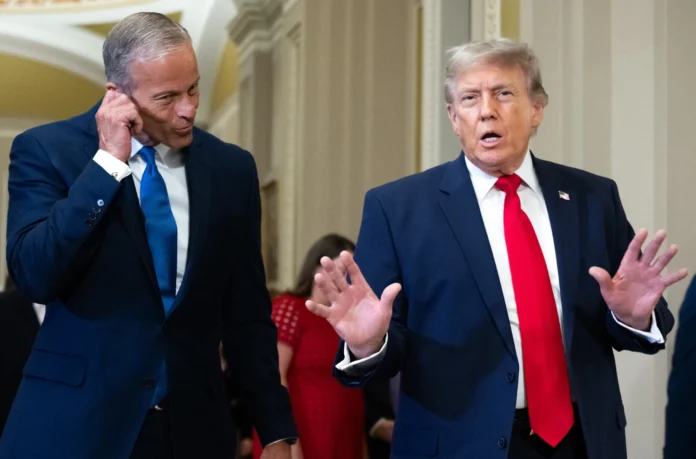
President Donald Trump met with Senate Republicans for a closed-door Capitol Hill lunch that exposed sharp tensions inside the party over Iran war powers.
The meeting came one day after the Senate passed a symbolic war-powers resolution by a 50-48 vote, with four Republicans joining Democrats.
Those Republicans were Bill Cassidy, Rand Paul, Lisa Murkowski and Susan Collins.
- The resolution called for limiting Trump’s ability to continue military action against Iran without congressional approval.
- Because it was a concurrent resolution, it carried political weight but did not have the force of law.
- Trump said the vote weakened his negotiating position with Iran.
Inside the lunch, Trump confronted Cassidy over his vote.
CBS News reported Trump sternly told Cassidy to sit down during the exchange, while Cassidy later acknowledged that both men raised their voices.
Cassidy said he made no apology for standing up to the president.
But the confrontation did not end with a sustained Republican revolt.
Late Wednesday, the Senate rejected a stronger war-powers measure from Democratic Sen. Tim Kaine that would have required Trump to remove U.S. forces from hostilities involving Iran unless Congress authorized the action.
The measure failed 50-47, with Rand Paul voting present and Cassidy voting against advancing the resolution.
Why It Matters
The episode matters because it shows both the depth and the limits of Republican unease over Trump’s Iran policy.
On Tuesday, four GOP senators were willing to publicly rebuke the president.
By Wednesday night, after Trump’s direct pressure and further White House engagement, that rebellion had weakened.
- Trump turned the vote into a loyalty test.
- Republicans who questioned war powers faced immediate pressure from the White House.
- The final vote showed Trump still has strong control over the Senate GOP conference.
For Trump, the late-night reversal protected his negotiating position.
He can argue that Republicans ultimately stood with him during a sensitive moment in Iran talks.
For critics, the sequence shows Congress struggling to assert its constitutional role over war.
The Constitution gives Congress the power to declare war, but modern presidents have repeatedly used military force without formal declarations.
This fight over Iran is the latest test of whether lawmakers are willing to reclaim that authority.
Political and Public Context
The Iran fight is unfolding as Trump tries to turn a fragile memorandum of understanding with Tehran into a lasting settlement.
The administration argues that congressional war-powers votes send the wrong message to Iran during negotiations.
Republican leaders echoed that argument, saying the timing of the resolutions could undermine the president just as talks were moving forward.
- Trump said Iran was under pressure and making concessions.
- Supporters argued Congress should not weaken the president’s hand.
- Opponents argued no president should continue military operations without congressional authorization.
ABC News reported Cassidy clashed with Trump over the earlier measure before later helping deliver the president a win on the follow-up vote.
The Guardian reported Cassidy reversed his position after additional briefings from Vice President JD Vance and envoy Steve Witkoff, while Rand Paul voted present to avoid undercutting peace negotiations.
That sequence gave both sides a talking point.
Trump allies can say the president restored unity when it mattered.
Democrats can say Republicans briefly admitted concern about the war, then backed down under pressure.
What Happens Next
The Senate fight is unlikely to be the final word on Iran war powers.
If negotiations with Tehran stall, if military operations resume, or if the administration requests more Iran-related funding, Democrats are likely to force new votes.
Republican defectors may again become pivotal.
- Watch whether Cassidy, Paul, Murkowski or Collins support future Iran limits.
- Monitor whether Trump keeps personally lobbying senators on war powers.
- Follow whether the 60-day Iran framework produces a final deal.
- Track whether Congress demands more briefings before approving Iran-related funding.
For Trump, the immediate outcome is positive.
He contained a public split inside his party and prevented a stronger war-powers rebuke from advancing.
For Senate Republicans, the lunch showed the cost of breaking from Trump on national security.
For Democrats, the fight gives them a midterm argument that Trump’s Iran campaign lacks clear congressional authorization.
For the White House, the lesson is clear: direct pressure still works, but the Iran issue remains politically fragile.
The president won the vote, but the rift over war powers has not disappeared.
Sources
- CBS News: Trump Has Testy Meeting With GOP Senators, Telling Cassidy to Sit Down
- ABC News: Senate Blocks War Powers Resolution, Delivering Trump a Win
- CBS News: Senate Rejects Measure to Restrict Trump’s Iran War Powers
- The Guardian: Senate Republicans Reject Iran War Powers Measure After Trump Pressure
- Fox News: Closed-Door Outburst Turns Into Victory for Trump’s Iran Negotiations
