

Story Highlights
- Trump said China agreed to purchase U.S. oil and order 200 Boeing aircraft, though China has not officially confirmed the plane purchase
- Xi warned that mishandling Taiwan could lead to “clashes and even conflicts,” while Trump said he has not yet decided on a $14 billion arms sale to the island
- Both sides agreed to a “strategic stability” framework for the next three years, with Xi’s return visit to the U.S. tentatively set for September
What Happened
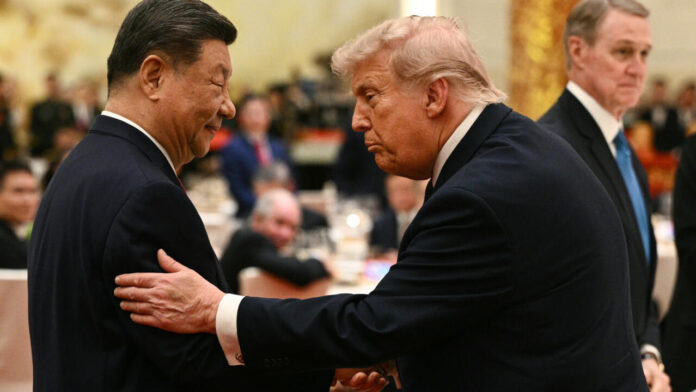
President Donald Trump wrapped up a two-day summit in Beijing on Friday with Chinese President Xi Jinping, departing the Chinese capital and heading to Alaska before returning to Washington. The trip marked Trump’s first state visit to China since 2017 and was heavy on ceremony, including flag-waving crowds, a state dinner, and meetings at Zhongnanhai Garden, the historic imperial-era compound that serves as the heart of Chinese Communist Party governance.
Trump told reporters aboard Air Force One that the two leaders had “settled a lot of different problems that other people wouldn’t have been able to settle,” though he did not elaborate on specifics. In a Fox News interview conducted during the trip, Trump said China had agreed to purchase American oil and order 200 commercial aircraft from Boeing — a transaction that, if confirmed, would represent the first Chinese purchase of U.S.-made commercial jets in nearly a decade. Chinese officials, however, had not officially confirmed the aircraft deal by the time Trump departed.
On Taiwan, the fault line that most sharply divides Washington and Beijing, Xi issued a direct warning during the first day of talks, telling Trump that mishandling China’s claims on the democratic island could cause “clashes and even conflicts.” Trump told reporters he does not believe conflict over Taiwan is imminent, but acknowledged he had spoken “a lot” about the issue with Xi. He added that he has not yet made a determination on whether to move forward with a proposed $14 billion arms sale to Taiwan, saying he would need to consult with Taiwan’s president, Lai Ching-te, before deciding.
On Iran, both sides agreed in principle that the Strait of Hormuz should remain open and that Tehran should not acquire nuclear weapons. Analysts, however, noted those pledges were largely symbolic. Craig Singleton, a senior fellow at the Foundation for Defense of Democracies, said Beijing’s commitments cost China very little and the harder test would be whether Beijing actually pressures Iran or curtails its purchases of Iranian oil.
Trump also raised the detention of pro-democracy activist Jimmy Lai, who was sentenced in February to 20 years in a Hong Kong national security case. Xi reportedly told Trump that Lai’s case was a difficult one. Xi, for his part, framed the broader summit as a foundation for stability, with Chinese state media reporting that both sides had agreed to adopt “strategic stability” as a framework governing the relationship over the next three years.
Why It Matters
The Beijing summit holds enormous significance for Americans regardless of its lack of concrete deliverables. The U.S.-China relationship shapes everything from consumer prices to military posture in the Pacific, and any shift in tone between the two capitals resets the operating environment for businesses, policymakers, and allies who must calculate their own positions accordingly. The fact that both leaders invested significant political capital in face-to-face meetings signals an intent to manage, rather than escalate, the competition.
For American exporters, a confirmed Chinese order of 200 Boeing jets and purchases of U.S. oil would represent a meaningful step toward rebalancing trade flows that have remained deeply contentious. Boeing, which has faced both manufacturing crises and intense competition from China’s state-backed COMAC aircraft program, would welcome any large Chinese order as validation of its commercial recovery. The oil sales, similarly, would inject new demand into U.S. energy markets at a time when global supply chains remain fragile.
The Taiwan question remains the most consequential unresolved issue to emerge from the summit. Trump’s refusal to commit to or abandon the $14 billion arms package keeps strategic ambiguity intact but also signals that the administration is treating Taiwan as a bargaining chip rather than a settled commitment. That posture will be watched closely in Taipei, Tokyo, Seoul, and every NATO capital that depends on American credibility.
The September timeline for Xi’s potential return visit to the United States adds a second act to the diplomatic calendar. If that summit proceeds, it will likely coincide with the United Nations General Assembly in New York, putting the U.S.-China relationship at the center of the global diplomatic stage at a moment when the international order remains under stress from the Iran war and the ongoing conflict in Ukraine.
Economic and Global Context
The Beijing summit took place against a backdrop of acute economic tension. The Iran war, which began in late February, has caused the largest energy supply disruption in modern history, closing the Strait of Hormuz and driving gasoline prices up sharply. The most recent U.S. inflation reading showed a 3.8 percent annual increase, the highest in nearly three years. Against that backdrop, China’s rhetorical commitment to keeping the strait open carries real weight — but analysts note it falls short of concrete action.
China’s Boeing purchase, if finalized, would carry significant economic implications. The original market expectation had been for roughly 500 aircraft; the 200-plane figure fell short, and Boeing shares were sensitive to the gap. Still, any large-scale resumption of Chinese commercial aviation orders would be a positive signal for the aerospace supply chain, which employs hundreds of thousands of Americans across multiple states.
On trade more broadly, the summit produced no new tariff agreements or formal trade framework. The two economies remain bound together by deep supply chain integration while simultaneously pursuing policies of strategic decoupling in semiconductors, artificial intelligence, and defense-related manufacturing. Neither side showed an appetite to accelerate that decoupling during the Beijing talks.
Markets were watching closely for signals about interest rates and inflation. With new Federal Reserve Chair Kevin Warsh taking office the same day Trump departed Beijing, financial markets found themselves processing two major transitions simultaneously — one in global diplomacy and one in U.S. monetary policy.
Implications
For American businesses operating in or trading with China, the summit’s most valuable product may simply be reduced uncertainty. A summit that ends with both leaders expressing goodwill and scheduling a follow-up lowers the immediate risk of tariff escalation, sanctions, or supply chain disruptions — at least in the near term. Companies will now watch to see whether the Boeing and oil commitments translate into actual purchase orders.
For U.S. allies in the Indo-Pacific, the summit’s ambiguity on Taiwan is the most consequential outcome. Japan, South Korea, Australia, and the Philippines all have defense arrangements with the United States that hinge on American credibility in the region. Any perception that the White House is trading Taiwanese security interests for commercial deals will prompt those governments to recalibrate their own hedging strategies with Beijing.
For Republican policymakers, the summit gives Trump a narrative of personal diplomatic achievement heading into a period of domestic economic difficulty. The administration will likely amplify the Boeing and oil deal announcements as proof that Trump’s dealmaking approach to foreign policy delivers tangible results where traditional diplomacy failed.
For the broader international community, the framework of “strategic stability” agreed upon by Washington and Beijing offers modest but real reassurance that the world’s two largest powers are not on a collision course — even if the deep structural competition between them remains fully intact.
