

Story Highlights
- Senate voted 51-45 to confirm Warsh as a Fed governor, granting him a 14-year term on the board
- Senator John Fetterman of Pennsylvania was the only Democrat to vote in favor of the nomination
- A separate confirmation vote to make Warsh Fed chair was expected as soon as Wednesday
What Happened
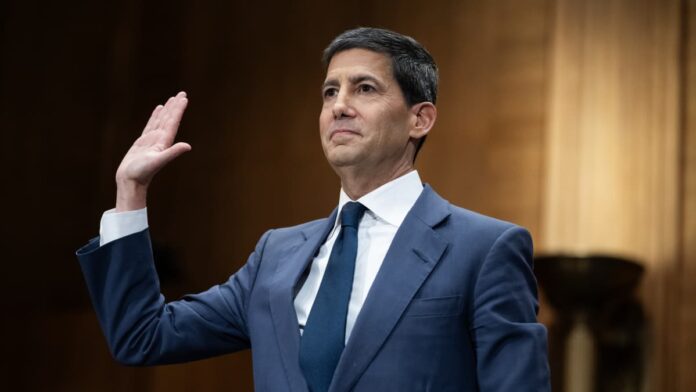
The U.S. Senate voted Tuesday afternoon to approve Kevin Warsh as a member of the Federal Reserve Board of Governors, granting him a 14-year term beginning February 1, 2026. The 51-45 tally was nearly entirely along party lines, with Senator John Fetterman, a Democrat from Pennsylvania, casting the sole crossover vote in favor of the nomination. Immediately following the governor confirmation, the Senate began procedural steps to advance Warsh’s separate nomination as Fed chairman, with that vote expected Wednesday.
Warsh, 56, is a former Morgan Stanley banker and government official who previously served on the Fed’s Board of Governors from 2006 to 2011 under President George W. Bush. During that tenure, he became former Fed Chairman Ben Bernanke‘s key liaison to Wall Street during the 2008 financial crisis — experience his supporters argue makes him uniquely suited to lead the central bank through the current period of economic turbulence. He holds a public policy degree from Stanford and a law degree from Harvard.
The confirmation was not without significant friction. For months, Republican Senator Thom Tillis of North Carolina, a member of the Senate Banking Committee, blocked Warsh’s nomination from advancing, citing a Justice Department investigation into outgoing Fed Chair Jerome Powell related to a costly renovation of the Federal Reserve’s headquarters. Tillis ultimately lifted his hold after the U.S. Attorney for the District of Columbia, Jeanine Pirro, closed the criminal probe and referred the matter to the Fed’s Inspector General. Powell has indicated he will remain on the board as a governor after his chairmanship ends Friday, pending the outcome of that review.
During his Senate Banking Committee confirmation hearings, Warsh repeatedly stressed the importance of the Fed’s independence. Senator Elizabeth Warren publicly accused him of serving as a “sock puppet” for Trump — a characterization Warsh flatly denied. He told senators that Trump had never asked him to predetermine any interest rate decision and that he would never agree to do so. The assurance did little to satisfy Democrats, who noted that Trump had publicly pressured Powell for years to cut rates and had pledged to appoint only Fed leaders who agreed with him on monetary policy.
Warsh has publicly called for what he describes as “regime change” at the Fed, including tighter coordination between the central bank and the Treasury Department on non-monetary policy areas, a reduction of the Fed’s balance sheet, and a path toward lower borrowing costs. He will take the board seat previously held by Stephen Miran, whose brief term ended after being appointed to serve out the remaining term of former Governor Adriana Kugler, who departed the Fed last August amid an ethics probe.
Why It Matters
The confirmation of Warsh marks a pivotal moment in the Trump administration’s long-running effort to reshape the Federal Reserve in its own image. The central bank is the single most powerful institution in the American economy, setting the benchmark interest rate that governs borrowing costs for mortgages, car loans, business credit, and the national debt. Who leads it — and with what priorities — affects every American household.
Trump’s campaign to install a loyalist at the Fed has raised serious alarms among economists and market participants who view central bank independence as a cornerstone of financial stability. When a president can effectively install a Fed chair willing to cut rates for political reasons, the risk of inflationary monetary policy rises, and investor confidence in the dollar and U.S. Treasury markets can erode. That concern is not hypothetical — financial markets have already shown volatility in response to the Trump administration’s various moves against the Fed, including the attempted firing of Governor Lisa Cook, a case currently before the Supreme Court.
For everyday Americans, the stakes are immediate. The Fed’s current target range for short-term borrowing costs stands at 3.5 to 3.75 percent. Warsh has signaled a preference for lower rates, but the economic environment complicates that ambition severely. Inflation has risen to nearly a three-year high, driven in significant part by energy price spikes tied to the Iran war. Markets are currently pricing in a roughly one-in-three probability of a rate hike by December — not a cut.
The outcome of this confirmation also carries implications for financial regulation. Warsh’s disclosed investment history in blockchain and digital asset companies, including exposure to Bitcoin infrastructure, Layer 1 and Layer 2 blockchain networks, and decentralized finance platforms, positions him as a Fed chair with unusual familiarity with the crypto sector. He has pledged to divest most of those holdings. His approach to stablecoin regulation, bank crypto custody rules, and digital payment policy will be closely watched by both the financial industry and crypto markets.
Economic and Global Context
Warsh steps into the chairmanship at a moment of exceptional complexity for monetary policymakers. The Iran war has pushed energy prices sharply higher, and the pass-through effect to consumer prices has been swift. Headline inflation figures are now at their highest level since early 2023, and the dual pressures of a tariff-driven supply shock and a war-driven energy shock are forcing the Fed to navigate competing risks simultaneously.
Financial markets have responded uneasily to the transition. While some investors welcome the prospect of a more growth-oriented Fed under Warsh, others are concerned that political interference in monetary policy could undermine the credibility that the Fed has spent decades building. That credibility — the market’s confidence that the Fed will prioritize price stability over short-term political pressures — is itself a form of economic infrastructure, and its erosion can have lasting consequences for borrowing costs and investment.
Internationally, the confirmation adds to a broader pattern of institutional change in Washington that allies and trading partners are monitoring closely. Central bank independence is a norm shared by virtually all major Western economies, and the perception that the U.S. is weakening that norm could prompt subtle but meaningful adjustments in how foreign governments and investors manage their exposure to dollar-denominated assets.
Implications
For the Trump administration, a confirmed Warsh chairmanship provides an important policy lever heading into the 2026 midterm elections. If Warsh can engineer a rate cut without triggering a fresh inflation surge, it would provide economic relief to millions of American borrowers and give Republicans a tangible deliverable for voters. The political calendar makes that an attractive possibility — though the economic fundamentals make it a risky one.
For financial markets, the most pressing near-term question is whether Warsh will act quickly to signal the Fed’s direction or take a more cautious, data-dependent approach in his early months. A sudden shift in tone from the Fed would increase volatility in bond and equity markets. A steadier hand would reassure investors that the transition, however politically charged, will not fundamentally alter the institution’s policy framework.
For Powell, his decision to remain on the board as a governor is itself historically unusual and politically significant. His continued presence ensures that the perspective of the previous leadership is represented in FOMC deliberations, and his earlier public statement that he is staying in part to protect monetary policy from political interference signals that the battle over Fed independence is far from over.
Sources
“Senate confirms Kevin Warsh as Fed governor, clears way for chair vote”
