

Story Highlights
- Warsh confirmed 54-45, the most divisive Fed chair vote in American history
- Only Pennsylvania Democrat Sen. John Fetterman voted in favor of Trump’s nominee
- Warsh’s first Federal Open Market Committee meeting as chair is scheduled for June 16-17
What Happened
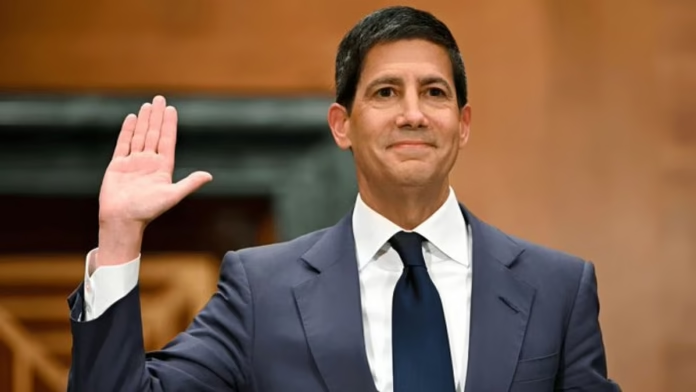
Kevin Warsh was confirmed Wednesday as the next Federal Reserve chair, taking over the central bank at a time when President Donald Trump is pushing for lower interest rates even as fresh inflation data complicates the case for cuts. In the most divisive vote ever for a Fed chair, Warsh, 56, won confirmation to take over for Jerome Powell, who has served in the top leadership position since 2018 and whose term expired Friday.
Warsh was confirmed in a 54-45 vote, mostly split along party lines, with only Democratic Sen. John Fetterman of Pennsylvania crossing the aisle to vote in favor of Warsh’s nomination. The vote underscored how thoroughly the Federal Reserve’s independence has become a flashpoint in Washington’s broader political divisions.
Warsh will replace Powell, who has led the Fed since 2018. Although Trump appointed Powell to the job, he has relentlessly criticized the outgoing Fed chairman for not moving more aggressively to lower borrowing costs. The confirmation process was delayed when Sen. Thom Tillis of North Carolina initially blocked a committee vote to protest a Department of Justice investigation into Powell, dropping his opposition only after the probe was resolved.
Warsh previously served on the Fed’s governing board from 2006 to 2011, a time during which Fed officials initially dismissed dangers from the subprime mortgage meltdown that led to the global financial crisis, then implemented a historic set of policies aimed at rescuing the economy. Since departing, he has been a lecturer at Stanford and a consistent critic of the Fed’s post-crisis monetary approach.
Why It Matters
Warsh’s confirmation marks the end of an eight-year chapter for the Fed under Jerome Powell and the beginning of an era defined by its relationship with a White House that has made monetary policy a political priority. The institutional significance is substantial: the Fed has long prided itself on independence from elected officials, and the near party-line vote reflects how thoroughly that independence has been contested during Trump’s second term.
Warsh will formally succeed Fed Chair Jerome Powell, whose eight-year tenure was marked by several economic crises and a heated clash with the White House to defend the U.S. central bank’s political independence. Powell leaves having navigated the pandemic, a historic inflation surge, and aggressive rate-hiking cycle — all while resisting sustained political pressure from the president who appointed him.
Warsh has argued there is room to lower rates, but he also promised to use his own judgment in setting monetary policy — and not to take orders from the White House. Warsh denied charges from Sen. Elizabeth Warren of Massachusetts that he would be Trump’s “sock puppet.” The distinction matters because markets and economists will be watching closely for any signs that the Fed’s rate-setting process is being influenced by political considerations rather than economic data.
A report from the Labor Department said the cost of living had increased 3.8 percent in the last twelve months, the biggest annual increase in nearly three years. Warsh has called for other changes at the Fed. He has suggested improvements in the way the government measures inflation and proposed changes in the way Fed policymakers communicate with the public. Those structural reforms could be as consequential in the long run as any single rate decision.
Economic and Global Context
The energy shock is complicating hopes for a swift rate cut, with investors now expecting the Fed to keep its benchmark lending rate unchanged for the rest of the year — or even raise rates if inflation worsens. That prospect is likely to frustrate Trump, who may direct his ire at Warsh in the same way he has done with Powell.
The inflation backdrop is particularly challenging. Gas prices have surged as the Iran war has kept the Strait of Hormuz at least partially closed, adding supply-chain and energy cost pressures that the Fed cannot directly address through interest rate policy. Warsh inherits these conditions immediately, with his first meeting of the rate-setting Federal Open Market Committee scheduled for mid-June.
The Fed chair is just one vote on the Federal Open Market Committee that considers rate moves. While Warsh would control the agenda at every Fed meeting, he would not have unilateral authority over what the majority of the committee decides. So far, there is a faction of policymakers with voting power who have telegraphed serious concerns with inflation. This internal dynamic means Trump’s expectations of rapid rate cuts may face structural resistance from within the institution regardless of who chairs it.
At the last rate-setting meeting in April, three members of the committee hinted their next move could as easily be a rate increase as a cut. The markets are pricing in a prolonged pause, which suggests that the transition from Powell to Warsh may not immediately produce the monetary loosening the White House has been seeking.
Implications
The Warsh era at the Fed will be defined immediately by how he navigates the tension between the president’s demand for lower interest rates and the economic data that continues to point toward persistent inflation. If Warsh moves aggressively to cut rates without clear support from the data, he risks accelerating price pressures that are already straining American households.
Powell will stay on at the Fed, as he has two years left in his term as governor. He said last month that he will remain at least until an investigation into renovations at the Fed’s headquarters is complete. This unusual arrangement — a former chair remaining as a board member — will keep a measure of institutional continuity intact even as Warsh reshapes leadership.
For Republican lawmakers, Warsh’s confirmation is a win that signals a more cooperative relationship between the executive branch and the country’s most powerful financial institution. For Democrats, the near party-line vote represents a warning about the long-term erosion of norms around Fed independence.
Ordinary Americans will ultimately feel the consequences of Warsh’s decisions through mortgage rates, credit card interest, auto loans, and overall economic growth. Whether those rates go up, down, or stay flat in the months ahead will depend as much on geopolitical events in the Strait of Hormuz as on anything the new Fed chair decides at his first committee meeting.
Sources
“Kevin Warsh wins Senate confirmation as the next Federal Reserve chair”
