

Story Highlights
- Trump’s visit to Beijing is the first by a U.S. president since his own November 2017 trip during his first term
- Summit agenda includes trade, Taiwan, artificial intelligence, and the U.S.-Israel war on Iran
- Trump said he will have a “long talk” with Xi on Iran, but downplayed the need for Chinese assistance
What Happened
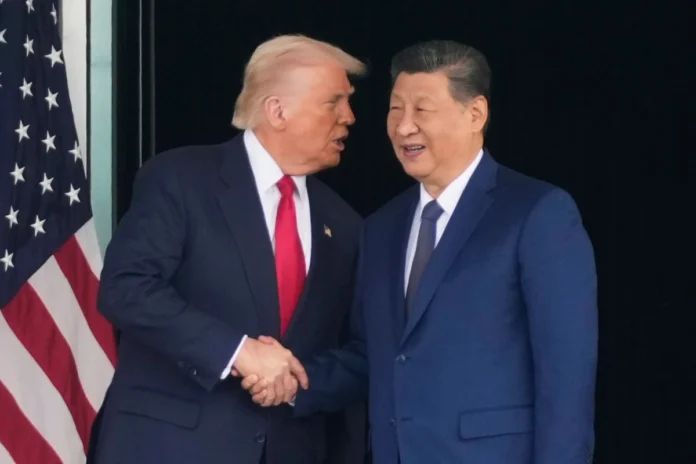
Donald Trump departed Washington on Tuesday evening aboard Air Force One, accompanied by First Lady Melania Trump and, in a personal capacity, his son Eric Trump and daughter-in-law Lara Trump. The White House confirmed Trump’s arrival in Beijing Wednesday evening, with formal bilateral meetings scheduled across Thursday and Friday. The itinerary also includes a tour of the Temple of Heaven and a state banquet — the kind of ceremonial flourish the president has long favored.
The visit was originally planned for early April but was postponed due to the outbreak of the 2026 U.S.-Iran war. The White House officially announced the rescheduled May trip on March 25, signaling that diplomatic engagement with Beijing remained a priority despite the ongoing conflict. Trump’s second-term administration had previously secured a commitment from Chinese President Xi Jinping that Beijing would not transfer surface-to-air missiles to Iran, a breakthrough Defense Secretary Pete Hegseth attributed to the “strong and direct relationship” between the two leaders.
At the heart of this summit is an attempt to stabilize a bilateral relationship that has grown significantly more complex since Trump’s first China visit in 2017. China has in the intervening years transformed its manufacturing sector, upgraded its export infrastructure, and emerged as a genuine technology competitor. Xi, meanwhile, has extended his grip on power past China’s official term limits, leaving Trump to negotiate with a leader who faces no electoral pressures of his own.
Speaking to reporters before departure, Trump characterized the upcoming meetings as productive and said trade would be the primary focus, though he acknowledged that Iran would feature in discussions. He told reporters he planned to have a “long talk” with Xi on the matter but expressed confidence that the United States did not require Beijing’s direct intervention to manage the conflict. That framing, analysts noted, may underestimate the leverage China holds as a critical energy customer for Iran and as a potential diplomatic interlocutor with Tehran.
Complicating the diplomatic backdrop, Iranian Foreign Minister Abbas Araghchi traveled to Beijing just days before Trump’s arrival — a pointed signal of China’s continued ties to Iran. U.S. intelligence had previously indicated that China was considering delivering new air defense systems to Iran, a claim Beijing denied. On the eve of the trip, the U.S. Treasury Department blacklisted 12 individuals and entities linked to Iranian oil sales to Chinese buyers, a move seen as a pressure signal ahead of the summit.
Why It Matters
The Beijing summit represents the most consequential bilateral diplomatic event of Trump’s second term. The United States and China together account for roughly 44 percent of global economic output, and their relationship shapes everything from supply chains and semiconductor availability to maritime security and energy prices. A stable, functioning framework between the two powers is not merely desirable — it is a precondition for global economic stability.
The Iran dimension adds urgent pressure. The ongoing conflict has triggered a blockade of the Strait of Hormuz, through which roughly 20 percent of the world’s oil supply normally flows. The U.S. Department of Energy now projects oil prices will remain above $100 per barrel in the coming weeks, with some analysts warning that national average gasoline prices could reach $5 per gallon. Any diplomatic progress Trump can extract from Xi on pressuring Iran to return to negotiations would offer immediate relief to American consumers.
For American businesses, the summit carries significant weight on the trade front. Tariffs Trump levied in 2025 continue to affect bilateral commerce, and both governments are under pressure to find a more workable equilibrium. American manufacturers, agricultural exporters, and technology companies are all watching for signals about the future trajectory of the trade relationship, including the status of technology export controls that have become a major point of contention.
Taiwan, meanwhile, remains a deeply sensitive fault line. Taipei has expressed concern that Trump may make concessions on arms sales to Taiwan as part of a broader bargain with Beijing — a scenario that would unsettle U.S. credibility across the Indo-Pacific. Trump acknowledged before his departure that he intended to discuss arms sales to Taiwan with Xi, a signal that the issue is very much in play.
Economic and Global Context
The summit takes place against a backdrop of heightened economic strain for American households. Inflation has risen to its highest level in nearly three years, driven by a combination of the Iran war’s effect on energy prices and residual pressure from Trump’s 2025 tariff program. The Federal Reserve, navigating a politically charged transition in leadership, has held interest rates steady, and financial markets are now pricing in a roughly one-in-three chance of a rate hike by December.
Globally, the Strait of Hormuz blockade has disrupted energy flows far beyond the United States. European and Asian economies that depend heavily on Gulf oil imports have faced their own inflationary pressures, and several international institutions have downgraded growth forecasts in recent weeks. China itself has an economic interest in restoring stability to the strait, as Beijing is one of the largest importers of Gulf energy. That shared interest in open shipping lanes is one area where U.S. and Chinese goals genuinely align, even amid broader competition.
The summit also intersects with technology decoupling that has defined U.S.-China relations for the better part of a decade. Export controls on advanced semiconductors, restrictions on Chinese telecom companies in U.S. networks, and disputes over artificial intelligence development have all created structural friction that neither side has been able to fully resolve. While a two-day summit is unlikely to untangle these disputes, any progress on reducing barriers in less sensitive sectors could represent meaningful economic relief for companies on both sides.
Implications
For the Trump administration, a visually successful summit — one that yields a joint statement, some trade concessions, and at least a rhetorical commitment from Xi on the Iran situation — would represent a significant political win heading into the 2026 midterm cycle. Voters have grown increasingly anxious about the economy, the cost of war, and rising energy prices. A credible diplomatic breakthrough, even a modest one, would give the administration a much-needed positive narrative.
For American allies in the Indo-Pacific, particularly Japan, South Korea, and Taiwan, the outcome of these talks will be scrutinized intensely. The redeployment of U.S. military assets toward the Middle East has already thinned the security buffer in Asia, and any signals that Trump is willing to trade Taiwan-related commitments for concessions elsewhere would send a destabilizing message across the region.
For policymakers in Washington, the summit underscores the fundamental tension of the current strategic moment: the United States is simultaneously engaged in a costly military conflict with Iran, managing a high-stakes trade and technology rivalry with China, and trying to hold together a global alliance structure built for a very different era. How Trump manages that balancing act in Beijing will have consequences well beyond these two days of meetings.
Sources
“Trump set to meet with Xi in Beijing as war and inflation weigh on his presidency”