

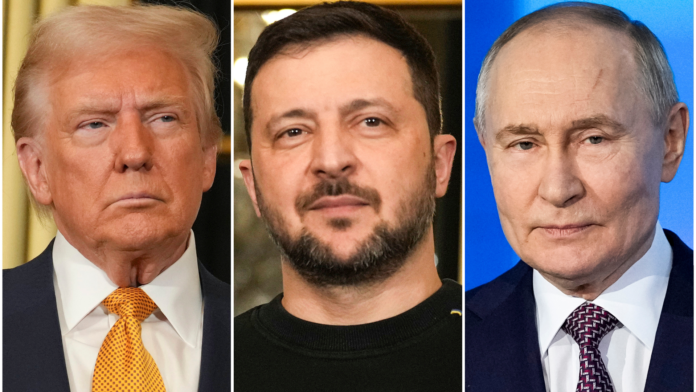
President Donald Trump announced a surprise three-day ceasefire between Russia and Ukraine on Friday, coinciding with Russia’s Victory Day holiday, and described the halt in fighting as potentially the “beginning of the end” of a war that has dragged on for years. Both Ukrainian President Volodymyr Zelenskyy and a top adviser to Russian President Vladimir Putin confirmed the agreement within hours of Trump’s announcement on Truth Social. The prisoner exchange attached to the deal — one thousand from each side — marks one of the most significant diplomatic developments in the conflict in months.
Story Highlights
- Trump announced the three-day ceasefire covering May 9, 10, and 11, timed to Russia’s World War II Victory Day commemorations
- The deal includes a 1,000-for-1,000 prisoner exchange confirmed by both Zelenskyy and Putin’s foreign affairs adviser Yuri Ushakov
- Zelenskyy responded with a sardonic presidential decree “allowing” Russia to hold its Victory Day parade in Moscow’s Red Square
What Happened
President Donald Trump posted the ceasefire announcement on Truth Social on Friday, May 8, writing that the three-day halt would cover Saturday through Monday and include “a suspension of all kinetic activity.” Trump said the request was made directly by him and thanked both Vladimir Putin and Volodymyr Zelenskyy for agreeing to it. He described the development as potentially “the beginning of the end” of the war.
Russian Presidential foreign affairs adviser Yuri Ushakov confirmed Moscow’s agreement, stating that the decision came after a recent phone call between Putin and Trump in which the two leaders discussed the possibility of a ceasefire during the Victory Day period. The Kremlin noted that both countries had been allies during World War II — a rhetorical framing Trump himself echoed in his announcement.
Zelenskyy confirmed the prisoner exchange on X, stating that Ukraine had received Russia’s formal agreement to conduct a swap in the 1,000-for-1,000 format. He instructed his team to begin preparations immediately. However, his presidential decree accompanying the announcement carried a notable edge: rather than broadly endorsing the ceasefire, he issued a formal order “allowing” Russia to hold its military parade in Moscow, providing the precise geographic coordinates of Red Square and specifying that only that sector would be excluded from Ukrainian weapons targeting.
The Kremlin’s spokesman Dmitry Peskov dismissed Zelenskyy’s decree as a “silly joke,” but the Ukrainian framing underscored continuing tensions over the scope and sincerity of the truce. Ukraine has long been skeptical of Russian ceasefire commitments, and Kyiv made clear that the broader fighting pause would apply to the holiday window rather than signaling any permanent change in posture.
Russia had separately announced a two-day unilateral ceasefire for May 8 and 9 to mark its annual Victory Day holiday. Trump’s announcement effectively extended and formalized that pause through Monday, adding the prisoner exchange component that gives the agreement more diplomatic weight than a simple holiday gesture.
Why It Matters
The announcement carries significance well beyond the three-day window. Trump framed it as a possible gateway to a broader peace process, and his direct personal involvement in securing agreement from both sides demonstrates that the United States continues to hold meaningful leverage over both Kyiv and Moscow. The White House has made ending the Ukraine conflict a stated foreign policy priority since Trump returned to office.
For American voters, the development offers a rare moment of visible diplomatic progress in a war that has cost the United States tens of billions of dollars in military and economic aid to Ukraine over several years. Whether the ceasefire holds through the weekend will be a critical early test of whether Trump’s personal diplomacy can translate into something durable.
The 1,000-for-1,000 prisoner exchange is the most tangible, immediate benefit of the deal. Thousands of military personnel and civilians have been held in captivity on both sides since Russia launched its full-scale invasion in 2022. For families on both sides, the announcement brings the prospect of news about their relatives.
The broader diplomatic significance is harder to gauge in real time. Both Russia and Ukraine have violated previous ceasefires, and Zelenskyy’s pointed decree suggests Kyiv is not prepared to let the moment be characterized as a sweeping goodwill gesture toward Moscow. Still, the fact that both governments confirmed the terms publicly gives Trump something to point to as a concrete achievement.
Economic and Global Context
The Russia-Ukraine war has had persistent effects on global energy and food markets since 2022. Ukraine is one of the world’s major wheat exporters, and the ongoing conflict has contributed to elevated grain prices in developing nations. Any step toward a lasting resolution would be welcomed by international agricultural commodity markets that have spent years pricing in war-related uncertainty.
Energy markets have also reacted to developments in the conflict. European nations, many of which have reduced or eliminated their dependence on Russian natural gas since 2022, have spent heavily on alternative energy infrastructure. A diplomatic thaw backed by Washington could ease some of the geopolitical risk premium still embedded in European energy prices.
Markets globally have generally responded positively to signals of reduced geopolitical tension. The announcement came on the same day that the United States was managing a fragile ceasefire with Iran in the Middle East, meaning traders and analysts were simultaneously assessing two separate de-escalation signals in one trading session — an unusual circumstance that analysts said added modest positive momentum to equity markets on Friday.
NATO allies are watching closely to understand what conditions Trump may be seeking from Ukraine as part of any broader peace framework. Questions about Ukraine’s long-term security guarantees, territorial concessions, and NATO membership remain unresolved and continue to divide European capitals.
Implications
If the three-day ceasefire holds without major incident, it strengthens Trump’s argument that his direct engagement with both Putin and Zelenskyy is producing results that previous administrations could not. The White House is likely to use a successful holiday pause as momentum to push for longer-term negotiations, with Trump having publicly described the ceasefire as a possible turning point.
For Ukraine, the stakes are high. Zelenskyy’s government faces pressure both to pursue peace and to avoid accepting terms that cede Ukrainian territory or legitimize Russian gains. The sardonic tone of his decree signals that Kyiv remains determined to retain its diplomatic positioning even while cooperating with Washington’s mediation.
For Russia, the ceasefire offers a window of relative calm during its most symbolically important national holiday. Putin benefits from being seen as willing to engage with Trump’s peace framework without making any formal concessions on territorial issues.
For the broader international community, the episode is being watched as a signal of how Trump’s diplomatic style — publicly pressuring both sides through social media and personal phone calls — can produce short-term results, and whether those results can be converted into something lasting.
Sources
“Trump says Russia and Ukraine have agreed to his request for a 3-day ceasefire”
