

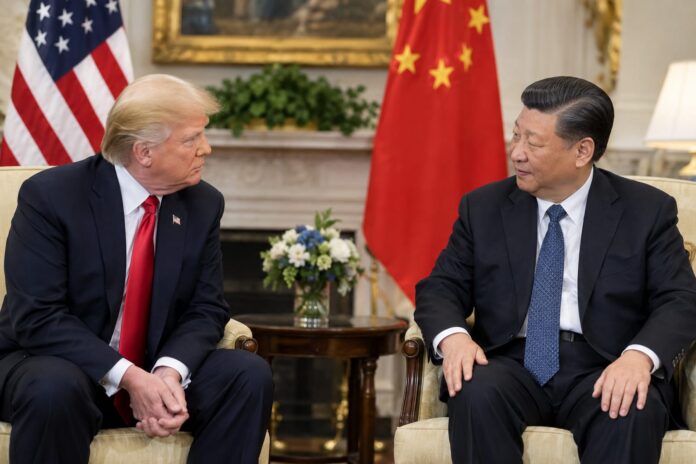
Story Highlights
- President Trump will hold a separate one-on-one meeting with Russian President Vladimir Putin during his China visit Thursday, marking their first bilateral discussion since an August summit in Alaska
- The agenda encompasses nuclear disarmament, Iran policy, economics, trade discussions, and the Russia-Ukraine conflict, signaling the administration’s comprehensive approach to critical global issues
- The president has expressed optimism about progress in negotiations, suggesting Putin may be willing to move toward concluding the conflict
- Intelligence assessments indicate mixed signals regarding Russia’s readiness for substantive peace talks, though the White House remains focused on diplomatic engagement
What Happened
The White House announced that President Trump will conduct a bilateral meeting with Russian President Vladimir Putin during his current Asia trip, separate from a planned trilateral discussion involving Chinese President Xi Jinping. This face-to-face engagement represents the first direct meeting between the two leaders since their summit last August in Alaska, which centered on advancing negotiations toward ending the Russia-Ukraine war. The timing and sequence of the separate Putin meeting relative to the three-way discussion with Xi remain unconfirmed.
The president has indicated the bilateral session will address several major policy areas simultaneously. Nuclear disarmament, Iranian affairs, economic matters, trade relations, and developments surrounding the Ukraine conflict will feature prominently in discussions. This multifaceted agenda reflects the administration’s recognition that global security challenges are interconnected and require comprehensive diplomatic engagement at the highest levels.
The president has communicated optimism about the trajectory of negotiations. He indicated that Putin may be showing signs of willingness to pursue a resolution to the conflict, observing that the Russian leader appears to be reconsidering his position and might be interested in bringing the war to a conclusion. These assessments have been conveyed to reporters during his Asia visit.
- Meeting scheduled for Thursday in China between President Trump and Putin, separate from Xi trilateral gathering
- First bilateral encounter since August Alaska summit focused on Ukraine war negotiations
- Discussion agenda includes nuclear disarmament, Iran policy, economics, trade, and Russia-Ukraine developments
- Presidential statements suggest movement toward conflict resolution is within reach
Why It Matters
Direct diplomatic engagement at this level carries substantial significance for global stability and American strategic interests. The willingness to conduct separate bilateral discussions demonstrates the administration’s commitment to multilateral problem-solving while maintaining focused channels with key actors. Such high-level personal diplomacy often proves essential for breaking through negotiating deadlocks and establishing frameworks for broader cooperation.
The Russia-Ukraine conflict continues to reshape international geopolitics and poses ongoing humanitarian challenges. Any progress toward negotiated settlements would have far-reaching implications for European security, NATO dynamics, and global economic stability. The inclusion of nuclear disarmament on the agenda underscores recognition that long-term strategic competition between major powers requires formal agreements and confidence-building measures.
Economic and trade dimensions of the meeting reflect the administration’s broader policy framework, which emphasizes American prosperity and competitive advantage alongside security considerations. Addressing these issues simultaneously with geopolitical concerns allows for potential linkages that could incentivize cooperation across multiple domains.
- Direct presidential engagement may catalyze progress on Ukraine conflict resolution and reduce ongoing humanitarian suffering
- Nuclear disarmament discussions could establish frameworks preventing future weapons proliferation and reducing existential risks
- Economic cooperation opportunities may create mutual incentives for broader de-escalation
- Diplomatic success would strengthen American influence in shaping the post-conflict geopolitical landscape
Political and Public Context
The administration’s approach to Russia policy reflects a calculated balance between deterrence and engagement. Rather than pursuing isolation strategies alone, the diplomatic track demonstrates confidence in the president’s negotiating capabilities and belief that direct communication with adversarial leaders can yield practical results. This positions the United States as an active shaper of international outcomes rather than a passive observer.
The China setting for these meetings adds another layer of diplomatic complexity. Conducting the Putin discussion during a visit centered on Xi suggests a coordinated approach to major power relations. The arrangement allows for signaling to all parties involved the administration’s intent to maintain multiple channels of dialogue while pursuing coherent strategic objectives.
Western intelligence assessments regarding Russian intentions remain mixed, reflecting genuine uncertainty about Putin’s current readiness for substantive negotiations. Such divergence between optimistic presidential statements and more cautious intelligence perspectives is not uncommon in diplomatic contexts, where public positioning and classified assessments often differ. The White House’s persistence in pursuing dialogue despite these mixed signals demonstrates commitment to the diplomatic process.
Previous signals from the White House suggested the Russia-Ukraine war might not be central to discussions, yet the president has subsequently indicated it will receive significant attention. This evolution reflects the practical reality that avoiding the conflict in conversations with Putin would prove unrealistic and counterproductive.
- August 2024 Alaska summit established precedent for direct presidential-level engagement on Ukraine matters
- Intelligence community maintains cautious assessment of Russian negotiating readiness despite diplomatic engagement
- Xi’s involvement through trilateral framework connects Asia-Pacific strategic interests with European security dynamics
- Administration approach prioritizes personal diplomacy over containment-focused strategies
5 takeaways on Trump’s unprecedented summit with Putin, Xi #TheHill https://t.co/Kpe1C6PEVn
— #TuckFrump (@realTuckFrumper) November 19, 2026
What Happens Next
The Thursday meeting will provide crucial indicators regarding the viability of diplomatic pathways for resolving the Ukraine conflict. Immediate readouts from the White House will detail which topics received emphasis and whether concrete proposals or frameworks emerged from discussions. The substance of these conversations will likely shape public and international understanding of the administration’s strategic direction for addressing the war.
Following the bilateral session, the trilateral meeting with Xi will offer opportunities to assess how Russian and Chinese interests align or diverge on matters of mutual concern. The sequencing and outcomes of both meetings will send important signals to allied nations, adversaries, and international observers about America’s commitment to active diplomatic engagement.
Longer-term implications will depend on whether preliminary discussions lead to formal negotiating processes. The administration appears positioned to follow up on any promising areas of agreement, potentially involving lower-level diplomatic teams and working groups. Success would require sustained engagement and willingness to navigate complex technical and political obstacles.
The nuclear disarmament discussions may establish parameters for future arms control negotiations. Given the strategic importance of such agreements, any framework emerging from presidential-level talks would likely require extensive follow-up negotiations between technical experts and diplomats.
- White House readout expected following Thursday meeting to detail discussion outcomes and any preliminary agreements
- Trilateral Xi meeting will follow, offering broader context for American engagement with major powers
- Potential for establishing formal negotiating channels or working groups on specific issues discussed
- Administration likely to pursue follow-up diplomatic engagement based on emerging opportunities or obstacles
