

Story Highlights
- The Senate rejected a war powers resolution on Thursday in a 48-51 vote that largely split along party lines
- The measure sought to compel a halt to military operations against Iran that began in February
- Four Republicans broke ranks to support the resolution, while one Democrat opposed it
- The vote occurred weeks after Republicans lost control of both chambers of Congress in midterm elections
What Happened
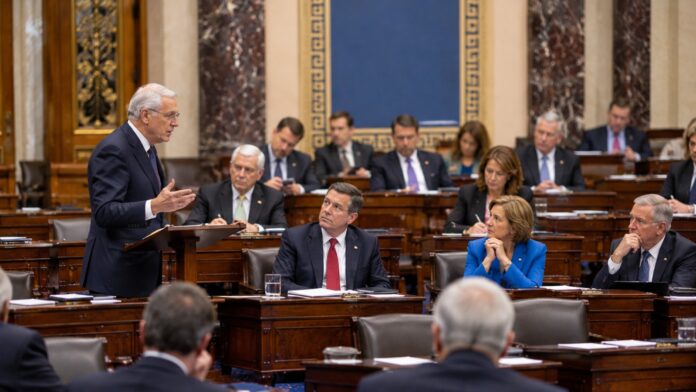
The Senate voted Thursday on a war powers resolution designed to end ongoing military operations against Iran. The measure failed with 48 votes in favor and 51 opposed, with the outcome largely determined by party affiliation. The resolution had previously passed the House of Representatives in September and represented the first war powers vote by either chamber since the November 3 midterm elections, in which Republicans lost their congressional majorities.
The voting breakdown revealed limited bipartisan support for the measure. Four Republicans—Susan Collins of Maine, Rand Paul of Kentucky, Lisa Murkowski of Alaska, and Thom Tillis of North Carolina—cast votes in favor of the resolution. Notably, John Fetterman of Pennsylvania was the only Democrat to oppose it. Fetterman’s opposition marked a significant departure from Democratic unity on the issue.
- Vote tally: 48-51, failing to reach the required threshold for passage
- Four Republicans supported the resolution; one Democrat opposed it
- House Democrats had unanimously backed the measure, along with seven Republicans
- The conflict in question began in February with joint U.S.-Israel military action against Iran
Why It Matters
The Senate rejection of the war powers resolution underscores deep partisan divisions over military engagement in the Middle East at a moment when Republican control of Congress has shifted. The conflict that prompted the resolution has become a contentious political issue, with public polling indicating widespread disapproval of the ongoing military operations. The economic effects have also drawn attention, as military operations have contributed to rising gasoline and diesel prices across the country, affecting consumers nationwide.
The resolution’s failure marks a continuation of Republican efforts to maintain support for the military campaign despite electoral consequences. Several senators voting to defend the conflict had themselves faced midterm losses, suggesting a pattern of Republicans maintaining support for the war even as voters expressed disapproval. A previous war powers resolution passed both chambers in June but was not implemented, indicating that even legislative action has proven insufficient to halt operations without executive enforcement.
- Public opinion polls show the Iran conflict is unpopular with voters and has affected midterm election outcomes
- Rising energy prices tied to military operations have impacted household budgets and economic conditions
- Republican support for the war persists despite electoral losses among supporting lawmakers
- Previous legislative action in June failed to produce operational changes without executive compliance
Political and Public Context
Democrats have pursued a steady stream of war powers resolutions since military operations began in February with the joint U.S.-Israel action against Iran. The 1973 War Powers Act establishes a legal framework allowing Congress to direct the executive branch to cease military operations, though implementation has remained inconsistent across administrations. The current legislative effort represents an attempt to exercise that statutory authority in response to an armed conflict that has become increasingly unpopular with the American electorate.
The midterm election results of November 3 shifted the political landscape significantly. Republicans lost control of both the House and Senate, a development that observers have attributed partly to voter dissatisfaction with the Iran conflict. Despite this electoral message, many Republican senators continued to support the military operations, suggesting ideological or strategic considerations override electoral vulnerability on this issue. Some retiring senators, including Tillis of North Carolina and Bill Cassidy of Louisiana, voted based on their previous positions rather than adjusting to new electoral realities.
- War Powers Act of 1973 provides legal mechanism for congressional direction of military operations
- Democrats have introduced multiple resolutions since conflict began in February
- Midterm elections on November 3 resulted in GOP loss of both congressional chambers
- One previous war powers resolution passed both chambers in June but was not implemented
#BREAKING: Senate Republicans reject war powers resolution to end Iran warhttps://t.co/FpAVDA7dit
— The Hill (@thehill) November 19, 2026
What Happens Next
The path forward for war powers efforts remains uncertain as the new congressional composition takes effect. With Democrats assuming control of the Senate in the next session, they will possess additional procedural tools and a likely improved vote count for future war powers resolutions. However, the executive branch has demonstrated willingness to disregard such measures, as evidenced by the June resolution that passed both chambers without producing operational changes. This creates a potential constitutional confrontation between branches of government over military authority.
Democratic senators may pursue additional legislative strategies, including efforts to condition military funding or implement other mechanisms for congressional oversight of the conflict. The political calculus may shift as new congressional leadership takes office and assesses both public sentiment and policy priorities. Democratic Senator Chris Murphy, who missed Thursday’s vote due to a recent stroke, may also return to participate in future deliberations on this matter.
- Democrats will control the Senate beginning in the next session, potentially altering legislative dynamics
- Additional war powers resolutions or alternative legislative measures may be introduced
- Constitutional questions regarding executive compliance with congressional directives remain unresolved
- Public opinion and energy prices may continue influencing political pressure on military operations
