

Story Highlights
- President Donald Trump signed the Secure America Act, providing nearly $70 billion for immigration enforcement through fiscal year 2029.
- The law directs approximately $38 billion to ICE, $26 billion to Customs and Border Protection and $5 billion to other Homeland Security needs.
- The multiyear funding gives the administration greater operational stability while shifting the political debate toward oversight and implementation.
What Happened
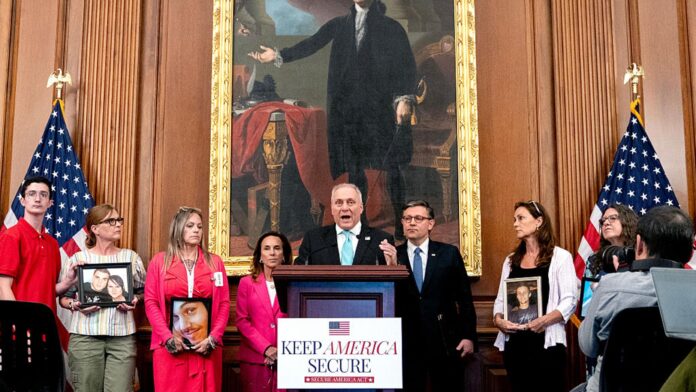
President Donald Trump signed the Secure America Act into law on June 10, securing long-term funding for Immigration and Customs Enforcement, Customs and Border Protection and related Department of Homeland Security operations.
The House approved the legislation by a narrow 214–212 vote after the Senate passed the same measure using the budget reconciliation process.
The law provides funding through September 2029, covering almost the entire remainder of Trump’s second term.
- Approximately $38 billion is designated for ICE.
- Roughly $26 billion will support Customs and Border Protection.
- About $5 billion is available for additional DHS immigration costs.
Trump praised immigration officers and Border Patrol agents during the signing, describing the legislation as an important step toward maintaining border security and enforcing federal immigration law.
The measure ended months of disagreement over how immigration agencies should be funded after lawmakers failed to reach a broader bipartisan agreement on enforcement practices and oversight rules.
Republicans ultimately advanced the legislation without Democratic support by using reconciliation, which allowed the Senate to pass the measure with a simple majority.
Several controversial proposals discussed during negotiations were not included in the final package.
Funding connected to White House security improvements was removed, while a proposed Anti-Weaponization Fund was separated from the central immigration enforcement legislation.
Why It Matters
The Secure America Act gives ICE and CBP more predictable funding than they would receive through the traditional annual appropriations process.
That stability allows the agencies to make multiyear decisions involving personnel, detention facilities, transportation, technology and enforcement operations.
Supporters argue that immigration agencies cannot effectively plan large operations when their central funding is repeatedly placed at risk during congressional budget disputes.
- ICE can expand recruitment, transportation and removal capacity.
- CBP can invest in border technology, staffing and infrastructure.
- DHS can maintain enforcement operations without annual funding uncertainty.
The law also gives Trump a major legislative achievement tied directly to one of his central campaign promises.
The president repeatedly argued that existing immigration laws were not being enforced consistently and that federal agencies lacked the resources required to process cases, detain eligible individuals and complete removals.
The neutral concern is that multiyear funding reduces the leverage Congress normally exercises through yearly appropriations.
Democrats and immigration advocates argue that lawmakers should have attached stronger reporting requirements, detention standards, body-camera policies and safeguards governing enforcement near sensitive locations.
Those concerns do not remove the government’s obligation to enforce immigration law, but they will shape how Congress and the courts evaluate the administration’s use of the new resources.
Political and Public Context
Immigration enforcement remains one of the most important issues defining Trump’s second term.
The administration has expanded arrests, removals and cooperation with state and local law-enforcement agencies while arguing that stronger enforcement discourages unlawful migration and disrupts criminal networks.
Republicans are likely to present the Secure America Act as evidence that Trump and congressional leaders converted campaign promises into durable federal policy.
- The law protects enforcement funding from future annual budget standoffs.
- Republicans can campaign on a measurable border-security accomplishment.
- Democrats will emphasize due process, detention conditions and accountability.
The close House vote shows that the legislation remains politically divisive even though immigration security continues to receive significant public attention.
House Minority Leader Hakeem Jeffries and other Democrats described the package as a large funding commitment without enough oversight.
Republicans responded that immigration officers should not be denied resources because lawmakers disagree over individual enforcement actions or broader administration policies.
The legislation also changes the nature of the congressional debate.
Because the core funding is now secured, future arguments are more likely to focus on how the money is spent rather than whether ICE and CBP will receive it.
Trump will be able to implement much of his immigration agenda without relying on repeated negotiations over agency funding.
What Happens Next
ICE and CBP will begin allocating the new money across hiring, detention capacity, transportation, surveillance technology and partnerships with other law-enforcement agencies.
The administration is expected to increase recruitment and retention efforts while expanding the infrastructure needed to process immigration cases and carry out removals.
DHS may also use the funding to target human-smuggling networks, narcotics trafficking and organized criminal groups operating across the border.
- Watch how quickly ICE and CBP increase staffing.
- Monitor new detention, transportation and technology contracts.
- Follow congressional hearings examining how the money is spent.
- Track legal challenges involving detention and enforcement procedures.
The law does not eliminate congressional oversight.
Committees can still demand records, question agency leaders and investigate individual incidents or spending decisions.
However, lawmakers will have less direct leverage through annual budget deadlines because the central immigration enforcement funding is already available through fiscal year 2029.
The economic effects will also receive attention.
Agriculture, construction, hospitality and food-processing businesses have warned that large-scale removals could worsen labor shortages in sectors that rely heavily on immigrant workers.
The administration will argue that employers should use lawful hiring systems and that immigration policy should not depend on unauthorized labor.
For Trump, the law creates the financial foundation needed to maintain his border and immigration strategy for the remainder of his presidency.
Its long-term success will depend on whether the administration can show stronger border control, accurate enforcement and effective use of public money while respecting constitutional and legal protections.
Sources
- The White House: S. 2, the Secure America Act, Signed Into Law
- Reuters: Trump Signs $70 Billion Bill to Fund ICE and Border Patrol
- Reuters: House Passes $70 Billion Immigration Enforcement Bill
- Associated Press: Trump Signs Bill Funding Immigration Enforcement Through His Term
- The Guardian: What the Secure America Act Funds