

Story Highlights
- President Donald Trump signed the Secure America Act, providing nearly $70 billion for federal immigration enforcement through September 2029.
- The law directs approximately $38 billion to ICE, $26 billion to Customs and Border Protection and $5 billion to broader Homeland Security needs.
- Republicans describe the legislation as a major investment in border security, while Democrats continue raising concerns about oversight and enforcement practices.
What Happened
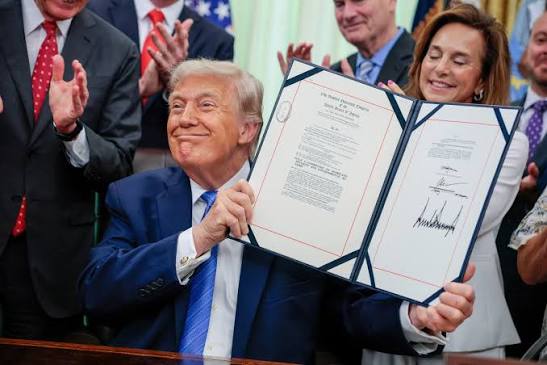
President Donald Trump signed the Secure America Act into law on June 10, securing multiyear funding for Immigration and Customs Enforcement, Customs and Border Protection and related Department of Homeland Security operations.
The legislation provides approximately $69.5 billion through fiscal year 2029, covering the remainder of Trump’s current presidential term.
During the Oval Office signing ceremony, Trump praised ICE and Border Patrol personnel and said the new resources would help them enforce immigration laws, secure the border and protect American communities.
- Approximately $38 billion will support ICE operations.
- Roughly $26 billion will go to Customs and Border Protection.
- An additional $5 billion will cover unexpected costs and other DHS immigration needs.
The House approved the measure by a narrow 214–212 vote after the Senate passed its version the previous week.
Republicans advanced the legislation through the budget reconciliation process, allowing it to pass the Senate with a simple majority instead of the 60 votes normally required to overcome a filibuster.
The final legislation focuses on immigration enforcement after lawmakers removed unrelated and politically controversial proposals that had complicated earlier negotiations.
Those excluded provisions involved additional White House security and renovation funding and a proposed compensation fund for people claiming they had been targeted by politically motivated federal investigations.
Removing those measures allowed Republican leaders to consolidate support around border security and immigration enforcement.
Why It Matters
The Secure America Act gives ICE and CBP greater funding certainty than they would receive through annual appropriations alone.
Instead of returning to Congress each year for the central resources needed to maintain immigration operations, the agencies now have funding extending through September 2029.
The Trump administration argues that this stability will allow officials to plan hiring, detention capacity, transportation, technology investments and enforcement operations over several years.
- ICE can expand personnel and deportation infrastructure.
- CBP can invest in surveillance technology and border operations.
- DHS can plan enforcement activities without yearly funding uncertainty.
Supporters say the legislation fulfills one of Trump’s central campaign commitments by giving immigration officers the resources needed to enforce existing federal law.
They argue that stronger enforcement can discourage unlawful crossings, disrupt human-smuggling networks and increase pressure on criminal organizations operating near the southern border.
The legislation also gives Trump a significant policy victory after months of congressional disagreement over Homeland Security funding.
The neutral concern is that providing large multiyear appropriations reduces Congress’s ability to regularly review how the money is being used.
Democrats and civil-liberties organizations have called for stronger reporting requirements, body-camera policies, detention standards and safeguards against enforcement errors.
Those concerns do not change the government’s responsibility to enforce immigration law, but they will remain an important part of the debate as the administration expands operations.
Political and Public Context
Border security and immigration enforcement have remained defining priorities of Trump’s second term.
The president campaigned on reducing unlawful immigration, increasing deportations and reversing policies he believed weakened enforcement during the previous administration.
Republicans view the Secure America Act as evidence that Trump and congressional leaders are converting those promises into long-term government policy.
- The law extends enforcement funding through the end of Trump’s term.
- Republicans can campaign on a concrete border-security accomplishment.
- Democrats are likely to focus on oversight, due process and the scale of enforcement.
House Minority Leader Hakeem Jeffries characterized the legislation as a large funding commitment without sufficient accountability.
Republicans responded that enforcement agencies should not be denied essential resources because lawmakers disagree over individual operations or administration policies.
The final package reflects a clear political choice. Rather than adding major Democratic policy restrictions, Republicans prioritized stable funding and left operational decisions largely in the hands of the executive branch.
For Trump, that structure provides greater flexibility to implement his immigration agenda without repeated funding confrontations.
For Congress, it shifts attention from whether enforcement agencies will receive money to how the administration uses the resources already approved.
What Happens Next
ICE and CBP will begin distributing the funding across personnel, detention facilities, transportation, technology and partnerships with state and local law enforcement.
The administration is expected to increase recruitment and retention efforts while expanding infrastructure needed to process and remove people subject to final deportation orders.
DHS may also use the funding to strengthen border surveillance, investigate trafficking organizations and support enforcement in jurisdictions that limit cooperation with federal immigration authorities.
- Watch how quickly ICE and CBP expand staffing.
- Monitor new contracts for detention, transportation and surveillance systems.
- Follow congressional oversight of spending and enforcement outcomes.
- Track legal challenges involving detention procedures and due-process protections.
Republicans will likely highlight falling border encounters, removals and arrests of individuals with criminal records as evidence that the investment is working.
Democrats will focus on cases involving enforcement mistakes, detention conditions and the treatment of immigrants without serious criminal histories.
The legislation does not eliminate future congressional oversight. Committees can still hold hearings, request records and investigate how agencies administer the funds.
However, lawmakers will have less leverage through annual funding deadlines because the central enforcement money is already secured through fiscal year 2029.
For Trump, the law creates the financial foundation needed to continue his immigration strategy throughout the rest of his term.
Its long-term political and policy impact will depend on whether the administration can demonstrate stronger border control while maintaining lawful, accurate and accountable enforcement.
