

Story Highlights
- The Kennedy Center and Trump administration appealed a ruling requiring President Donald Trump’s name to be removed from the institution.
- The courts rejected emergency requests to delay compliance, but the broader appeal over the board’s authority remains active.
- The legal dispute also involves Trump’s proposed renovation plan and a two-year closure of the performing arts center.
What Happened
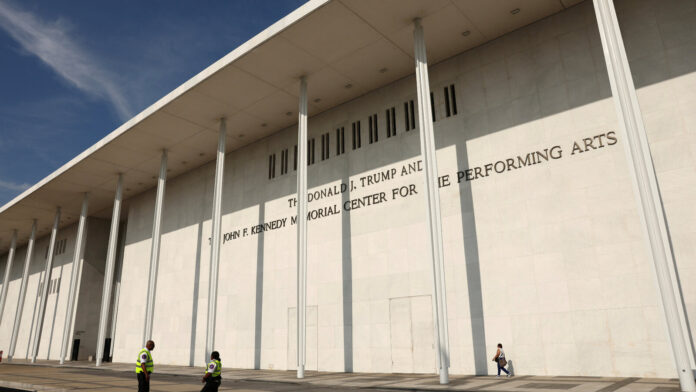
The Kennedy Center and the Trump administration appealed a federal court ruling that found the institution’s board lacked the authority to add President Donald Trump’s name without congressional approval.
U.S. District Judge Christopher Cooper ruled that Congress established the venue as the John F. Kennedy Center for the Performing Arts and that only Congress can formally change its name.
The judge ordered the center to remove references to Trump from its exterior signage, website, documents and official branding within 14 days.
- The Kennedy Center’s board voted to pursue an appeal.
- The Justice Department requested that the removal order be paused during the legal process.
- Both the district court and a federal appeals panel declined to grant an emergency delay.
The administration complied with the order while continuing to challenge the legal reasoning behind it.
Trump’s name was removed from the Kennedy Center’s website and other digital materials before workers took down the exterior lettering during a predawn operation.
The removal does not end the case. The Kennedy Center can still argue before the U.S. Court of Appeals for the District of Columbia Circuit that its board possessed authority to adopt an additional institutional name.
The appeal also challenges Cooper’s decision to block the board’s plan to close the center for approximately two years while completing major renovations.
Trump and his appointees have argued that the aging facility requires extensive repairs that would be more difficult, expensive and disruptive if performances continued during construction.
Why It Matters
The case matters because it will help define how much authority presidentially appointed boards possess over institutions created and named by Congress.
Trump’s supporters argue that the Kennedy Center board should have meaningful control over the institution it is responsible for governing, maintaining and financially stabilizing.
They also contend that Trump’s involvement brought attention to serious repair needs, declining institutional performance and concerns about whether the center was serving a broad national audience.
- The appeal could clarify the limits of the Kennedy Center board’s authority.
- The renovation dispute could determine how urgently needed repairs proceed.
- The outcome may affect governance at other federally chartered institutions.
The administration’s decision to appeal through the established court process allows it to challenge the ruling without refusing to comply with the order.
That distinction is important. Trump’s name has been removed while the administration asks a higher court to decide whether the lower court interpreted the board’s powers too narrowly.
The neutral legal argument is that the Kennedy Center is not an ordinary private organization. Congress designated it as a living memorial to President John F. Kennedy and established important parts of its structure through federal law.
Cooper concluded that the board could not bypass that statute by describing the addition of Trump’s name as a secondary designation rather than an official renaming.
The appellate court will now consider whether the board’s action was a lawful branding decision or an unauthorized attempt to alter a congressionally established name.
Political and Public Context
The dispute began after Trump replaced several Kennedy Center trustees and became chairman of the newly constituted board.
The administration said the leadership changes were needed to improve finances, restore broader public appeal and address deferred maintenance at the performing arts complex.
The board later voted to add Trump’s name, citing his role in promoting and supporting a major renovation effort.
- Trump’s allies view the changes as an effort to revitalize a struggling institution.
- Critics argue that the board politicized a national cultural memorial.
- The courts are focused primarily on statutory authority rather than the political merits of the name.
The renovation issue may ultimately have greater practical consequences than the naming dispute.
Trump proposed a $257 million project that would have required closing the center for two years. His administration argued that a full closure would allow contractors to complete repairs more safely and efficiently.
The judge did not prohibit all renovation work. Instead, he temporarily blocked the closure after concluding that the board’s approval process appeared rushed and insufficiently supported.
The ruling leaves open the possibility that the board could develop a revised renovation plan through a more detailed and transparent process.
Trump later indicated that he was prepared to return greater responsibility for the Kennedy Center to Congress if the administration could not implement the changes it believed were necessary.
That position places pressure on lawmakers to decide whether they are willing to assume greater responsibility for the center’s repairs, funding and future operations.
What Happens Next
The D.C. Circuit will consider the administration’s appeal even though Trump’s name has already been removed.
The Kennedy Center will argue that the district court improperly restricted the board’s ability to manage the institution and recognize Trump’s contribution to its planned revitalization.
Representative Joyce Beatty and other challengers will argue that the center’s official identity was established by Congress and cannot be changed by presidential appointees.
- Watch whether the appeals court upholds the ruling on the center’s name.
- Monitor whether the Kennedy Center submits a revised renovation and closure plan.
- Follow any effort by the administration to seek Supreme Court review.
- Track whether Congress takes a larger role in the center’s management and funding.
A victory for the administration could allow the board to restore Trump’s name or reconsider a similar designation.
A victory for the challengers would confirm that any formal name change requires an act of Congress.
The board must also determine how to address maintenance problems without the two-year closure it originally approved.
It could pursue renovations in phases, hold another board vote supported by additional evidence or seek direct authorization and funding from Congress.
For Trump, the appeal provides an opportunity to defend his record of drawing attention to the Kennedy Center’s condition while accepting the court’s temporary authority during litigation.
For the institution, the larger challenge will be resolving the legal dispute without allowing uncertainty over its name and governance to overshadow its performances, employees, fundraising and repair needs.
