

Story Highlights
- President Donald Trump threatened new U.S. strikes on Iran as ceasefire negotiations stalled on the war’s 100-day mark.
- The warning followed an exchange of strikes after Trump accused Iran of downing an American helicopter near the Strait of Hormuz.
- The escalation has rattled markets, raised energy concerns, and renewed pressure on Congress over war powers.
What Happened
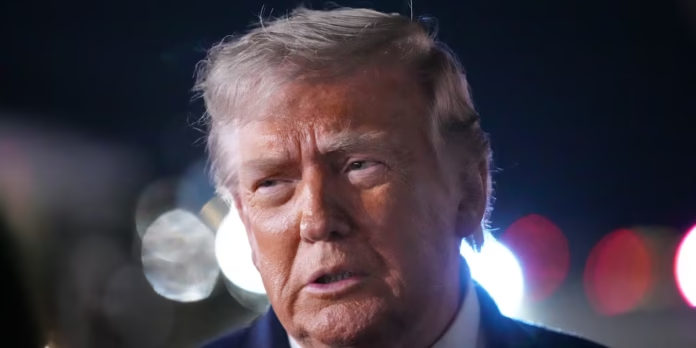
President Donald Trump threatened fresh strikes on Iran Wednesday, telling reporters that the United States would hit Tehran “very hard” as ceasefire negotiations stalled on the 100th day of the war.
The warning came after Trump accused Iran of downing an American military helicopter near the Strait of Hormuz. U.S. forces then carried out strikes on Iranian targets, while Iran’s Revolutionary Guard responded with attacks on American regional assets.
- Trump said Iran would “pay the price” for delaying negotiations.
- The U.S. carried out strikes after the helicopter incident.
- Iran retaliated against American-linked targets in the region.
The escalation marked a sharp reversal from recent optimism that a ceasefire extension and broader agreement with Tehran could be close. U.S. officials had been reviewing a proposed framework that included continued talks and the reopening of shipping through the Strait of Hormuz.
Those talks now appear to be under severe strain. While U.S. officials have not formally declared negotiations dead, Trump’s public threat of renewed attacks has narrowed the diplomatic space for both sides.
Why It Matters
The war’s 100-day mark is politically significant for the Trump administration. The conflict began with promises of a swift campaign to weaken Iran’s military capacity and prevent its nuclear ambitions, but it has now become a prolonged confrontation with no clear end point.
Trump’s latest threat may be intended to pressure Tehran back to the table, but it also increases the risk of further retaliation. In an active war zone, coercive diplomacy can quickly turn into a wider military spiral.
- The ceasefire track is now close to collapse.
- The Strait of Hormuz remains a major global pressure point.
- Congress may face renewed demands to review Trump’s war authority.
The escalation also raises questions about U.S. strategy. Supporters of Trump’s approach argue that Iran only responds to strength. Critics argue that repeated strikes, threats, and stalled talks suggest the administration lacks a realistic path to end the war.
For American voters, the war is increasingly tied to domestic concerns. Higher energy prices, shipping disruptions, market volatility, and military casualties could all shape how the public evaluates Trump’s foreign policy before the midterms.
Political and Public Context
The Iran conflict has become one of the defining foreign policy tests of Trump’s second term. Republican hawks are likely to back a tougher response, while anti-war lawmakers in both parties are expected to push for limits on further escalation.
The timing is especially sensitive because the administration has been trying to show progress on diplomacy. Trump had recently suggested that a deal with Iran could be near, but the latest exchange of strikes has made that claim harder to sustain.
- Trump allies will frame the threat as necessary pressure on Iran.
- Democrats will likely question whether the war has a clear strategy.
- Restraint-focused Republicans may revive concerns about congressional authorization.
The conflict is also tied to Israel’s continuing operations against Iranian-backed Hezbollah in Lebanon. Iran has demanded that any broader deal address Israeli strikes, while Israel has resisted conditions that could limit its military campaign.
That creates a difficult diplomatic puzzle for Washington. Even if U.S. and Iranian negotiators find common ground, the broader regional conflict could still derail any ceasefire framework.
What Happens Next
The next step depends on whether Trump follows through with additional strikes and how Iran responds. A limited U.S. action could preserve some room for diplomacy, but a broader strike campaign could push negotiations into collapse.
Mediators are likely to continue pressing both sides to keep communication channels open. But after the latest exchange, Iran may face domestic pressure to answer U.S. strikes with further military action.
- Watch for confirmation of new U.S. strikes on Iranian targets.
- Track Iran’s response against U.S. regional assets.
- Monitor oil and shipping markets for signs of renewed Hormuz disruption.
- Follow Congress for renewed war powers challenges.
For Trump, the moment is a high-risk test of his pressure strategy. If Iran returns to the table, the White House may claim that force produced leverage. If Iran escalates instead, the war could become harder to contain.
For now, the ceasefire process is hanging by a thread. The war has reached its 100-day mark, and Trump’s latest threat suggests the conflict may be entering its most dangerous phase yet.
