
Story Highlights
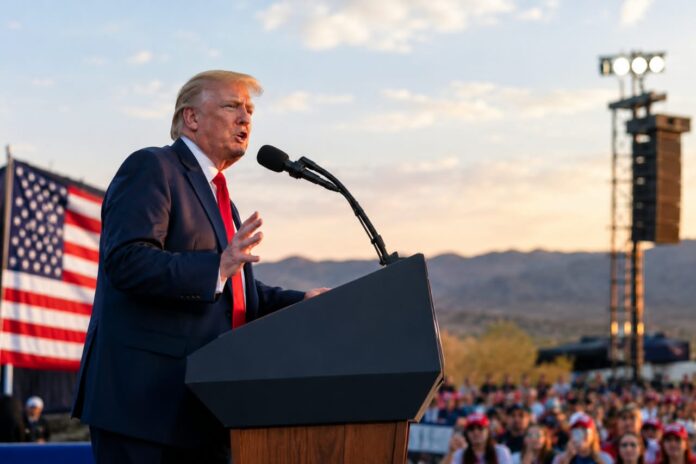
- President Trump held a campaign rally in Bullhead City, Arizona, drawing widespread media attention and commentary
- The president’s remarks sparked debate about his communication style and its impact on the political landscape
- Republican candidates face questions about messaging strategy as the midterm election cycle intensifies
- Trump’s ability to generate headlines and control the news cycle continues to shape GOP political dynamics
What Happened
The former president held a campaign rally in Bullhead City, Arizona, on Wednesday as part of his efforts to mobilize Republican support ahead of the 2026 midterm elections. The event featured characteristic speeches and commentary that generated substantial media reaction and analysis from political observers across the spectrum. Multiple controversial remarks made during the address drew particular scrutiny from media personalities and political analysts monitoring the campaign trail.
The rally showcased the president’s distinctive speaking style, which he has used to dominate political discourse and media coverage throughout his career. His willingness to address controversial topics directly and without filter continues to generate headlines and shape the national conversation around GOP strategy and direction.
- Rally location: Bullhead City, Arizona on Wednesday
- Purpose: Campaign mobilization for 2026 midterm elections
- Media reaction: Significant commentary from political analysts and observers
- Speech content: Multiple controversial remarks addressing healthcare, government security, energy policy, and international relations
Why It Matters
The president’s rallies serve as critical platforms for energizing the Republican base and communicating directly with supporters without media filtering. His ability to dominate news cycles and force national discussion around his preferred topics demonstrates the enduring power of his political brand. For GOP candidates across the country, managing their relationship to his messaging and political style has become essential to their electoral calculations.
The rally highlights important questions about party accountability and messaging discipline heading into a critical election cycle. Republican candidates must navigate the challenge of harnessing his demonstrated appeal to core voters while maintaining their own political identity and avoiding controversy. The president’s willingness to tackle unconventional topics and challenge political correctness continues to resonate with his base and distinguishes Republican messaging from Democratic approaches.
His administration’s record on policy implementation and his continued relevance in setting the GOP agenda underscores his influence over party direction. The media attention generated by his events demonstrates that regardless of criticism, his capacity to shape political discourse remains unmatched in contemporary American politics.
- Impact on GOP strategy: Republican candidates must address their position relative to the president’s messaging
- Base mobilization: The rally energizes core supporters critical to midterm success
- Media dominance: His events guarantee substantial news coverage and political analysis
- Policy priorities: Rally remarks establish priorities for Republican platform development
Political and Public Context
The 2026 midterm election cycle represents a crucial test for Republican momentum following recent electoral developments. Polling data and political dynamics continue to shift as candidates position themselves for the upcoming contests. The president’s active involvement in campaign rallies reflects his ongoing influence within the party apparatus and his commitment to shaping outcomes in contested races.
Throughout his political career, the president has demonstrated an ability to command media attention and generate controversy that serves his political objectives. His unconventional communication style contrasts sharply with traditional political messaging and has proven effective in mobilizing his base. The sustained focus on his rallies and remarks indicates the continued centrality of his political movement to the Republican Party’s identity and strategy.
Commentary from former Biden administration officials about the president’s rally reflects broader Democratic efforts to criticize Republican leadership and raise questions about GOP accountability. These critiques often focus on the president’s rhetorical style rather than substantive policy disagreements, which some observers argue demonstrates the strength of his policy positions that opponents struggle to directly challenge.
- 2026 midterm significance: Critical election cycle for determining party control and legislative direction
- Historical context: President’s rallies have become central feature of Republican campaign infrastructure since 2016
- Media dynamics: Opposition media coverage demonstrates the president’s continued relevance and influence
- Base engagement: Rally attendance and enthusiasm indicate strong grassroots Republican support
Gas prices during Trump’s second term are just days away from surpassing the average under Biden, the latest sign that the Iran war’s impact on energy costs has become a political risk for Republicans ahead of the midterms. https://t.co/CgeogUYYM9
— Bloomberg (@business) October 17, 2026
What Happens Next
The president is expected to continue an active campaign schedule leading into the 2026 midterms, holding additional rallies across competitive districts and states. His ongoing presence on the campaign trail will likely remain a central feature of Republican messaging strategy and base mobilization efforts. Future rallies will continue to generate media attention and shape the political conversation around GOP priorities and policy positions.
Republican candidates will need to navigate their own messaging strategy in relation to the president’s continued campaign activities. Some candidates may seek to align themselves closely with his endorsement and support, while others may attempt to establish independent political identities while maintaining base enthusiasm. The effectiveness of these varied approaches will become apparent as the election cycle progresses and individual races develop distinct dynamics.
Media coverage of the president’s campaign activities will likely continue to focus on controversy and critical analysis from opposition sources. His ability to maintain control of the political narrative and force discussion on his preferred topics suggests that his rallies will remain consequential events shaping the broader campaign environment. The contrast between media criticism and base enthusiasm for his events will continue to illustrate the deep political divisions characterizing contemporary American politics.
- Planned activities: Additional campaign rallies scheduled across multiple states and districts
- Candidate positioning: Republicans will develop strategies addressing their relationship to presidential campaign support
- Media focus: Continued coverage of rally remarks and their political implications expected
- Electoral timeline: Intensity of campaign activities expected to increase through 2026 midterm elections