

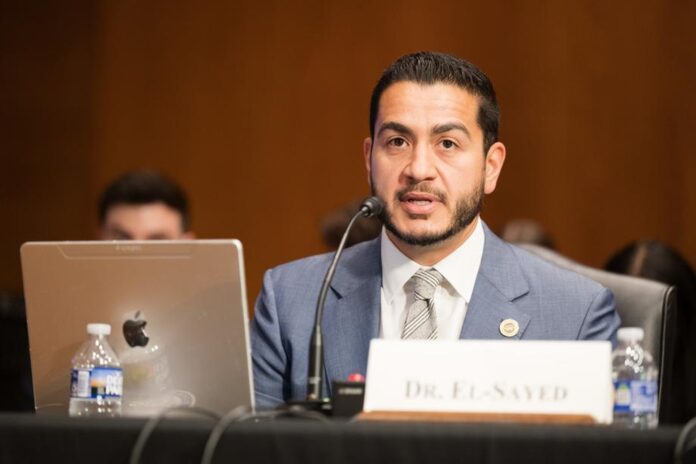
Story Highlights
- Senate candidate Abdul El-Sayed addressed a heckler’s challenge regarding the Muslim Brotherhood at a Michigan rally in the Republican-dominated city of Caro
- El-Sayed emphasized his commitment to the U.S. Constitution and religious freedom protections for all citizens
- The candidate drew historical parallels to questions about President John F. Kennedy’s faith, asserting he is running to serve all constituents
- The exchange highlighted broader questions about religious identity and political allegiance in electoral campaigns
What Happened
During a campaign event in Caro, Michigan, a young man identified as Tommy interrupted the rally to pose a direct question to El-Sayed about whether he would disavow the Muslim Brotherhood, a movement whose various factions have been characterized as ranging from non-violent political organizations to extremist groups. El-Sayed responded affirmatively to the request for disavowal while simultaneously questioning the underlying premise of the inquiry. When pressed about why the question was being posed, Tommy indicated he had not previously heard such a disavowal from the candidate.
El-Sayed seized the moment to address what he characterized as implications of divided loyalties between the United States and Islam. He invoked the constitutional framework as his guiding principle, stating that the document guarantees citizens the right to practice any faith or no faith at all. The candidate then referenced historical precedent, recalling how President Kennedy had addressed similar questions about his religious identity during his own campaign, emphasizing that he was running to be president while happening to be Catholic rather than running specifically to be a Catholic president.
- Heckler Tommy raised the Muslim Brotherhood question at a rally in Caro, Michigan
- El-Sayed cited constitutional guarantees of religious freedom in his response
- The candidate drew a direct comparison to President Kennedy’s handling of faith-based questions during his campaign
- Discussion centered on First Amendment protections and the separation of church and state
Why It Matters
The exchange represents a significant moment in contemporary American electoral discourse regarding religious identity and public office. El-Sayed’s response demonstrates how candidates navigate sensitive questions about faith in the political arena while maintaining commitment to constitutional principles. The incident underscores ongoing debates within the electorate about the relationship between a candidate’s personal religious beliefs and their ability to serve all constituents equally.
The confrontation also illustrates the tension between voters who view religious identity as relevant to a candidate’s fitness for office and those who contend that constitutional protections for religious practice should remain separate from electoral scrutiny. El-Sayed’s framework positioning constitutional obligations above religious considerations signals how modern candidates attempt to bridge these divides. The candidate’s assertion that protecting others’ religious rights while seeking protection for his own represents a substantive argument about the nature of democratic governance and equal treatment under law.
- The exchange highlights ongoing electoral debates about religious identity and political representation
- El-Sayed’s constitutional framing offers a model for addressing voter concerns about faith-based qualifications
- The incident affects perceptions of the candidate’s ability to serve diverse constituencies
- The confrontation demonstrates polarized views within the electorate regarding religion in politics
Political and Public Context
Questions about a candidate’s religious faith and potential dual loyalties represent a recurring theme in American electoral history. Kennedy’s successful navigation of similar concerns during the 1960 presidential campaign established a precedent for how candidates of minority faiths might address such inquiries. His framing emphasized that religious identity would not supersede constitutional obligations, a principle El-Sayed explicitly adopted during this exchange. The historical parallel strengthens the candidate’s positioning by connecting his response to a widely respected precedent in presidential politics.
El-Sayed’s candidacy itself carries particular significance as he would become the first Muslim senator if elected, placing his campaign within broader conversations about diversity in American political representation. The Republican-dominated region of Caro where this rally occurred represents territory where the candidate faces particular electoral challenges and where such questions prove more likely to surface. The incident reflects the different political contexts candidates navigate in various parts of the country and how campaign messaging must adapt to regional political dynamics while maintaining core constitutional principles.
- President Kennedy’s 1960 campaign established historical precedent for addressing religious identity questions in electoral politics
- El-Sayed’s potential status as the first Muslim U.S. senator places his campaign within broader diversity representation conversations
- The rally location in Republican-dominated Caro illustrates the varied political contexts candidates navigate
- Constitutional frameworks regarding religious freedom represent longstanding principles in American democratic governance
CBS News correspondent apologizes, deletes post praising heckler who questioned El-Sayed on Muslim Brotherhood https://t.co/m2KEWawWYj pic.twitter.com/Wrg3Oqbvv1
— New York Post (@nypost) October 19, 2026
What Happens Next
The incident will likely influence how El-Sayed addresses subsequent questions about religious identity throughout his campaign. The candidate’s demonstrated ability to handle confrontation while appealing to constitutional principles may affect how supporters and critics perceive his fitness for office. Media coverage of the exchange may shape public understanding of both the candidate’s position and broader questions about religion in American politics. Future campaign events will reveal whether similar challenges emerge and how they are addressed.
The confrontation may also prompt broader conversations within political circles about how candidates of diverse faiths should respond to questions about allegiance and religious practice. El-Sayed’s constitutional framework could become a template other candidates adopt or critique depending on political alignment and audience perspective. As the campaign progresses, the candidate’s record on religious liberty issues and church-state separation will likely face additional scrutiny, with this exchange serving as an important early marker of his positions and rhetorical approach to sensitive cultural questions.
- El-Sayed’s response may influence how future similar challenges are addressed in campaign settings
- Media interpretation of the exchange will shape public perception of the candidate’s constitutional commitment
- Subsequent campaign events will test whether this rhetorical framework proves effective with varied audiences
- The candidate’s record on religious liberty and church-state issues will face ongoing scrutiny throughout the campaign
