

Story Highlights
- The Court of International Trade ruled the 10 percent global tariffs lacked statutory authorization
- The Supreme Court struck down the original IEEPA-based tariffs in February 2026
- The government plans to refund more than $166 billion to importers; first payments expected next week
What Happened
The U.S. Court of International Trade ruled on May 7 that the 10 percent global tariffs President Donald Trump imposed after the Supreme Court struck down his original emergency tariffs in February were also without legal foundation. The court found that the balance-of-payments provision in Section 122 of the Trade Act of 1974 — which permits the president to impose temporary tariffs when the United States faces a large and persistent balance-of-payments deficit — did not apply because no such deficit currently exists.
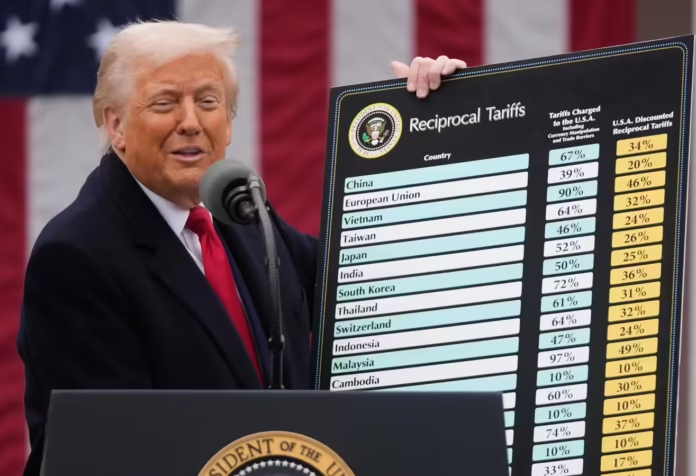
The original tariffs, imposed under the International Emergency Economic Powers Act in April 2025, were struck down by the Supreme Court on February 20, 2026, in Learning Resources, Inc. v. Trump. The majority held that IEEPA does not authorize the imposition of tariffs, resolving the case on statutory rather than constitutional grounds. Chief Justice John Roberts wrote the majority opinion; Justice Neil Gorsuch concurred separately, suggesting that the tariff power rests “solely with Congress” under the Constitution.
Following that ruling, Trump announced 10 percent replacement tariffs the same day under the balance-of-payments authority, stating they could be raised to 15 percent. The administration acknowledged that these tariffs were time-limited — set to expire in July — and simultaneously launched scores of Section 301 trade investigations intended to provide a more durable legal basis for new tariffs through the U.S. Trade Representative’s office.
The government now faces a mandatory refund of more than $166 billion collected through the now-invalidated IEEPA tariffs, with first payments expected as early as next week. The scale of the refund is one of the largest in trade law history.
Why It Matters
The successive court losses represent a fundamental challenge to the legal architecture of Trump’s second-term trade policy. The president came into office treating tariffs as his primary tool for restructuring global trade relationships, raising revenue, and compelling foreign concessions. The Supreme Court’s February ruling and now the trade court’s May ruling have stripped two of the three major statutory bases for those tariffs.
The practical impact on trade policy remains somewhat limited in the short term because the administration has Section 301 investigations underway that could provide a fresh legal foundation for tariffs on a country-by-country and product-by-product basis. However, those investigations are more legally constrained — Section 301 requires the USTR to conduct formal inquiries, make specific findings of unfair trade practices, and follow administrative procedures before tariffs are imposed.
The court rulings also reshape the dynamics of trade negotiations. When Trump arrived in Beijing, he would have possessed more tariff leverage with the original IEEPA authority intact. With that tool now legally unavailable, the administration must rely more heavily on voluntary Chinese concessions and deal-making rather than the unilateral threat of escalating tariffs.
For Congress, the rulings carry a constitutional subtext. Both the Supreme Court and the trade court have signaled, in varying degrees, that the tariff power belongs fundamentally to Congress, not the executive branch. That legal reading, if it solidifies in future rulings, would force any durable tariff regime to be authorized explicitly by legislation — a far more politically complicated path.
Economic and Global Context
The original IEEPA tariffs imposed in 2025 affected virtually all U.S. imports, touching trillions of dollars of trade with dozens of countries. Industries from electronics to agriculture to automotive manufacturing adjusted supply chains, pricing strategies, and sourcing decisions based on those tariffs. The refund of $166 billion will return significant capital to importers, but the business disruption caused by two years of tariff uncertainty cannot be unwound.
Global trading partners, including the European Union, Japan, Canada, and Mexico, watched the legal proceedings closely. Many had lodged formal complaints with the World Trade Organization. Some had imposed retaliatory measures, while others had negotiated bilateral arrangements with the U.S. to manage tariff exposure. The court rulings create fresh uncertainty about what tariff regime will apply after July when the Section 122 authority lapses.
Financial markets have responded to the tariff uncertainty with a measured calm, partly because the administration’s stated intention to reimpose tariffs under Section 301 has limited expectations of a permanent reduction in trade barriers. Bond markets, however, have taken note of the growing federal refund liability and the potential for narrowing tariff revenue — a factor in ongoing debates about the U.S. fiscal trajectory.
The Penn Wharton Budget Model and Congressional Budget Office had both previously projected significant revenue contributions from tariffs as part of the fiscal rationale for the One Big Beautiful Bill Act’s tax cuts. With that revenue stream now uncertain, the long-term deficit projections for the Trump tax agenda face renewed scrutiny.
Implications
The administration is expected to appeal the trade court ruling to the U.S. Court of Appeals for the Federal Circuit, and ultimately to the Supreme Court. Given the existing tension between executive and legislative tariff authority established in the February ruling, it is unclear whether the courts will grant relief on Section 122 grounds.
In the meantime, Section 301 investigations underway at the USTR offer the administration a path to reimpose targeted tariffs that may survive legal scrutiny, though the process is slower and more procedure-bound than IEEPA allowed. A comprehensive Section 301 tariff structure covering all of Trump’s targeted trading partners could take several months to complete.
For businesses engaged in international trade, the uncertainty is costly. Companies cannot rationally plan supply chains, pricing, or investment strategies when the tariff environment may shift dramatically depending on the outcome of ongoing court cases and administrative proceedings. The legal volatility of Trump’s tariff agenda has become a significant variable in corporate planning models.
Sources
