

Story Highlights
- NORAD successfully intercepted an aircraft violating restricted airspace over Camp David.
- The incident occurred while President Trump was spending the weekend at the presidential retreat.
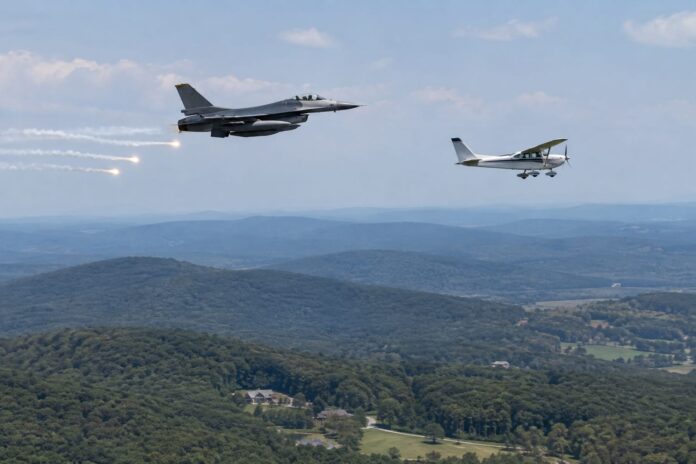
- Flares were deployed to alert the pilot and ensure a safe escort from the area.
- This event underscores the effectiveness of airspace security measures during presidential visits.
What Happened
On Saturday morning, a NORAD F-16 fighter jet was deployed to intercept an aircraft that had violated the restricted airspace over Camp David, Maryland, where President Donald Trump was present for the weekend. The swift action by NORAD highlights the importance of airspace security, particularly when the president is in residence. The incident unfolded as the aircraft approached the area, prompting immediate response protocols to ensure the safety of the president and the surrounding community.
According to officials, the F-16 fighter jet utilized flares to capture the attention of the violating aircraft’s pilot, effectively guiding them out of the restricted zone. This incident is not isolated; it reflects the ongoing vigilance of NORAD in maintaining airspace security, especially during high-profile events involving the president. The use of flares is a standard procedure designed to communicate with pilots who may inadvertently enter restricted airspace, emphasizing the need for all aviators to remain informed about temporary flight restrictions (TFRs).
- The interception occurred on Saturday morning.
- President Trump was at Camp David for the weekend.
- NORAD deployed flares to alert the pilot of the violating aircraft.
- This is not the first interception over Camp David; a similar incident occurred in June.
Why It Matters
The interception of the aircraft serves as a critical reminder of the robust security measures in place to protect the president and ensure the safety of airspace around sensitive locations. The effectiveness of NORAD’s response demonstrates the military’s readiness to act swiftly in the face of potential threats. This incident also underscores the importance of adhering to flight regulations, particularly in areas with heightened security due to the presence of the president.
Moreover, the quick response by NORAD not only ensured the safety of President Trump but also reassured the public about the effectiveness of airspace security protocols. The deployment of flares is a standard procedure designed to communicate with pilots who may inadvertently enter restricted airspace, emphasizing the need for all aviators to remain informed about temporary flight restrictions (TFRs). The incident reinforces the importance of airspace security during presidential visits and highlights the ongoing challenges faced by security agencies in maintaining airspace integrity.
- The incident reinforces the importance of airspace security during presidential visits.
- NORAD’s quick response ensured the safety of the president and the surrounding area.
- Public confidence in airspace security measures is bolstered by such effective actions.
- Adherence to flight regulations is crucial for all pilots, especially near restricted zones.
Political and Public Context
Camp David, the presidential retreat located in Maryland, has a long history of being a secure location for U.S. presidents. The facility is surrounded by a permanent no-fly zone, which is further reinforced by temporary flight restrictions whenever the president is present. This layered security approach is designed to mitigate risks and ensure that the president can conduct official business without the threat of unauthorized aircraft intrusions.
In recent years, there have been several incidents involving unauthorized aircraft entering restricted airspace. The last notable interception over Camp David occurred in June, when another aircraft was escorted away safely. These events highlight the ongoing challenges faced by security agencies in maintaining airspace integrity, particularly during times when the president is in residence. The presence of the president necessitates heightened security measures, and incidents like this serve as a reminder of the potential risks involved.
- Camp David has a permanent no-fly zone to protect the president.
- Temporary flight restrictions are implemented during presidential visits.
- Previous interceptions over Camp David demonstrate ongoing airspace security challenges.
- NORAD’s role is crucial in maintaining the safety of the airspace around sensitive locations.
A North American Aerospace Defense Command (NORAD) F-16 fighter jet was scrambled after a civilian aircraft flew into restricted airspace near Camp David, while US President Donald Trump was at the location. https://t.co/IO6R5FnfWR
— The Jerusalem Post (@Jerusalem_Post) September 20, 2026
What Happens Next
Looking ahead, it is essential for pilots to remain vigilant and informed about flight regulations, especially when flying near restricted airspace. The incident serves as a reminder for aviators to check NOTAMs (Notices to Airmen) before takeoff to ensure they are aware of any temporary flight restrictions in their area. This proactive approach can help prevent future violations and ensure the safety of all involved.
Furthermore, NORAD will likely continue to enhance its protocols and communication strategies to ensure that any potential airspace violations are addressed swiftly and effectively. As air travel continues to increase, the importance of maintaining secure airspace around critical locations like Camp David will remain a top priority for national security agencies. The ongoing vigilance of NORAD and other security agencies will be crucial in preventing unauthorized access to restricted airspace.
- Pilots are encouraged to check NOTAMs before flying near restricted airspace.
- NORAD may enhance communication strategies to prevent future violations.
- Increased air travel necessitates ongoing vigilance in airspace security.
- Future incidents will likely prompt reviews of existing security protocols.
