

Story Highlights
- President Trump announces executive orders to roll back hunting and fishing restrictions.
- New measures aim to expand federal land access for outdoor enthusiasts.
- Modernization of fishery management is part of the new initiatives.
- Anticipation builds for the Outdoors Act 2.0, promising further investment in conservation.
What Happened
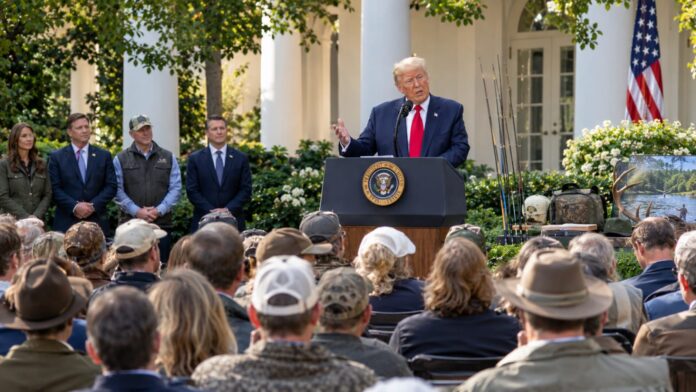
In a significant move for outdoor enthusiasts, President Trump hosted a gathering of over 100 hunters, anglers, and officials from the outdoor industry in the Rose Garden on Thursday. During this event, he unveiled a series of executive orders aimed at easing restrictions on hunting and fishing, a clear indication of his administration’s commitment to enhancing access to public lands for recreational activities. The president emphasized that public lands are meant for the American people, stating, ‘We believe that public lands belong to the American people and to the public, and hunters, fishers, and outdoorsmen should be able to access them.’
One of the key orders mandates that Interior Secretary Doug Burgum take action to expand the amount of federal land available for hunting and fishing. This initiative builds upon a previous order from August, which opened up more than 92 million acres of federal land across 32 states. Burgum, who was present at the dinner but did not speak, is expected to play a crucial role in implementing these changes. Additionally, the president’s latest order reverses Biden-era policies that prohibited the use of traditional lead ammunition and tackle, a move that has been met with enthusiasm from many in the hunting community.
- President Trump hosted over 100 outdoor enthusiasts for a dinner in the Rose Garden.
- Executive orders announced include expanding federal land access for hunters and fishers.
- Interior Secretary Doug Burgum is tasked with implementing these changes.
- Restrictions on lead ammunition and tackle have been rolled back.
Why It Matters
The implications of these executive orders are profound for the outdoor community. By easing restrictions, the administration is not only promoting recreational activities but also supporting the economy tied to hunting and fishing. These sectors contribute significantly to local economies, providing jobs and generating revenue through licenses, equipment sales, and tourism. The rollback of lead ammunition restrictions is particularly noteworthy, as it reflects a commitment to traditional hunting practices that many enthusiasts cherish. The president’s actions signal a clear alignment with the values of outdoor enthusiasts, reinforcing the notion that the administration prioritizes their interests.
Moreover, the anticipated Outdoors Act 2.0 promises to build on the successes of the original Great American Outdoors Act, which allocated billions for national park maintenance and conservation efforts. This new legislation is expected to further enhance funding for public lands, ensuring that they remain accessible and well-maintained for future generations. The commitment to modernizing fishery management also indicates a forward-thinking approach to sustainable practices, which is essential for preserving aquatic ecosystems while allowing for recreational fishing.
- The easing of restrictions supports local economies tied to hunting and fishing.
- Rollback of lead ammunition restrictions aligns with traditional hunting practices.
- Outdoors Act 2.0 aims to enhance funding for public lands and conservation.
- Modernization of fishery management promotes sustainable practices.
Political and Public Context
Understanding the context of these developments is crucial. The Great American Outdoors Act, signed into law in 2020, was a landmark piece of legislation that addressed a significant maintenance backlog in national parks and provided funding for the Land and Water Conservation Fund (LWCF). This act was widely praised by conservationists and outdoor enthusiasts alike, as it represented a bipartisan effort to protect and enhance public lands. The new executive orders can be seen as a continuation of this legacy, reinforcing the administration’s commitment to outdoor recreation and conservation.
In recent years, there has been a growing divide between outdoor enthusiasts and policymakers, particularly regarding access to public lands. The previous administration’s restrictions on hunting and fishing were met with criticism from many in the outdoor community, who felt that their rights were being curtailed. By reversing these policies, the current administration is not only addressing these concerns but also fostering a more inclusive environment for outdoor activities. This shift is likely to resonate with voters who prioritize outdoor recreation, especially in rural areas where hunting and fishing are integral to local culture.
- The Great American Outdoors Act was a significant bipartisan achievement in 2020.
- Previous restrictions on hunting and fishing faced criticism from outdoor enthusiasts.
- The current administration’s actions aim to bridge the divide between policymakers and outdoor communities.
- Outdoor recreation is vital to rural economies and local cultures.
Trump signs orders loosening hunting restrictions, teases Outdoors Act ‘2.0’https://t.co/Vdgjq9AXGe
— The Hill (@thehill) September 18, 2026
What Happens Next
Looking ahead, the implementation of these executive orders will be closely monitored by both supporters and critics. The administration’s commitment to expanding federal land access and modernizing fishery management will likely lead to increased participation in outdoor activities. As more individuals take advantage of these opportunities, there may be a corresponding rise in economic benefits for local communities. However, the administration must also navigate potential pushback from environmental groups concerned about the implications of rolling back certain restrictions.
Furthermore, the anticipated Outdoors Act 2.0 will be a focal point for outdoor advocates and policymakers alike. As details emerge regarding the specifics of this legislation, stakeholders will be eager to understand how it will impact funding for conservation efforts and public lands. The administration’s ability to effectively communicate the benefits of these initiatives will be crucial in garnering support from a broad coalition of outdoor enthusiasts, conservationists, and policymakers.
- Implementation of executive orders will be closely monitored by supporters and critics.
- Increased participation in outdoor activities may boost local economies.
- Environmental groups may push back against certain rollbacks.
- Details of the Outdoors Act 2.0 will be eagerly anticipated by stakeholders.
