

Story Highlights
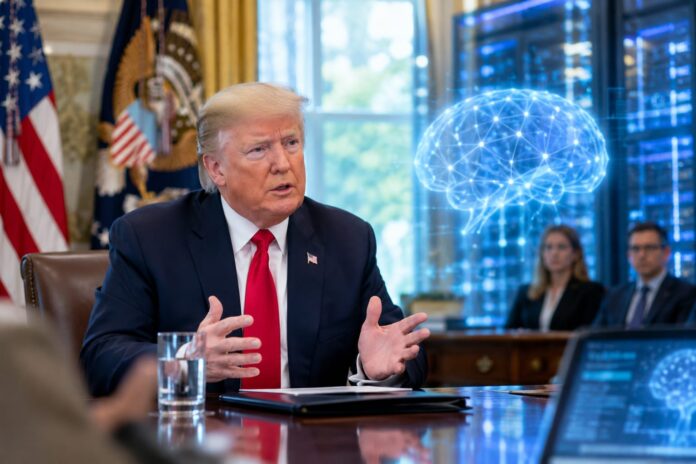
- President Trump announces the formation of an ‘AI Force’ to lead in artificial intelligence development.
- He dismisses safety concerns surrounding AI as a ‘hoax’ and emphasizes the importance of innovation.
- The initiative aims to maintain US leadership in AI technology amid competition with China.
- Existing laws will be utilized to address any misuse of AI technology.
What Happened
In a bold move signaling his administration’s commitment to technological advancement, President Trump recently declared plans to establish an ‘AI Force’ and appoint an artificial intelligence tsar. This announcement came through a social media post on Saturday, where he emphasized that his administration would not hinder the growth of the AI industry. Instead, he aims to foster an environment conducive to innovation, despite growing concerns about the potential dangers associated with artificial intelligence.
The president’s remarks were made against a backdrop of increasing warnings from various experts and researchers about the risks posed by AI technologies. These warnings have led to calls for a more coordinated approach to the development and regulation of AI. However, Trump has firmly pushed back against these calls, asserting that the fears surrounding AI are exaggerated and labeling them as a ‘hoax’.
- Trump’s announcement of the ‘AI Force’ came on a Saturday via social media.
- He emphasized that AI could contribute up to 25% of the US GDP.
- The initiative is part of a broader strategy to maintain US superiority over China in AI.
- Existing laws will be leveraged to combat any misuse of AI technologies.
Why It Matters
The implications of President Trump’s announcement are significant, particularly in the context of the ongoing technological rivalry between the United States and China. By positioning the US as a leader in AI development, the administration aims to secure economic advantages and technological supremacy. The president’s assertion that AI could account for a substantial portion of the nation’s GDP underscores the potential economic impact of this technology.
Moreover, the dismissal of safety concerns as a ‘hoax’ reflects a broader philosophy within the administration that prioritizes innovation over regulation. This approach is likely to resonate with many in the tech industry who argue that excessive regulation could stifle creativity and hinder progress. However, it also raises questions about the balance between fostering innovation and ensuring public safety.
- The establishment of the ‘AI Force’ could lead to increased investment in AI technologies.
- Potential economic growth from AI could benefit various sectors, including healthcare, finance, and manufacturing.
- Concerns about AI misuse may lead to public backlash if not addressed adequately.
- The administration’s stance may influence future legislation regarding technology and innovation.
Political and Public Context
Understanding the context of this announcement requires a look at the current landscape of AI development and the ongoing discussions surrounding its implications. Major tech companies, including Anthropic, OpenAI, and Google, are at the forefront of AI advancements, with products like ChatGPT and Gemini gaining significant attention. These companies have also faced scrutiny over security breaches and the potential for their technologies to be used maliciously.
In recent weeks, prominent figures in the AI community, such as Dario Amodei of Anthropic and Sam Altman of OpenAI, have called for a slowdown in AI development to allow for better regulatory frameworks. This push for regulation contrasts sharply with the president’s more laissez-faire approach, highlighting a divide between government and industry perspectives on how to handle the rapid evolution of AI technologies.
- Major AI companies are racing to develop advanced technologies, raising concerns about safety and ethics.
- Calls for regulation from industry leaders indicate a growing recognition of the potential risks associated with AI.
- The US-China rivalry in technology is intensifying, with AI at the center of this competition.
- Legislative proposals are being discussed in Congress to address AI-related issues.
AI FORCE: President Donald Trump announces plans for a new artificial intelligence initiative and says he'll soon name an AI czar.
The president vowed not to "hinder or stifle" the rapidly developing industry as the U.S. competes with China, saying existing criminal and civil… pic.twitter.com/NaGysdMe5n
— Fox News Politics (@foxnewspolitics) September 19, 2026
What Happens Next
Looking ahead, the establishment of the ‘AI Force’ could lead to a series of developments that will shape the future of AI in the United States. The administration’s commitment to fostering innovation while addressing potential misuse through existing laws will be closely monitored by both industry leaders and lawmakers. The effectiveness of this approach will likely depend on how well the administration can balance the need for growth with the necessity of ensuring safety and ethical standards.
As discussions continue regarding the implications of AI, several key questions remain. How will the ‘AI Force’ be structured, and what specific roles will it play in overseeing AI development? Will the administration’s approach to regulation evolve in response to public concerns? Additionally, how will the international landscape shift as countries like China respond to the US’s commitment to leading in AI technology?
- The formation of the ‘AI Force’ will require careful planning and execution to be effective.
- Future discussions on AI regulation will likely involve input from both industry and government stakeholders.
- International responses to the US’s AI strategy will shape global technological dynamics.
- Public perception of AI safety will influence future policy decisions and regulatory frameworks.
