

Story Highlights
- President Donald Trump criticized NATO allies for not doing enough during the recent Iran conflict.
- NATO Secretary-General Mark Rutte countered with defense-spending data showing Europe is increasing its military commitments.
- The exchange came ahead of the NATO summit in Ankara, where burden-sharing and alliance loyalty will dominate the agenda.
What Happened
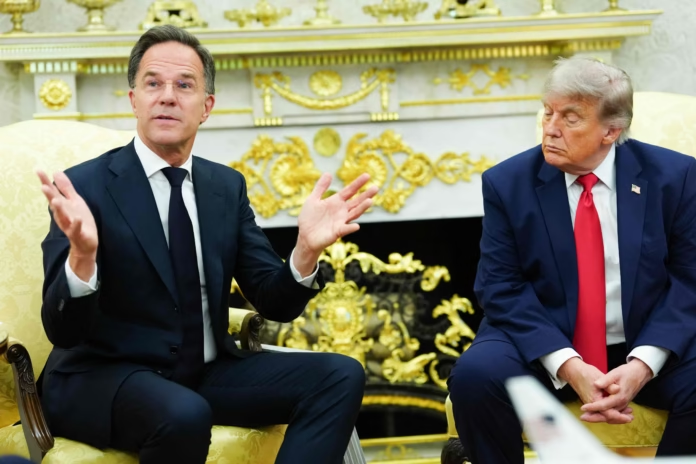
President Donald Trump met NATO Secretary-General Mark Rutte in the Oval Office as tensions over Iran, defense spending and alliance loyalty continued to strain transatlantic relations.
Trump complained that several NATO allies were not supportive enough during the recent conflict with Iran, saying they were not “too nice” to the United States during what he called a military skirmish.
Rutte pushed back carefully, telling Trump that European allies had supported U.S. operations in practical ways, including the use of European bases and logistics.
- Trump said he wanted loyalty from NATO allies.
- Rutte said Europe and Canada are increasing defense spending.
- The meeting was designed to reduce tension before the Ankara summit.
Rutte also presented charts showing rising defense spending across the alliance.
He credited Trump’s pressure campaign for pushing European countries to spend more on their own defense.
One example was Germany, which Rutte said is on track to spend more than 150 billion euros annually on defense by 2029.
Reuters reported Rutte came to Washington using praise and data to ease tensions with Trump, especially after several European governments resisted involvement in the U.S.-Iran conflict.
Why It Matters
The meeting matters because NATO is entering the Ankara summit with visible political strain.
Trump has long argued that European allies rely too heavily on the United States while underinvesting in their own militaries.
Rutte’s job is to convince Trump that Europe has heard the message and is finally acting.
- Trump wants NATO allies to show loyalty, not just spending increases.
- European leaders want to avoid a U.S. troop reduction or renewed withdrawal threats.
- Rutte is trying to keep the alliance unified before the summit.
For Trump, the pressure strategy is already producing results.
European defense budgets are rising, and NATO leaders are increasingly crediting Trump for forcing a long-delayed burden-sharing shift.
For European allies, the challenge is different.
They need to show progress without appearing to make the alliance dependent on managing Trump’s personal approval.
The Ankara summit will test whether those two goals can be balanced.
Political and Public Context
The Iran conflict has made NATO tensions worse.
Trump was frustrated that key European allies did not fully join or publicly endorse the U.S. campaign, while Rutte argued that the alliance still provided meaningful operational support.
Reuters reported Trump praised Poland but remained critical of several major European allies, including countries that opposed or limited support for the Iran operation.
- Trump sees NATO support through the lens of loyalty during crises.
- Rutte sees alliance support through logistics, spending and long-term coordination.
- European governments are trying to avoid a public rupture before Ankara.
NATO’s official readout said Rutte met Trump to prepare for the Ankara summit and emphasized that Europe is stepping up.
The New York Post reported Rutte brought charts labeled around Trump’s defense-spending impact, while Trump still challenged the idea that allies had truly been there for the United States.
That exchange captures the core dispute.
Rutte is offering measurable spending increases.
Trump is demanding political loyalty in moments of conflict.
What Happens Next
The Ankara summit will be the next major test of NATO unity.
Leaders are expected to focus on defense spending, European readiness, Russia, Iran, North Korea and the future U.S. military footprint in Europe.
Trump’s attendance and tone will shape how the summit is received globally.
- Watch whether NATO leaders reaffirm the 5% defense-spending path.
- Monitor whether Trump threatens troop reductions in Europe.
- Follow how Turkey positions itself as host of the Ankara summit.
- Track whether Rutte can translate spending charts into a broader unity message.
For Trump, the summit is a chance to claim that his pressure has made NATO stronger and fairer to American taxpayers.
For Rutte, the goal is to keep that claim inside the alliance rather than against it.
For Europe, the message is that more defense spending is no longer optional.
For NATO, the larger question is whether rising budgets can overcome declining trust.
The Oval Office meeting showed that Rutte can manage the conversation, but Ankara will show whether he can manage the alliance.
Sources
- Reuters: Rutte Tries to Ease NATO Tensions With Trump Over Iran
- NATO: Secretary General Meets President Trump in Washington
- New York Post: Rutte Claims European Allies Have Been There on Iran
- Al Jazeera: Trump Slams NATO Over Iran War Support
- The National: NATO Chief Rutte Meets Trump Before Ankara Summit
