

Story Highlights
- Ukraine’s military continues experiencing significant performance degradation with Starlink and Starshield satellite systems despite presidential assurances of restoration
- Speed restrictions limiting drone operations to below 100 mph remain in place, severely hampering Ukraine’s defensive capabilities against Russian attacks
- The White House and SpaceX have offered conflicting explanations regarding responsibility for the service slowdown that began in mid-October
- Ukrainian leadership expresses hope that full service restoration will be achieved through ongoing coordination with the Trump administration
What Happened
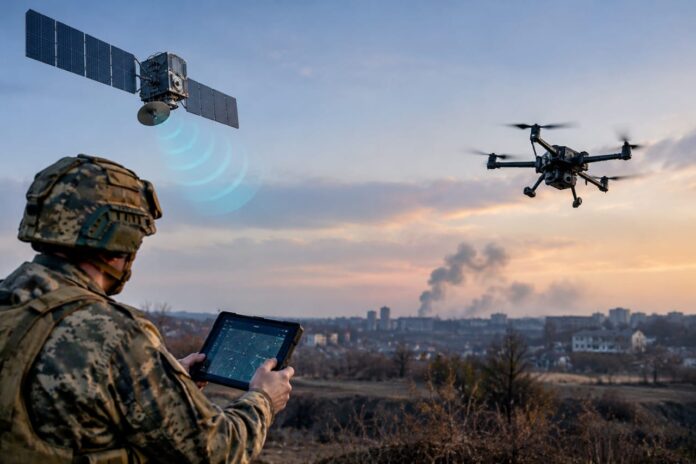
Ukraine’s military encountered persistent difficulties with its Starlink and Starshield satellite communications on Friday, despite the president’s statement the previous day that SpaceX owner Elon Musk had resolved the service interruptions. The military version of the satellite system, known as Starshield, remained functionally compromised across most of Ukraine, with connection failures occurring whenever drone operations exceeded speeds of 100 miles per hour. This technical limitation has proven particularly problematic for Ukraine’s air defense strategy.
Ukrainian President Volodymyr Zelensky acknowledged the ongoing challenges, noting that speed restrictions remained in place and full service had not been restored. He indicated that Ukraine’s government continues to anticipate that SpaceX and the Trump administration will take decisive action to remove these limitations entirely. The situation has created tension between the White House’s public messaging and the ground-level reality facing Ukrainian military operations.
- Speed restrictions limiting operations to below 100 mph remain operational as of Friday
- Starshield connection failures affect drone-based military equipment across the country
- Ukrainian President Zelensky publicly stated that service restoration has not occurred despite earlier announcements
- The service degradation began on October 14 without advance notice to Ukrainian forces
Why It Matters
The Starlink and Starshield systems represent critical infrastructure for Ukraine’s ability to coordinate its military response to ongoing Russian aggression. These satellite communications enable real-time coordination of air defense systems, drone operations, and rapid response to missile and drone attacks from Russian forces. The speed restrictions that remain in place fundamentally compromise Ukraine’s capacity to deploy interceptor drones effectively against incoming threats, undermining the nation’s defensive posture at a crucial moment in the conflict.
The technical limitations have created a situation where Ukraine’s military cannot utilize equipment that moves at high speeds—a serious constraint for modern warfare. Beyond the immediate tactical implications, the inconsistency between presidential assurances and actual operational conditions raises questions about communication between the White House, SpaceX, and Ukrainian military leadership. Resolution of these technical issues carries significant implications for Ukraine’s ability to protect civilian populations and military assets from Russian attacks.
- Restricted drone speeds directly impact Ukraine’s air defense capabilities and ability to intercept Russian missiles and drones
- Ukrainian military operations dependent on high-speed equipment coordination are significantly hampered by current limitations
- The service degradation affects Ukraine’s civilian protection infrastructure and military coordination across the entire country
- Unresolved technical issues undermine confidence in commitments made by the White House regarding support for Ukrainian defense
Political and Public Context
The Starlink situation emerged against a backdrop of complex diplomatic dynamics between the Trump administration and the Ukrainian government. President Zelensky had previously criticized the president regarding sanctions policy and energy purchases, characterizing certain decisions as reflecting weakness in approach to Russia. These political tensions preceded the service restrictions, suggesting a potential connection between diplomatic disputes and the technical limitations that followed.
Responsibility for the service slowdown has become a point of contention among the parties involved. SpaceX leadership indicated through social media that speed and usage limitations are determined by the U.S. military and ultimately by presidential authority, effectively shifting responsibility to the government. Meanwhile, the president stated Friday that he had not spoken with Musk about the restrictions but indicated willingness to engage if the issue remained unresolved. This clarification came after reporting suggested the president had contacted the SpaceX owner requesting removal of the limitations.
- Prior tensions between President Zelensky and the Trump administration regarding sanctions and energy policy preceded the Starlink restrictions
- SpaceX has attributed speed limitations to decisions made by the U.S. military and presidential authority
- The president indicated openness to direct engagement with SpaceX leadership if service restoration does not occur
- The October 14 service degradation occurred without advance notice and with unclear initial attribution
Ukraine's Starlink and Starshield back at full power after Musk-White House blame game https://t.co/7U41bihp5t pic.twitter.com/Zmn00CMNc5
— New York Post (@nypost) October 24, 2026
What Happens Next
The immediate priority involves determining whether full Starlink and Starshield service restoration will be implemented to remove speed restrictions that currently limit drone operations. Ukrainian military officials have made clear that complete restoration of service capabilities represents a necessary condition for effective defense against Russian attacks. The Trump administration has signaled that further engagement with SpaceX may occur if current conditions persist, suggesting potential intervention to resolve the technical limitations.
The resolution of this situation will likely require coordination between the White House, SpaceX leadership, and Ukrainian military officials to establish clear technical parameters and remove existing restrictions. Whether this coordination occurs through informal channels or formal diplomatic processes remains to be determined. The outcome will significantly influence Ukraine’s near-term defensive capabilities and could affect the broader relationship between the Trump administration and the Ukrainian government going forward.
- Potential direct engagement between the president and SpaceX leadership regarding full service restoration
- Ukrainian military awaits confirmation that speed restrictions will be completely removed to restore operational capacity
- Coordination between the White House, SpaceX, and Ukrainian defense officials to establish final technical parameters
- Resolution timeline remains unclear, with ongoing operational limitations affecting Ukraine’s response capabilities