

Story Highlights
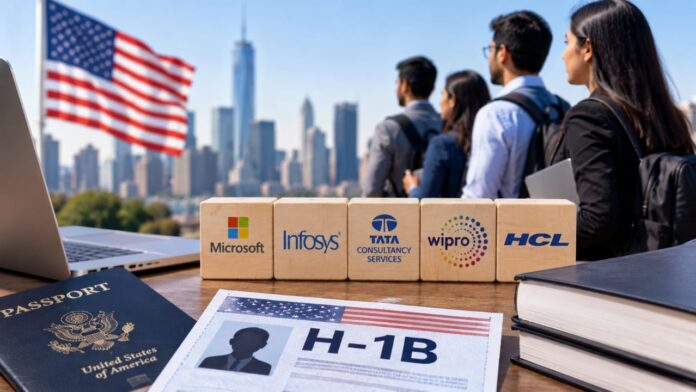
- The Trump administration suspended eight major technology firms from hiring permanent skilled international workers through the Permanent Labor Certification Program, freezing new and pending applications
- Indian workers holding H-1B visas face significant uncertainty as the pathway to green cards and permanent residency has been curtailed
- Tech companies are adapting by increasing local hiring, with firms reporting that over 80 percent of their U.S. workforces are now domestically hired
- While business impact may be minimal, the human cost remains substantial for workers caught between countries and uncertain futures
What Happened
The Trump administration announced earlier this month that it would suspend eight technology firms—including Microsoft, India’s Infosys, Tata Consultancy Services, Wipro, and HCL Technologies—from hiring skilled international workers on a permanent basis through a widely used visa pathway. The Permanent Labor Certification Program, commonly known as PERM, has been frozen for new and pending applications under this directive, targeting the primary mechanism by which Indian tech professionals have traditionally transitioned from temporary H-1B visas to permanent residency and eventual U.S. citizenship.
For millions of Indian technology professionals, the traditional career path had followed a predictable trajectory: complete an engineering degree, secure a position with a tech services firm, obtain posting to the United States, navigate repeated visa renewals, and ultimately secure the green card conferring permanent residency. This latest policy action disrupts that well-established pathway significantly. Indians hold the majority of H-1B visas, which provide temporary work authorization for specialized professionals, making this restriction particularly impactful for that population.
- Eight major tech firms suspended from PERM-based hiring: Microsoft, Infosys, Tata Consultancy Services, Wipro, HCL Technologies, and others
- PERM applications frozen for both new and pending cases under the restriction
- Indians constitute the majority of H-1B visa holders affected by this policy change
- The restriction aligns with the administration’s broader push for stricter skilled-worker immigration rules
Why It Matters
While financial analysts assess that the business impact on technology firms may prove minimal, the human and professional consequences are decidedly more profound. Nasscom, the trade association representing India’s $300 billion technology industry, has noted that Indian companies have already been reducing their dependence on H-1B visas and increasingly hiring locally. The number of employees transitioning from H-1B status to permanent residency through PERM has consequently become relatively limited within major firms.
However, this does not diminish the acute distress experienced by individuals already within the U.S. system who find themselves in limbo. A senior executive at one of the eight suspended firms explained to independent observers that while the new PERM restriction will not devastate business operations, its impact is profoundly intense at the human level. Workers who have spent years in America, invested in lives there, and built families now confront the reality that their green card applications may never advance. The difficult calculus facing these individuals involves deciding whether to remain in the United States without clear pathways to permanent status or return to India, a choice complicated by children who have grown up in America and possess limited connections to their parents’ homeland.
- Workers already in the U.S. face indefinite limbo without green card advancement through the frozen PERM process
- Families with children educated in American schools confront relocation dilemmas and potential separation
- The policy creates psychological and professional uncertainty for hundreds of thousands of skilled workers
- Financial impact on major tech firms remains limited, as PERM-linked jobs represent only a small revenue share
Political and Public Context
The administration’s restrictive immigration stance reflects a broader policy framework prioritizing the domestic labor market and favoring American workers in skilled positions. This approach represents a significant shift from prior decades when H-1B visas expanded considerably to meet technology sector demands. Vice President JD Vance has contributed to the evolving conversation surrounding H-1B policy, with remarks that have heightened concerns about the future direction of skilled-worker immigration.
The technology industry’s response demonstrates adaptive capacity within businesses. Wipro reported that more than 80 percent of its U.S. workforce comprises locally hired employees. Tata Consultancy Services disclosed that its PERM applications numbered only in single digits over the previous two years. Microsoft indicated that its H-1B visa filings were directed primarily at retaining existing staff rather than importing new international workers. Data tracking PERM applications shows dramatic declines: TCS filings fell to two applications in 2025-26 from 513 in the previous year and 1,804 two years prior, demonstrating the substantial reduction already underway before the suspension.
- Trump administration policy prioritizes domestic labor market protections and American worker preferences
- Technology companies have voluntarily reduced H-1B dependence over recent years through increased local hiring
- Vice President Vance’s statements have shaped public discourse around skilled immigration policy
- Industry data shows PERM application filings had already been declining substantially before the formal suspension
Trump's green card curbs test Indian tech workers' American dream – With immigration curbs and tech firms cutting foreign hiring, US residency is becoming a distant dream for many Indians. Via @BBC:https://t.co/XxwCEJQtUf
— 🌊💙 Viking Resistance 💙🌊 (@BlueCrewViking) October 22, 2026
What Happens Next
The technology sector will likely continue its existing trajectory of emphasizing local talent development and domestic hiring practices. Major firms have already demonstrated substantial progress in reducing their reliance on international visa pathways, suggesting that business operations will adapt without major disruption. Companies may accelerate investments in domestic talent pipelines, training programs, and recruitment from underutilized domestic labor pools.
For individual workers and their families currently navigating the immigration system, outcomes remain uncertain. The frozen PERM applications create a backlog of pending cases whose ultimate resolution depends on potential policy modifications or administrative decisions regarding the suspension. Some affected workers may choose to remain in the United States in temporary status, hoping for eventual policy changes, while others will inevitably decide to relocate to India or other countries offering clearer pathways to permanent residency. The international technology talent pool will redistribute itself based on visa availability and immigration friendliness of various nations, potentially advantaging countries actively courting skilled professionals.
- Technology companies will likely accelerate expansion of domestic hiring and talent development initiatives
- Thousands of pending PERM applications remain frozen without clear timeline for resolution or advancement
- Affected workers face decisions about remaining in the U.S. or relocating internationally
- Global competition for skilled technology talent may intensify as workers seek countries with more accessible immigration pathways
