

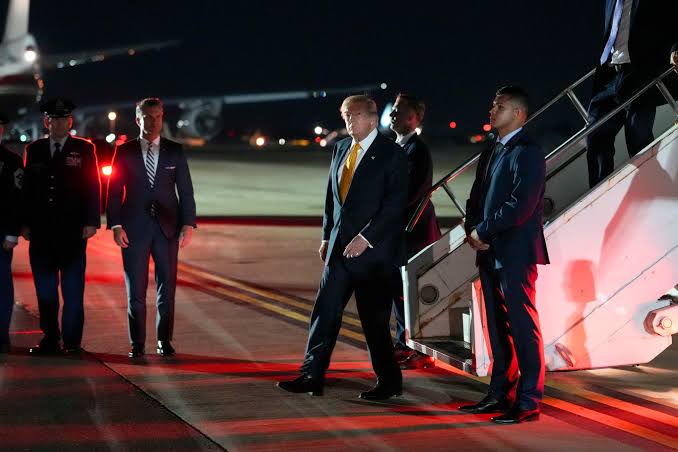
The United States military carried out its fifth straight day of airstrikes against Iran on Wednesday, targeting coastal defense systems and missile storage sites near the Strait of Hormuz as President Donald Trump signaled the campaign could soon widen dramatically. The strikes come as a fragile ceasefire reached last month has collapsed entirely, with Trump warning that power plants and bridges across Iran could be hit next if Tehran does not return to the negotiating table. Oil prices and gas prices are already climbing as the conflict enters its fifth month with no resolution in sight.
Story Highlights
- U.S. Central Command conducted two waves of strikes on Wednesday against Iranian coastal defenses and cruise missile sites near the Tunb Islands
- Trump held a Situation Room meeting and said strikes would intensify over the next three days, threatening power plants and bridges
- Iran released an American woman, identified as Dena Karari, held since December 2024, which Trump called a “gesture of Goodwill”
- Iran’s Health Ministry says more than 260 people have been injured and over 30 civilians killed in the recent strikes
What Happened
U.S. Central Command announced it launched a second wave of strikes against Iran at 3 p.m. ET on Wednesday, hours after an initial morning assault that concluded around 7:30 a.m. ET. The strikes targeted Iranian coastal defense systems and cruise missile storage and launch sites on Greater Tunb Island, a strategically located territory near the Strait of Hormuz. CENTCOM said the operations were aimed at degrading Iran’s ability to threaten commercial vessels transiting the vital oil shipping route, which has come under repeated attack in recent weeks.
President Trump convened a Situation Room meeting with his national security team on Wednesday, after telling Fox News that the military would hit Iran “hard” over the next three days. He warned that the following week could bring far more severe consequences. Trump said the United States plans to systematically destroy Iran’s power plants and bridges unless Tehran agrees to negotiate an end to the conflict. He also confirmed that officials are monitoring activity at Pickaxe Mountain, a deeply fortified underground facility believed to be linked to Iran’s nuclear program, and said American bunker-busting munitions “can go deep” enough to strike it, though he acknowledged uncertainty about whether the site is truly impervious to attack.
Trump also disclosed on Truth Social that Iran had released an American citizen, identified by human rights lawyer Jared Genser as his client, Dena Karari, a U.S.-Iranian dual national who ran a nonprofit and had been charged with espionage. Trump described the release as a “gesture of Goodwill” by Tehran, and Genser said his client was safe and traveling back to the United States. The release came even as fighting intensified elsewhere, underscoring the contradictory signals both governments have sent throughout the conflict.
According to Reuters, U.S. officials familiar with military planning said the recent strikes are also designed to degrade Iranian capabilities that would need to be eliminated before any more complex American operations could proceed, suggesting the current campaign may be laying groundwork for a broader offensive. Iran, for its part, has shown no public appetite for talks. A foreign ministry spokesperson said Wednesday that Tehran has no plans for negotiations, even as parliamentary speaker Mohammad Bagher Ghalibaf said Iran remains open to diplomatic tools alongside continued military readiness.
Why It Matters
The escalating conflict represents one of the most consequential military commitments of Trump’s second term, now stretching into its fifth month with no clear endpoint. What began as a limited campaign has evolved into sustained, multi-wave daily strikes, raising the stakes for American service members, regional allies, and global energy markets alike. The administration’s willingness to openly discuss targeting Iran’s power grid and transportation infrastructure marks a significant escalation in both rhetoric and apparent intent, moving beyond military targets toward broader economic infrastructure.
For American consumers, the conflict is already translating into higher costs at the pump. Gas prices have risen ten cents over the past week to $3.89 a gallon nationally, according to AAA data, as the Strait of Hormuz, through which roughly a fifth of global oil supply passes, remains contested. Continued instability in the region threatens further price increases that would ripple through the broader economy, complicating the Federal Reserve’s efforts to manage inflation.
The political risks are also substantial. Trump’s own coalition includes vocal skeptics of continued Middle East military involvement, and his administration faces a difficult balancing act between demonstrating strength against Iran and avoiding the kind of open-ended conflict that has proven politically costly for past presidents. Analysts caution that the current trajectory carries real risk of what some have termed a “forever war,” with no negotiated settlement in sight and both sides continuing to trade strikes.
Economic and Global Context
Global oil markets have responded to the escalation with sustained price pressure. Brent crude futures held above $85 per barrel as of Wednesday morning, reflecting persistent concern about safe passage through the Strait of Hormuz. Shipping industry officials describe the situation as increasingly difficult to navigate, citing the unpredictable, rapidly shifting nature of the conflict as a major complicating factor for commercial vessel operators trying to plan safe routes.
The blockade dynamics have grown more complex as well. U.S. forces disabled an empty oil tanker sailing toward Kharg Island, an economic lifeline for Iran’s oil exports, further tightening pressure on Tehran’s ability to generate revenue through crude sales. Trump has said he ordered the military to avoid striking Iran’s oil facilities directly during earlier operations, but has left open the possibility of seizing Kharg Island entirely if Iran does not change course.
International reaction has been cautious. Iranian Foreign Minister Abbas Araghchi traveled to Doha this week, though it remains unclear whether his visit included any discussion of restoring peace talks. The broader international community, including European allies and Gulf states, has largely avoided direct intervention, wary of being drawn into a widening conflict that could destabilize the broader region.
Implications
In the near term, expect the military campaign to continue expanding in scope, with Trump having explicitly signaled that Iranian power infrastructure and bridges are the next likely targets. Iran’s response will be closely watched, both militarily and diplomatically, as its officials continue to project a combat-ready posture while leaving a narrow door open to negotiation.
For American policymakers, sustained congressional oversight is likely, particularly given Trump’s formal notification to Congress of the conflict’s resumption. Questions about war powers authority and the scope of executive military action without a formal declaration of war are likely to intensify as the conflict continues without resolution.
For global markets and American consumers, continued volatility in oil prices should be expected as long as the Strait of Hormuz remains a contested zone. Businesses reliant on stable energy costs, along with everyday consumers facing rising gas prices, will bear much of the near-term economic burden of continued escalation.
Sources
“Trump says Iran wants to meet as U.S. fires more strikes; analysts warn of ‘forever war’ risk”
