

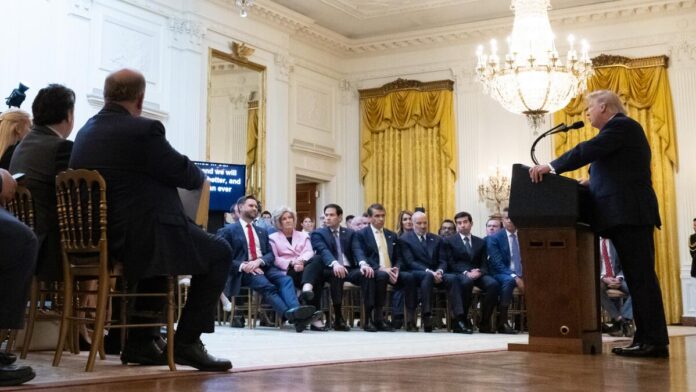
President Trump used a rare primetime address from the White House to cast doubt on the security of American elections, reviving unproven claims about his 2020 loss just months before the November midterms. Democrats immediately accused him of laying groundwork to challenge results if Republicans lose control of Congress, while the administration insisted the speech was about protecting future elections rather than relitigating the past. The address has intensified an already tense national debate over voting rules heading into a consequential election cycle.
Story Highlights
- Trump’s Thursday primetime speech focused on alleged vulnerabilities in the U.S. election system and renewed disputed claims about the 2020 election
- The administration released newly declassified documents, though officials confirmed none showed evidence that past vote counts were altered by fraud or foreign interference
- Democrats say the speech is designed to sow doubt ahead of the 2026 midterms, where Trump’s party faces the possibility of losing its congressional majorities
What Happened
President Donald Trump delivered a primetime address to the nation on Thursday evening, using the high-profile format typically reserved for major national moments to focus on what he described as catastrophic weaknesses in America’s election system. Trump opened with sharp rhetoric, claiming the country’s election security “falls catastrophically short,” and used the speech to rally support for a stalled federal elections overhaul bill that has been a longtime priority for the administration.
The address came as Trump has escalated calls for Republicans in Congress to pass tighter federal voting rules ahead of November’s midterm elections, where his party faces the possibility of losing either the House or the Senate. During the speech, the White House unveiled a set of newly declassified documents intended to bolster the president’s claims. However, officials confirmed afterward that none of the new material demonstrated that any previous election outcome, including the 2020 presidential race that Trump lost to Joe Biden, was directly affected by fraud or foreign interference.
Trump attempted to frame election security as a unifying rather than partisan issue, saying at one point that it “should cause to unite us, not to divide us.” He also alleged that China and unspecified “deep state” actors had misled American voters, claims that independent fact-checkers and Democratic lawmakers quickly disputed as misleading or unsupported by evidence presented.
Democratic reaction was swift and pointed. Representative Joseph Morelle of New York, the ranking Democrat on the House committee that oversees federal elections, said the speech was “a pretext for the president” to call the legitimacy of the 2026 elections into dispute, adding that current American elections are secure. Senator Chris Coons of Delaware told CNN he heard no concrete allegations that foreign actors had actually changed the outcome of any American election, despite the administration’s declassified document release. Representative Jason Crow of Colorado went further, accusing Trump of continuing “to lie, distort the truth to try to sow doubt and suppress the 2026 election.”
The speech notably came at a moment when polling shows voters are more concerned with the cost of living, the ongoing military escalation with Iran, and controversy surrounding aggressive immigration enforcement tactics than with election administration, a disconnect that some Republican strategists have acknowledged privately even as they publicly defended the president’s message.
Why It Matters
The speech represents a significant test of how a sitting president can use the institutional weight of a primetime address, historically reserved for genuine national milestones, to advance a contested political narrative. Critics argue this normalizes using the presidency’s biggest communication platform for messaging that a large portion of the electorate views as fundamentally distorting rather than informing.
For the midterm elections themselves, the speech raises the stakes around any future disputes over results. Trump’s history of refusing to accept his 2020 defeat culminated in the January 6, 2021 attack on the Capitol, and Democrats argue this address functions as an early attempt to prime supporters to distrust any unfavorable outcome in November. That dynamic could affect how closely contested races are litigated after election day, particularly in states with narrow margins.
The push for a federal elections overhaul also carries substantive policy consequences beyond the rhetoric. Stricter federal voting requirements could affect ballot access for millions of Americans, particularly those who rely on mail voting or same-day registration in states that currently allow it. How Congress responds to Trump’s renewed pressure campaign will shape the practical voting experience for the midterms and beyond.
The speech also illustrates a broader challenge for the Republican Party heading into November: whether to fully embrace the president’s election framing or to focus midterm messaging on economic and policy achievements instead. Republican strategist Scott Jennings noted that Trump has recently shifted toward acting as the party’s “salesman,” reasserting control over campaign messaging after a year focused heavily on foreign policy.
Economic and Global Context
While the speech centered on domestic election administration, it landed against a backdrop of significant economic anxiety that Democrats argue better reflects voters’ actual priorities. Persistent concerns about the cost of living, including the effects of the administration’s expansive tariff program, have remained a dominant theme in polling throughout the summer, and some Republican officials worry that a prolonged focus on election security distracts from an economic message they believe would be more persuasive to swing voters.
Internationally, the speech’s claims about foreign interference, particularly regarding China, carry diplomatic implications at a moment when U.S.-China relations are already strained over trade and tariff disputes. Beijing has not directly responded to the specific allegations raised in the address, but Chinese state media have previously dismissed similar claims from the administration as unfounded political theater.
Trump’s fundraising posture heading into the midterms adds another dimension to the electoral picture. The president has said his campaign operation raised over 600 million dollars in the three weeks following his 2024 victory,資source he has said he intends to deploy heavily on behalf of congressional candidates, giving Republicans a substantial financial advantage regardless of how the election security debate unfolds.
Historical trends complicate the picture further. Data compiled by the Brookings Institution shows that the president’s party has typically lost congressional seats during midterm elections, a pattern Trump referenced himself, telling Republican governors there is “some deep psychological thing” that works against the incumbent party even after a presidential win.
Implications
In the coming weeks, expect the administration to continue pushing its federal elections legislation through Congress, though its prospects remain uncertain given the narrow Republican majorities in both chambers and the bill’s contested provisions. Democrats are likely to use the speech as a rallying point in fundraising and voter mobilization efforts, framing it as evidence that Republicans intend to contest unfavorable results in November.
State election officials, both Republican and Democratic, will face pressure to respond publicly to the speech’s claims, particularly in swing states where election administration has already become a politically charged issue. Some secretaries of state have indicated they plan to proactively reassure voters about the integrity of existing safeguards regardless of the rhetoric coming from Washington.
For voters, the practical effect may be further erosion of trust in the electoral process itself, regardless of which party ultimately performs better in November. Polling organizations will likely track whether the speech shifts public confidence in election security, and by how much, among both Trump’s base and swing voters.
Congressional Republicans, meanwhile, must decide how closely to align with the president’s framing as they craft their own midterm messaging, a decision that could shape the party’s overall strategy and its ability to focus on economic issues where it may hold a stronger advantage with undecided voters.
Sources