

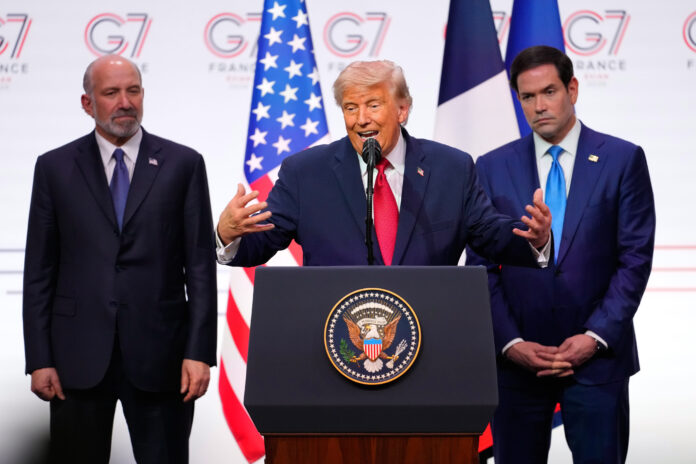
Story Highlights
- President Donald Trump signed a U.S.-Iran memorandum of understanding during the G7 summit in France.
- The agreement creates a 60-day window for a broader settlement while reopening the Strait of Hormuz.
- Trump warned that U.S. military action could quickly return if Iran fails to follow through.
What Happened
President Donald Trump used the closing stretch of the G7 summit in France to defend a new U.S.-Iran memorandum of understanding, presenting it as a breakthrough after months of conflict, economic pressure and uncertainty over the Strait of Hormuz.
The agreement is not being described as a final treaty. Instead, it sets up a 60-day period for negotiators to work toward a more complete settlement while keeping pressure on Iran to comply with the core terms.
- The memorandum includes a temporary ceasefire framework.
- It calls for maritime traffic through the Strait of Hormuz to resume.
- It leaves several major nuclear and sanctions questions for follow-up talks.
Trump said the deal gives the United States a chance to secure peace without giving up leverage. At the same time, he made clear that he does not view the memorandum as a blank check for Iran.
Speaking to reporters, Trump warned that if Iran does not honor the agreement or tries to change the terms, the United States could return to military action. The message was direct: diplomacy is open, but enforcement remains on the table.
Why It Matters
The memorandum gives Trump a major foreign policy moment at a time when energy prices, Middle East stability and U.S. military involvement have become central political issues.
For the White House, the deal allows Trump to argue that his pressure campaign forced Iran back into a framework that protects U.S. interests while giving the region a chance to de-escalate.
For critics, the biggest concern is that the memorandum may not go far enough on Iran’s nuclear program, missile activity or regional influence. Some lawmakers have warned that a temporary agreement could give Iran room to regroup if stronger terms are not secured within the 60-day window.
- Supporters see the agreement as a practical step toward ending a costly conflict.
- Critics say the administration must prove the deal has real enforcement power.
- Markets are watching closely because the Strait of Hormuz remains critical to global oil flows.
Political and Public Context
Trump’s approach fits his broader second-term foreign policy style: direct pressure, personal diplomacy and a willingness to threaten force while negotiating.
The president’s warning about a return to bombing was meant to reassure supporters that the deal is not a retreat. Instead, Trump framed it as a conditional pause that gives Iran one clear choice: comply or face consequences.
At the G7, allied leaders broadly welcomed the effort to reduce tensions, especially because instability around the Strait of Hormuz had already affected oil prices, shipping costs and global supply chains.
Domestically, the deal is likely to split Washington. Some Republicans may praise Trump for reopening a path to peace while maintaining a hard line. Others may demand stronger guarantees before accepting any sanctions relief or long-term diplomatic arrangement with Tehran.
What Happens Next
The next 60 days will decide whether the memorandum becomes the foundation for a larger agreement or collapses into another round of confrontation.
Negotiators are expected to focus on Iran’s nuclear commitments, sanctions relief, shipping security, regional military activity and the long-term status of the Strait of Hormuz.
If the talks succeed, Trump will likely present the agreement as one of the biggest foreign policy achievements of his second term. If they fail, the president has already signaled that the U.S. military option remains active.
- Iran must show it is honoring the ceasefire and maritime terms.
- The U.S. must decide how much sanctions relief is tied to compliance.
- G7 allies will keep pressure on both sides to turn the memorandum into a durable deal.
