

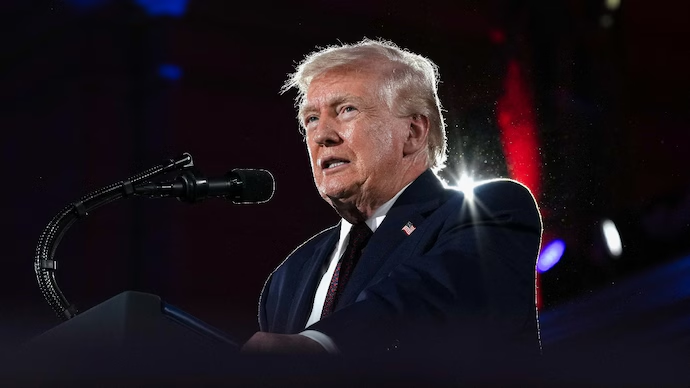
Story Highlights
- Trump says U.S. could end the Iran conflict within weeks
- Points to successful military objectives already achieved
- Signals a shift toward closure and regional stabilization
What Happened
Donald Trump stated that the ongoing conflict involving Iran could come to an end within the next two to three weeks. He indicated that U.S. military operations have already achieved key objectives, reducing Iran’s ability to continue sustained engagement. His comments suggest that the current phase of the conflict is moving toward conclusion rather than escalation.
According to his remarks, recent actions have focused on strategic targets that limit operational capacity without extending into a prolonged ground conflict. This approach reflects a controlled use of military force aimed at achieving clear outcomes within a short timeframe. While official timelines have not been formally confirmed by defense agencies, Trump’s statement presents a confident outlook on the situation.
The announcement comes at a time when global attention is focused on the Middle East due to rising tensions and economic impact. By suggesting a defined timeline, Trump introduces a sense of direction to what has otherwise been a fluid and uncertain situation.
Why It Matters
A potential end to the conflict within weeks carries significant implications for global stability. The Middle East plays a critical role in energy supply, and any disruption in the region directly affects oil prices and international markets. If the situation stabilizes quickly, it could ease pressure on fuel costs and improve economic confidence worldwide.
The statement also reflects a broader approach to conflict management. Instead of long-term involvement, the strategy appears focused on rapid, targeted actions designed to achieve specific goals. This model may influence how future military engagements are planned and executed, especially in regions where prolonged conflict carries high costs.
Additionally, clear communication about timelines can shape public perception and investor behavior. Markets often react not only to events but also to expectations. A defined path toward resolution can reduce uncertainty and support stability across financial systems.
Political and Geopolitical Impact
Politically, Trump’s remarks reinforce a leadership image centered on decisive action and time-bound results. This approach may appeal to audiences who prefer strong national defense combined with limited long-term military involvement. It positions the situation as controlled and outcome-focused rather than open-ended.
At the geopolitical level, the possibility of a near-term resolution may influence how other countries respond. Allies may view this as a sign of stability and coordination, while regional players may adjust their strategies based on expected de-escalation. It also creates space for diplomatic efforts to follow military actions, potentially leading to longer-term agreements.
However, without formal confirmation from multiple sources, some uncertainty remains. Governments and analysts will likely monitor developments closely before adjusting policies or expectations.
Implications
If the conflict concludes within the suggested timeframe, the immediate effect would likely be reduced geopolitical tension and improved economic stability. Energy markets could stabilize, and global trade routes may return to normal conditions. In the longer term, this situation may strengthen a model of short-duration, high-impact conflict management combined with strategic communication. However, until clear outcomes are confirmed, the situation remains subject to change.
Sources
“Trump says U.S. could end war in Iran in two to three weeks”
