

Story Highlights
- President Donald Trump says the Qatar-provided Boeing 747-8 will undergo another month of security modifications
- The aircraft serves as a temporary solution while Boeing’s purpose-built Air Force One replacements remain years behind schedule
- The president says the jet already has substantial capabilities but will return with its security systems “maxed out”
What Happened
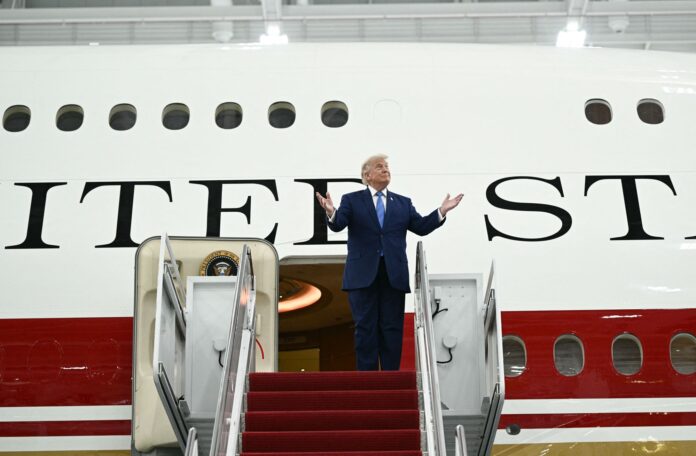
President Donald Trump confirmed that the Boeing 747-8 provided by Qatar will temporarily leave presidential service for an additional round of security upgrades.
Speaking to reporters at Joint Base Andrews, the president said the aircraft already possesses considerable capabilities but will be sent away in approximately one month for further work. He said the modification process should take about another month and leave the aircraft “maxed out.”
The announcement followed questions about whether the temporary presidential aircraft contains defensive systems comparable to those installed on the older planes traditionally used as Air Force One.
- The latest work is expected to strengthen defensive countermeasures
- The older presidential fleet will remain available during the modification period
- The Qatar-provided jet is not intended to replace the permanent Air Force One program
The aircraft was accepted by the United States and converted on an accelerated timetable as a temporary answer to Boeing’s repeated delays in completing two purpose-built presidential planes.
The permanent replacement program is based on two Boeing 747-8 aircraft and carries a reported contract value of approximately $3.9 billion. Delivery is now expected around the middle of 2028, roughly four years behind the previously anticipated timetable.
Why It Matters
The controversy highlights a larger government-procurement problem that existed before the Qatar aircraft entered the presidential fleet. Boeing’s inability to deliver the permanent replacements on schedule left the government choosing between continued reliance on aging aircraft and developing a temporary alternative.
The administration chose the second option. Supporters can argue that obtaining an available Boeing 747-8 gave the country a newer platform that could be converted for presidential use while the official program remained delayed.
The decision to order further upgrades also shows that the White House is treating the aircraft as a continuing defense project rather than assuming its initial conversion settled every security requirement.
- Presidential transportation must support secure military communications
- The aircraft must defend against missiles, surveillance and electronic interference
- Protective systems must remain effective during periods of heightened international tension
The need for additional modifications nevertheless raises questions about the accelerated original timetable. Lawmakers may ask which capabilities were installed before the aircraft entered service, which remain unfinished and who approved its initial presidential use.
Those questions do not erase the central role of Boeing’s delays. Had the permanent replacement aircraft arrived on schedule, the government would have faced far less pressure to create an interim solution.
Political and Public Context
The Qatar arrangement has drawn political criticism because of the aircraft’s value and the unusual circumstances of receiving such a major asset from a foreign government.
Critics have raised ethical, constitutional and counterintelligence concerns. They argue that even a gift transferred for government use can create questions about foreign influence and the security of equipment installed aboard the aircraft.
The administration’s strongest defense is practical: the United States needed a temporary aircraft because the official replacement program continued falling behind schedule. Rather than waiting several more years while relying exclusively on older jets, the president supported converting a newer available plane.
- The White House can present the aircraft as a stopgap created by procurement failures
- The latest upgrade demonstrates responsiveness to protective-security concerns
- Congress may investigate both the foreign gift and Boeing’s delayed contract
The disclosure also comes during heightened tensions with Iran, making presidential security an immediate operational concern rather than a theoretical debate about future aircraft capabilities.
The administration will therefore need to demonstrate that protective agencies—not political or ceremonial considerations—determine when the plane flies and when additional security work is required.
What Happens Next
The Qatar-provided aircraft is expected to be removed from active service for approximately one month while contractors install and test additional security equipment.
During that period, the president will likely rely on the older Boeing 747-200B aircraft that have carried American presidents for more than three decades.
- Defense and protective officials will test the newly installed systems
- Congress may request cost, procurement and security briefings
- Boeing will remain under pressure to prevent further delays to the permanent fleet
The aircraft’s return to regular service should depend on approval from the military, the Secret Service and other agencies responsible for presidential protection.
The longer-term solution remains the delivery of the two purpose-built Air Force One aircraft. Until that happens, the administration will continue balancing the capabilities of the aging fleet against the advantages and limitations of its newer temporary aircraft.
Sources
