

Story Highlights
- President Donald Trump attended the rescheduled White House Correspondents’ Association dinner three months after a shooting forced its postponement.
- The president opened by declaring that America would not yield to political violence before delivering an hour-long address.
- Enhanced security, a smaller guest list and stricter access procedures shaped the event at Washington’s Waldorf Astoria.
- His decision to attend marked a notable change after he skipped the traditional press gathering throughout his first term.
What Happened
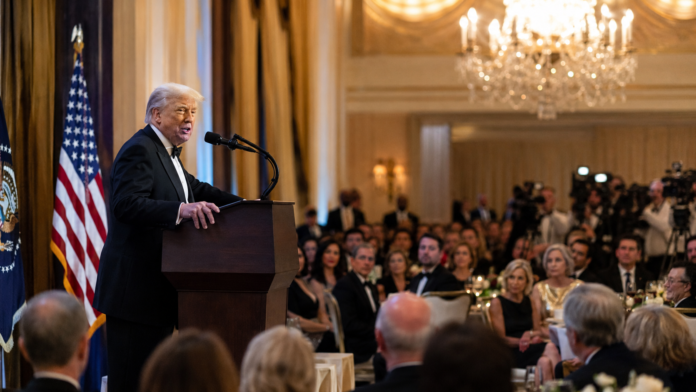
President Donald Trump returned to the White House Correspondents’ Association dinner Friday night, delivering an hour-long speech at an event postponed after an armed attacker disrupted the original gathering in April.
The rescheduled dinner was held at the Waldorf Astoria in Washington, formerly the Trump International Hotel, under substantially tighter security and with fewer guests than originally planned.
The president used his opening remarks to directly confront the violence that had prevented the first event from proceeding.
“In America, we do not yield to political violence,” he told the audience before shifting into the political humour, media criticism and self-deprecating remarks traditionally associated with the dinner.
He also revealed that he had discarded a more aggressive speech prepared for April, describing the original version as “a doozy.”
The event represented his first address as president to the annual correspondents’ dinner. First Lady Melania Trump, Vice President JD Vance and Secretary of State Marco Rubio did not attend the rescheduled gathering.
Over the course of the evening, the president targeted political opponents, television personalities and journalists while also joking about his political future and long association with the hotel.
Some remarks received muted reactions from the press-heavy audience, a response he occasionally acknowledged from the stage rather than attempting to hide.
Why It Matters
The president’s appearance carried greater significance than an ordinary political dinner because the original event had been halted by an act of violence.
Returning to the venue allowed the White House to present the gathering as a demonstration that threats would not prevent the administration, journalists or invited guests from participating in a longstanding Washington tradition.
His attendance also reflected a more direct approach to confronting the media.
During his first term, the president regularly skipped the correspondents’ dinner amid hostile relations with major news organisations. This time, he entered a room filled with reporters, criticised them directly and accepted that many would respond coolly.
- The event demonstrated continuity after an unprecedented security disruption.
- The White House used the evening to condemn political violence before a national audience.
- The president engaged directly with journalists despite continuing disputes over coverage and media credibility.
The evening did not erase the tense relationship between the administration and the press corps. However, it showed that both sides remain willing to participate in a shared public forum despite deep political and institutional disagreements.
Economic and Political Context
The correspondents’ dinner has limited direct economic importance, but it remains closely connected to the rapidly changing American media industry.
Traditional news organisations continue to face declining revenue, corporate consolidation, staffing cuts and disputes over editorial independence. The president referenced some of those changes while discussing television networks and prominent journalists during his remarks.
His criticism fits within a broader administration argument that major media outlets have become politically aligned institutions rather than neutral observers.
Journalists and press-freedom organisations counter that aggressive coverage, including criticism of the White House, is a necessary part of holding elected leaders accountable.
The event therefore brought together two competing views of the press: one portraying reporters as an essential democratic institution and another portraying many outlets as partisan organisations resistant to the president’s agenda.
The smaller attendance and heightened security also reflected a wider political environment in which public officials, campaign events and high-profile gatherings increasingly require stronger protective measures.
What Happens Next
The White House Correspondents’ Association is expected to review the security procedures used for the rescheduled gathering as it begins planning future events.
Organisers will likely examine venue access, guest screening and emergency-response arrangements following the attempted April attack.
The administration’s relationship with individual news organisations will continue to be shaped outside the dinner through press access disputes, lawsuits, interviews and daily briefing-room exchanges.
For the president, the event provided an opportunity to condemn political violence, confront his media critics in person and demonstrate that he would participate on his own terms.
The mixed response to his jokes may dominate immediate commentary, but the broader significance was his willingness to return after a violent disruption and address an audience that has frequently opposed his administration.
Sources
Trump Condemns Violence, Slams Press at White House Correspondents’ Dinner
