

Story Highlights
- The Supreme Court sided 6-3 with the Trump administration in a green card immigration case.
- The ruling gives immigration officers broader discretion when returning lawful permanent residents face certain criminal accusations.
- Justice Ketanji Brown Jackson dissented, warning the decision gives the government too much power over green card holders.
What Happened
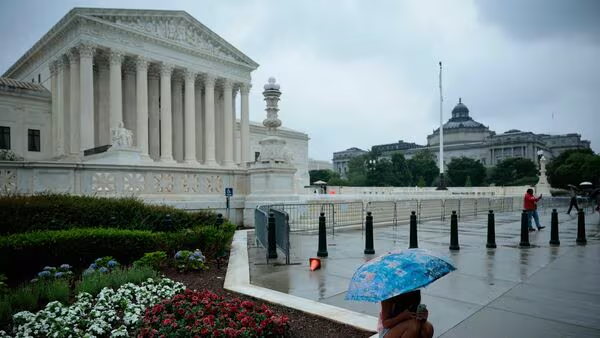
The Supreme Court handed the Trump administration a major immigration victory in a case involving the rights of green card holders returning to the United States.
The case, Blanche v. Lau, centered on Muk Choi Lau, a Chinese national who became a lawful permanent resident in 2007.
Lau was arrested in New Jersey in 2012 on counterfeiting charges involving nearly $300,000 worth of goods.
- Lau briefly left the United States while the charge was pending.
- When he returned through John F. Kennedy International Airport, immigration officers did not grant him standard admission.
- Instead, they placed him on immigration parole, making him subject to removal proceedings.
Lau argued that officers needed “clear and convincing evidence” that he had committed a disqualifying crime before treating him that way.
The 2nd U.S. Circuit Court of Appeals agreed with him.
The Supreme Court reversed that decision.
Writing for the majority, Justice Clarence Thomas said border officers did not have to meet that higher evidentiary standard before placing Lau on parole rather than admitting him as a returning lawful permanent resident.
Justice Ketanji Brown Jackson dissented, joined by the court’s two other liberal justices.
She warned that the ruling could leave green card holders in “immigration limbo” based on unresolved accusations.
Why It Matters
The ruling matters because millions of lawful permanent residents travel outside the United States each year for work, family and personal reasons.
The decision gives immigration officers more room to act when a returning green card holder has been accused of a crime that could trigger inadmissibility or removal.
Supporters of the ruling say it helps the government enforce immigration law and protect the integrity of permanent residency.
- The government gains more discretion at ports of entry.
- Green card holders with pending criminal cases may face greater travel risk.
- Immigration lawyers are likely to advise more caution before international travel.
The ruling does not mean every arrest automatically leads to deportation.
Removal still requires a legal process, and the government must prove its case in immigration court.
But the decision changes the front-end threshold at the border.
That is why immigration attorneys view the case as significant.
It confirms that officers can treat some returning permanent residents more like applicants for admission when certain criminal issues are present.
Political and Public Context
The case originated years before Trump returned to office, but the ruling arrives during a major immigration enforcement push by his administration.
Trump has argued that immigration officers need stronger tools to remove noncitizens who violate U.S. law.
This decision gives his administration another Supreme Court win on executive immigration authority.
- The Court’s conservative majority sided with the administration.
- The ruling fits a broader pattern of deference to immigration enforcement power.
- Advocacy groups are expected to monitor how DHS applies the decision.
Reuters described the ruling as part of a broader Supreme Court trend supporting Trump’s restrictive immigration agenda, including decisions tied to temporary protections, asylum rules and enforcement discretion. ([reuters.com](https://www.reuters.com/legal/government/immigration-supreme-court-accedes-trumps-restrictive-agenda-2026-06-26/))
For Republicans, the ruling reinforces Trump’s argument that his administration is restoring control over immigration law.
For Democrats and immigrant-rights groups, the concern is that lawful permanent residents may now face harsher treatment based on accusations before a final criminal conviction.
The political fight will likely center on whether the ruling is framed as public safety enforcement or as a weakening of green card protections.
What Happens Next
The immediate impact will be felt at airports, land crossings and other ports of entry.
Customs and immigration officers may rely on the ruling when deciding how to handle returning green card holders with pending criminal charges or suspected disqualifying conduct.
Immigration lawyers are likely to warn clients with unresolved criminal matters to avoid international travel unless they receive legal advice first.
- Watch whether DHS issues new guidance after the ruling.
- Monitor whether more green card holders are placed on parole after travel.
- Follow advocacy-group challenges if the policy is applied broadly.
- Track how the Court rules in other pending Trump immigration cases.
The ruling may also influence other immigration disputes before the Court.
The administration is still defending major policies involving birthright citizenship, asylum limits and temporary legal protections for migrants from several countries.
For Trump, the decision strengthens his legal footing on immigration enforcement.
For green card holders, it creates a clearer warning: pending criminal accusations can carry immigration consequences even before a conviction.
For Congress, the decision may trigger calls to clarify the evidentiary standard for returning lawful permanent residents, though any legislative fix would face difficult odds in the current political environment.
