

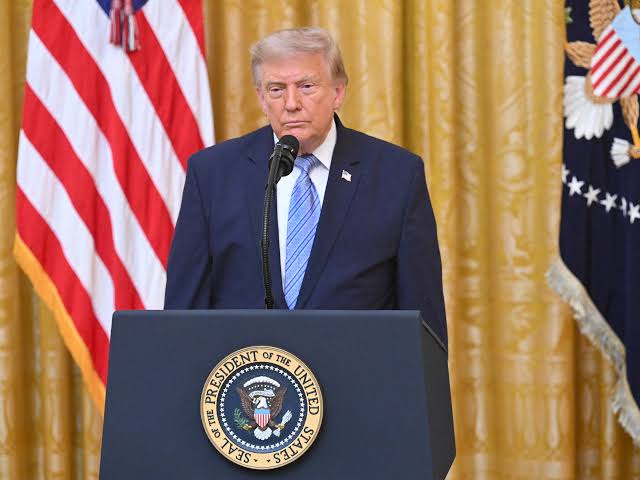
President Donald Trump used a rare primetime address from the White House on Thursday night to allege that Chinese operatives compromised American election data in 2020 and that “deep state” officials covered it up. The speech, billed in advance by the White House as containing “really big news,” offered few new facts but revived Trump’s long-standing claims about the integrity of the 2020 election just months before the November midterms. Democrats immediately accused the president of trying to undermine confidence in the electoral system ahead of a pivotal vote.
Story Highlights
- Trump claimed China acquired 220 million U.S. voter files and accused “deep state” officials of concealing the effort
- The president called for reopening an FBI probe into a Michigan voter registration case and urged passage of the SAVE America Act
- Major broadcasters including ABC, NBC and CNN declined to air the full speech live, and fact-checkers disputed several of Trump’s central claims
What Happened
Speaking from the East Room on Thursday evening, Trump delivered what the White House described as a major address on “election integrity.” He opened with a review of his administration’s accomplishments before pivoting to allegations that the People’s Republic of China carried out what he called the largest compromise of election data in American history during the 2020 cycle. Trump said Beijing obtained voter files from 18 states through means he described as “bought, stolen or hacked,” though he stopped short of claiming the data had been used to alter any election outcome.
The president also revived his familiar narrative of a “deep state” conspiracy, alleging that unnamed officials in his first administration withheld information about the Chinese effort from his daily intelligence briefings. He said he had directed law enforcement officials to pursue firings and potential criminal charges against those responsible. Press secretary Karoline Leavitt had previewed the speech to reporters as one that would “shock” the public, and Trump himself had teased it earlier in the week as containing major disclosures.
A separate portion of the address focused on a years-old voter registration case in Michigan, which Trump characterized as a significant instance of fraud despite the fact that state and federal investigators, including the FBI, found no evidence the forms in question affected the 2020 outcome. Trump said he was ordering the FBI to reopen that inquiry. He closed his remarks with a direct appeal to Congress to pass the SAVE America Act, legislation that would impose stricter voter identification requirements, including proof-of-citizenship documentation such as birth certificates or passports.
China’s embassy in Washington issued a swift denial, saying the country has never interfered in U.S. presidential elections. Independent fact-checkers, including those affiliated with PolitiFact, noted that much of the voter data Trump referenced is already publicly available or sold by state governments, and that a declassified 2021 intelligence assessment found China ultimately decided against launching a broad influence campaign in 2020. House Democratic Leader Hakeem Jeffries dismissed the speech as a political distraction, while Colorado Representative Jason Crow accused Trump of trying to suppress turnout ahead of the midterms.
Why It Matters
The timing of the speech, delivered less than four months before Americans vote in the 2026 midterm elections, carries significant political weight. Control of the House and Senate hangs in the balance, and any effort by a sitting president to cast doubt on the mechanics of voting has the potential to shape turnout, particularly among voters already skeptical of election administration. Public trust in elections is a foundational element of American democratic governance, and repeated assertions of fraud without conclusive evidence can erode that trust regardless of their factual basis.
The renewed push for the SAVE America Act also has direct policy consequences. Stricter documentary proof-of-citizenship requirements have been championed by Republicans as a safeguard against noncitizen voting, which is already illegal and exceedingly rare, according to numerous state and federal studies. Voting rights organizations argue such requirements could disenfranchise citizens who lack ready access to a passport or birth certificate, including some elderly voters, low-income Americans and married women who have changed their names.
The decision by several major broadcast networks not to carry the speech live on their main channels also raises broader questions about how media organizations navigate presidential communications that contain disputed claims. Trump’s call for regulatory action against networks that declined to air the address touches on press freedom concerns that extend well beyond this single speech.
Economic and Global Context
While the speech itself was not primarily economic in focus, it arrives amid a backdrop of intensifying domestic political battles that have market-watchers monitoring Washington closely. Analysts have noted that heightened political uncertainty ahead of midterm elections can weigh on investor sentiment, particularly when it intersects with disputes over the legitimacy of democratic institutions. Credit rating agencies have periodically flagged political instability as a risk factor in broader assessments of U.S. governance.
Internationally, the speech’s direct accusations against China add another layer of friction to an already strained U.S.-China relationship, which has been shaped by tariff disputes, technology restrictions and competing claims over election interference. Beijing’s rejection of Trump’s allegations is consistent with its standard posture on such accusations, but the renewed rhetoric could complicate any ongoing trade or diplomatic negotiations between the two governments.
Election-security experts internationally have also weighed in, noting that the United States’ decentralized election system, administered separately by thousands of state and local jurisdictions, has long been cited by U.S. intelligence agencies as a structural safeguard against large-scale foreign manipulation, a point that runs counter to some of the vulnerabilities Trump described in his address.
Implications
In the coming weeks, expect the SAVE America Act to become a central flashpoint in Congress, with Republicans pushing for a vote and Democrats mounting unified opposition. Voting rights groups are likely to file legal challenges if the legislation advances, setting up potential court battles before the midterms. State election officials, both Republican and Democratic, may face renewed pressure to publicly defend the security of their voting systems.
For voters, the speech signals that election integrity will remain a dominant campaign theme through November, with Trump and Republican candidates likely to continue invoking the narrative of foreign interference and internal cover-ups. Democratic candidates, in turn, are expected to use the speech as a rallying point, framing it as evidence of an effort to delegitimize future results.
For federal law enforcement, the president’s directive to reopen the Michigan investigation and pursue potential charges tied to the alleged China cover-up will test the independence of agencies like the FBI and Justice Department, both of which have faced scrutiny over politicization in recent years. How those agencies respond will be closely watched by lawmakers on both sides of the aisle.
Sources
“Key takeaways from Donald Trump’s controversial speech on election security”
