

Story Highlights
- Four advanced-nuclear companies achieved reactor criticality before President Donald Trump’s July 4 deadline.
- The administration originally directed the Energy Department to help at least three pilot reactors reach the milestone.
- The achievement supports a White House goal of expanding U.S. nuclear capacity from approximately 100 to 400 gigawatts by 2050.
- Critics continue questioning whether faster approvals could weaken regulatory oversight and opportunities for public input.
What Happened
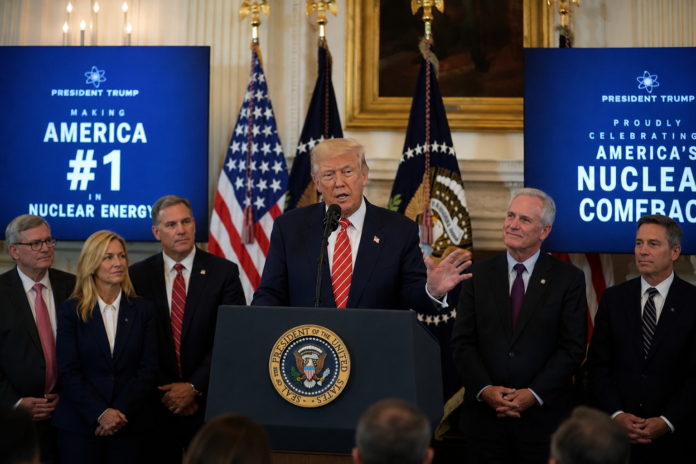
President Donald Trump welcomed nuclear-industry executives to the White House after four companies successfully brought experimental reactors to criticality before a July 4 deadline established by his administration.
Reactor criticality occurs when a nuclear chain reaction becomes self-sustaining. It is an important technical milestone, although it does not necessarily mean a reactor is ready to begin supplying commercial electricity.
The companies identified as Antares, Deployable Energy, Aalo and Valar completed the milestone through a Department of Energy pilot programme. The administration had initially sought at least three successful reactors, meaning the participating companies exceeded the stated target.
The initiative followed four executive orders signed in May 2025 to accelerate the development, testing and licensing of advanced nuclear technology.
Those directives instructed federal agencies to streamline approval processes, establish clearer licensing deadlines and support the deployment of small and modular reactors capable of being developed more quickly than conventional nuclear plants.
Aalo reportedly reached criticality during the early hours of July 4, completing the programme’s fourth successful demonstration before the deadline expired.
The president celebrated the result alongside Energy Secretary Chris Wright, Interior Secretary Doug Burgum and executives from the participating companies.
The White House presented the achievement as evidence that ambitious deadlines and regulatory reform can restore momentum to an American nuclear industry that has struggled with slow construction, high costs and limited new-reactor deployment.
Why It Matters
The milestone gives the administration a measurable result from its effort to revive domestic nuclear development.
For decades, large American nuclear projects have frequently faced lengthy licensing processes, construction delays and escalating costs. Those obstacles have discouraged investment even as Russia and China expanded their reactor industries and competed for nuclear contracts abroad.
The president’s approach seeks to reverse that decline by allowing companies to test smaller designs under faster and more predictable federal procedures.
- Advanced reactors could provide continuous electricity without the intermittency associated with some renewable sources.
- Smaller designs may be easier to manufacture, transport and deploy than traditional nuclear plants.
- Expanded domestic production could reduce reliance on foreign nuclear technology and fuel supply chains.
Additional nuclear power could become increasingly important as artificial-intelligence data centres, domestic manufacturing and electrification place greater demands on the national grid.
Unlike weather-dependent energy sources, nuclear plants can operate continuously and provide the stable electricity required by data centres, military facilities and industrial operations.
The achievement does not eliminate the commercial challenges facing these companies. Each reactor will still require additional testing, safety reviews, financing and deployment agreements before contributing significant electricity.
However, reaching criticality ahead of schedule gives the administration evidence that its accelerated programme is producing technical progress rather than remaining only an aspirational policy.
Economic and Global Context
The White House has established a long-term target of increasing American nuclear capacity from roughly 100 gigawatts to 400 gigawatts by 2050.
Reaching that level would require new reactor construction, expansion of existing facilities and the possible reopening of plants that were previously retired.
Advanced microreactors could also be deployed at military installations and remote industrial sites where reliable electricity is strategically important. Their smaller size may allow them to serve locations that cannot support a traditional large-scale plant.
The administration views nuclear development as both an energy policy and a geopolitical competition.
Russia and China have built extensive state-supported nuclear industries, allowing them to finance and construct reactors in developing countries. Those projects can create commercial relationships and strategic influence lasting for decades.
Restoring American nuclear-export capacity could therefore generate domestic manufacturing jobs while giving allied countries an alternative to Russian and Chinese technology.
The initiative also complements the administration’s recently announced civil nuclear cooperation framework with Saudi Arabia, although that international agreement remains subject to separate diplomatic and congressional considerations.
Critics, including Democratic lawmakers, argue that faster deployment should not come at the expense of Nuclear Regulatory Commission independence, environmental review or public participation.
Supporters respond that safety standards can remain strong while eliminating duplicative procedures and open-ended licensing timelines that have made new construction commercially impractical.
What Happens Next
The four participating companies will proceed with additional testing intended to demonstrate that their reactors can operate safely, reliably and economically.
Federal regulators will examine whether the pilot programme’s faster procedures can be applied to commercial licensing without weakening essential safety protections.
Utilities, technology companies and data-centre operators will also evaluate whether these designs can provide electricity at competitive prices and within predictable construction schedules.
Congressional Democrats are expected to continue scrutinising the administration’s regulatory changes, particularly provisions affecting the Nuclear Regulatory Commission and public review.
The White House will meanwhile promote the four successful demonstrations as proof that the United States can regain nuclear leadership when federal agencies establish firm goals and remove unnecessary delays.
The decisive test will be whether the reactors progress from experimental criticality to repeatable commercial deployment. Success at that stage could turn the July milestone into the beginning of a much larger transformation of America’s energy system.
