

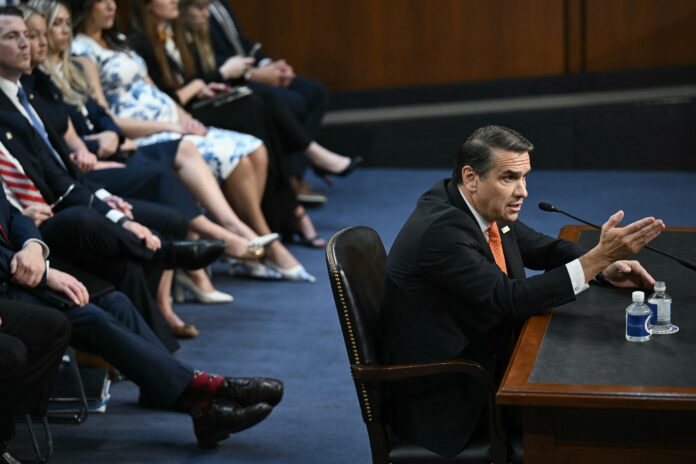
Todd Blanche, President Trump’s nominee for attorney general and former personal defense attorney, faced a combative Senate Judiciary Committee hearing on Wednesday, fielding tough questions on his handling of the Justice Department’s release of Epstein-related files, his firing of a career pardon attorney, and Trump’s pardons of January 6 rioters. The hearing exposed the razor-thin margin Republicans hold on the committee following the recent death of Senator Lindsey Graham, leaving little room for defections as Blanche’s confirmation heads toward an uncertain vote. Democrats used the hearing to spotlight testimony from an Epstein survivor and a fired DOJ official who claims she was pushed out for resisting political pressure.
Story Highlights
- Blanche defended DOJ’s release of Epstein files despite acknowledging redaction errors in the process
- Senator Lindsey Graham’s death left Judiciary Committee Republicans with just one vote to spare
- Blanche called Trump’s January 6 pardons “generous” while saying he had not personally celebrated them
- Democrats called Epstein survivor Dani Bensky and fired pardon attorney Elizabeth Oyer to testify
What Happened
Todd Blanche, currently serving as deputy attorney general and previously President Trump’s personal defense attorney, appeared before the Senate Judiciary Committee on Wednesday for a contentious confirmation hearing to become the nation’s next attorney general. At one point during his testimony, Blanche momentarily conflated his past and present roles, stating he “is” the president’s lawyer before correcting himself to clarify he “was” Trump’s attorney and now serves in an official Justice Department capacity, a slip that underscored the unusually close personal relationship between the nominee and the president he would serve under.
The hearing centered heavily on the Justice Department’s handling of files related to the late convicted sex offender Jeffrey Epstein. Blanche defended the department’s rollout of the documents, which were released in stages beginning in December 2025 under the Epstein Files Transparency Act, a law Trump signed after Congress passed it by a near-unanimous vote. Blanche acknowledged there were errors in the vetting process that led to some material being released improperly, but maintained those issues were identified and corrected. He faced pointed questions about the department’s earlier declaration that a January 2026 release of roughly three million documents would be the final significant disclosure, a decision that drew outcry from Epstein survivors and from the bipartisan lawmakers who authored the original transparency legislation.
Blanche also addressed his decision to fire Elizabeth Oyer, a career pardon attorney at the Justice Department who has since sued over her termination. Oyer alleges she was pushed out after refusing to comply with pressure from Trump appointees who wanted her to restore actor Mel Gibson’s gun rights, which he lost following a 2011 domestic violence conviction in California. Democrats called Oyer to testify at the hearing, using her account to raise broader questions about political interference in traditionally independent Justice Department functions.
In addition to Oyer, Democrats called Dani Bensky, a survivor of Epstein’s abuse, to testify, ensuring that survivors’ voices featured prominently in the public record surrounding Blanche’s nomination. Blanche was also pressed on Trump’s pardons of individuals involved in the January 6, 2021, attack on the U.S. Capitol, which he characterized as “generous,” while adding that he personally had not celebrated the decision. He further stated his belief that Trump could not legally pursue a third presidential term, a notable public break from speculation Trump himself has periodically stoked. Blanche was also questioned about FBI Director Kash Patel’s travel habits, which he described as “extraordinarily obnoxious” lines of inquiry, and about the department’s settlement with Live Nation and Ticketmaster, which he defended as beneficial to consumers.
Why It Matters
Blanche’s confirmation hearing carries outsized significance given his unusually close personal and professional relationship with Trump prior to joining the administration. As the president’s former defense attorney in multiple criminal cases, Blanche’s elevation to the nation’s top law enforcement position raises fundamental questions about the independence of the Justice Department from direct presidential influence, a concern that Democratic senators repeatedly emphasized throughout the hearing.
The razor-thin Republican margin on the Judiciary Committee, a direct consequence of Senator Graham’s recent death, means that Blanche’s path to confirmation carries genuine uncertainty in a way that few Trump nominees have faced during the current term. Any single Republican defection could imperil the nomination, giving individual senators unusual leverage to extract commitments or concessions from Blanche during this process.
The continued fallout from the Epstein files release also reflects a broader credibility challenge for the Justice Department. Survivors and bipartisan lawmakers alike have expressed frustration with what they view as an incomplete and poorly executed transparency effort, despite the existence of a specific federal law mandating fuller disclosure. That unresolved tension is likely to shadow Blanche’s tenure regardless of the outcome of his confirmation vote.
Economic and Global Context
While Blanche’s confirmation hearing is primarily a domestic legal and political story, it carries meaningful implications for the Justice Department’s broader enforcement priorities, including its role in the administration’s immigration crackdown, ongoing antitrust matters, and consumer protection actions like the Live Nation and Ticketmaster settlement referenced during the hearing. The department’s posture on these fronts affects industries ranging from live entertainment to healthcare, given Blanche’s testimony touching on abortion pill litigation and the 340B drug pricing program currently under review by federal regulators.
The hearing’s focus on DOJ’s institutional independence also resonates internationally, as allied democracies and international legal observers watch closely how the United States manages the relationship between its executive branch and its ostensibly independent law enforcement apparatus. Perceptions of politicization at the Justice Department can affect diplomatic and legal cooperation on cross-border law enforcement matters, extradition requests, and international sanctions enforcement.
Implications
In the near term, the Judiciary Committee vote on Blanche’s nomination will be closely watched given the thin Republican majority. Any additional Republican absences or defections could delay or derail the confirmation, forcing the White House to reassess its strategy or apply additional pressure on wavering senators.
For Epstein survivors and their advocates, the hearing signals that pressure for further transparency from the Justice Department will likely continue regardless of Blanche’s confirmation outcome, with survivors like Bensky positioned to keep the issue in the public eye through continued congressional testimony and advocacy.
For career Justice Department officials, the Oyer case and the broader tenor of the hearing may signal continued tension between political appointees and career staff over the department’s independence, a dynamic likely to persist as Blanche, if confirmed, works to implement the administration’s broader law enforcement and immigration priorities.
Sources
