

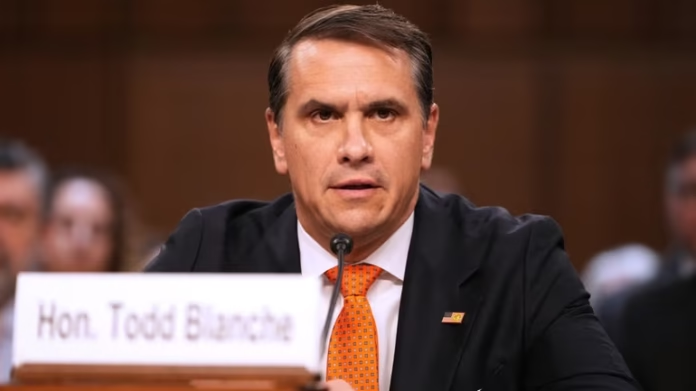
Acting Attorney General Todd Blanche appeared before the Senate Judiciary Committee on Wednesday for a contentious confirmation hearing dominated by questions over the Justice Department’s handling of the Jeffrey Epstein files and a since-abandoned $1.8 billion “anti-weaponization” fund tied to a settlement with President Trump. The hearing came just two days after a federal judge in Miami sanctioned Justice Department officials, including Blanche, and accused the administration of pursuing its lawsuit against the IRS in “bad faith.” Blanche’s nomination now hinges on winning over skeptical Republicans alongside near-uniform Democratic opposition.
Story Highlights
- Blanche, Trump’s former personal defense attorney, testified before the Senate Judiciary Committee on his nomination for permanent attorney general.
- A federal judge in Miami found Trump’s lawsuit against the IRS, which led to the fund’s creation, was brought in “bad faith” and sanctioned officials including Blanche.
- Blanche told senators under oath that the anti-weaponization fund is “dead” and “not moving forward,” though he declined to put that commitment in writing.
- Democrats criticized Blanche over the Epstein files disclosure, in which survivors’ personal information was reportedly left unredacted.
What Happened
Todd Blanche, who has served as acting attorney general since President Trump fired Pam Bondi in early April, testified Wednesday before the Senate Judiciary Committee in a hearing that touched on some of the administration’s most controversial legal disputes. Blanche, previously Trump’s personal defense attorney, opened his remarks by arguing he was “restoring American trust” in the Justice Department, saying past years had seen the department “turned against” Trump and damaged public faith in the justice system.
Much of the hearing centered on a $1.8 billion fund, informally known as the anti-weaponization fund, that was created as part of a settlement resolving a civil lawsuit Trump and his family brought against the IRS over the leak of his tax records. The settlement also granted Trump, his two oldest sons, and related businesses effective immunity from IRS audits, prosecution or regulatory action tied to past tax filings. Blanche told the committee under oath that the fund “is dead” and “not moving forward,” stating “there’s no modification. It’s just — it never started. No money went from the Treasury to any other account.” He declined, however, to commit that pledge to a formal written agreement, despite requests from both Republican and Democratic senators.
The hearing took place two days after U.S. District Judge Kathleen Williams in Miami issued a scathing ruling accusing Trump, his lawyers, and the Justice Department of pursuing the underlying IRS lawsuit for an “improper purpose,” describing it as an attempt to obtain the “appearance of judicial legitimacy” for a settlement lacking genuine legal viability. Williams sanctioned officials involved in the matter, including Blanche. A Justice Department spokesperson dismissed the ruling as incorrect, saying “there was no collusion in this case” and that the judge had “disregarded decades of precedent.”
Republican senators, including John Cornyn of Texas and Thom Tillis of North Carolina, pressed Blanche on the fund’s origins and whether the settlement’s tax immunity provisions for Trump’s family could still be modified or challenged. Cornyn, who lost his own primary earlier this year to a Trump-backed challenger, said he remained “uncommitted” on Blanche’s nomination and wanted to further explore the judge’s finding of bad faith. Democrats, led by ranking member Dick Durbin of Illinois, focused heavily on the Justice Department’s release of Epstein-related files, which Durbin said left hundreds of survivors’ personal information unredacted while shielding the identities of Epstein’s powerful associates, allegedly in violation of the Epstein Files Transparency Act.
Durbin also raised concerns about the department’s independence from the White House, telling reporters he had privately warned Blanche that “my greatest fear is that somehow or another you’re going to interfere in the next election,” to which Blanche reportedly responded, “No, we won’t.” Durbin recounted a separate conversation in which Blanche admitted “I made a mistake” regarding the anti-weaponization fund, though he stopped short of rescinding the order that created it, which Durbin noted remains posted on the Justice Department’s website.
Why It Matters
Blanche’s confirmation hearing represents a pivotal test of how far the Senate, including members of the president’s own party, are willing to go in scrutinizing an attorney general nominee closely tied to Trump personally. The fact that Republican senators like Cornyn and Tillis are voicing open skepticism suggests the anti-weaponization fund controversy has generated real friction within the GOP, not just partisan Democratic opposition.
The unresolved questions around the fund matter beyond the immediate confirmation fight. The tax immunity provisions shielding Trump and his family from IRS audits and enforcement remain in effect even though the payout fund itself has been shelved, raising longer-term questions about equal application of tax law and oversight of executive branch settlements involving the president’s personal financial interests.
The handling of the Epstein files continues to carry significant weight with the public, given the scale of public interest in the case and the legal requirement under the Epstein Files Transparency Act to release relevant materials. Allegations that survivors’ information was exposed while associates’ names remained protected strike at core Justice Department credibility issues that extend well beyond this single nomination fight.
For the broader justice system, Blanche’s leadership has already been marked by high-profile prosecutorial decisions, including the indictment of the Southern Poverty Law Center and cases involving perceived Trump adversaries, alongside the firing of career department officials. His confirmation would formalize a Justice Department leadership approach that critics argue has eroded traditional independence from the White House.
Economic and Global Context
The $1.8 billion anti-weaponization fund, even in its now-defunct state, represents a substantial sum relative to typical Justice Department settlement and restitution programs, and its creation raised questions among fiscal watchdogs about the precedent of using federal funds to compensate individuals for perceived political grievances rather than legally defined harms. Judge Williams’s ruling specifically criticized the arrangement as an attempt to “earmark billions of dollars from American taxpayers to redress grievances not defined in the law.”
The IRS settlement’s tax immunity provisions for Trump, his sons and related business entities also carry implications for how future disputes between senior government officials and federal revenue agencies are resolved, potentially setting a template that legal observers say could be invoked in other high-profile tax disputes involving powerful individuals.
More than 1,200 former Justice Department employees signed a letter urging the Senate to reject Blanche’s nomination, citing concerns about politicization of the department’s career workforce. This level of internal institutional opposition is notable and reflects broader unease within the legal community about the department’s operational independence under the current administration.
The ongoing litigation in South Florida tied to the IRS settlement remains active, meaning further rulings, sanctions or disclosures could continue to surface well after Blanche’s confirmation vote, keeping the matter in the news and potentially affecting confidence in Justice Department financial and legal dealings involving the president.
Implications
The Senate Judiciary Committee is expected to vote on Blanche’s nomination in the coming weeks, and his confirmation will likely depend on whether Republican holdouts like Cornyn ultimately support him despite lingering concerns about the fund and the Miami judge’s findings. A narrow committee margin, following the death of a Republican senator earlier this year, adds further uncertainty to the outcome.
For congressional Democrats, the hearing offered an opportunity to build a public record around the Epstein files handling and the IRS settlement ahead of the midterm elections, material they are likely to continue referencing in future oversight efforts regardless of whether Blanche is confirmed.
For the Justice Department’s career staff, the outcome of the confirmation will shape morale and staffing decisions, particularly given the letter from former employees warning about politicized personnel actions under Blanche’s leadership.
For the public, continued litigation and potential congressional hearings tied to the anti-weaponization fund and Epstein files disclosure mean this story is unlikely to be fully resolved even after the confirmation process concludes.
Sources
