

Story Highlights
- Sen. Thom Tillis said Trump’s SAVE America Act is effectively dead before the November midterms.
- The bill would require proof of citizenship for voter registration and photo identification for voting.
- Tillis said even if the bill passed, states would not have enough time or funding to implement it properly before Election Day.
What Happened
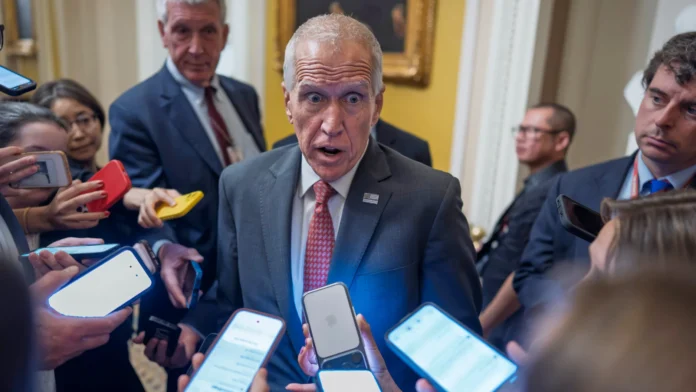
Sen. Thom Tillis of North Carolina said President Donald Trump’s SAVE America Act is effectively dead on Capitol Hill ahead of the midterm elections.
Tillis argued that the bill cannot realistically be implemented before voters go to the polls, even if Republicans somehow find the votes to pass it.
The legislation would create new federal election requirements, including documentary proof of citizenship for voter registration and photo identification to cast ballots.
- Tillis said the bill lacks the votes needed to overcome the Senate filibuster.
- He also warned that states do not have enough time to build the systems required before November.
- He called continued efforts to force the issue “theater.”
The bill has already run into repeated Senate resistance, including from a small group of Republicans who joined Democrats to block attempts to attach it to other legislation.
Trump has pushed Republicans to move the measure through Congress and has called for tougher national election rules as a top priority before the midterms.
Why It Matters
The dispute matters because election security remains one of Trump’s most important political issues.
Trump and his allies argue that proof-of-citizenship and voter ID rules are necessary to strengthen confidence in federal elections and prevent illegal voting.
Tillis is not rejecting election security as a goal. His argument is that the bill’s timeline and structure make it impractical before the 2026 midterms.
- The Senate filibuster means the bill needs 60 votes unless rules change.
- States would need time, funding, training, and new procedures to implement the requirements.
- The dispute exposes a divide between Trump’s urgency and Senate Republicans’ procedural concerns.
For Trump, the setback creates a challenge: his top election-security priority may remain a campaign issue rather than a law before November.
For Republican candidates, the issue could still energize voters who want tougher election safeguards, even if Congress does not act in time.
Political and Public Context
The SAVE America Act has become a major test of Trump’s influence over congressional Republicans.
Many Republicans support the bill’s goal, but several senators have objected to the way it is being pushed, especially attempts to attach it to unrelated legislation.
Tillis, Susan Collins, Lisa Murkowski, and Mitch McConnell have all broken with Trump-backed efforts to force the measure through the Senate. :contentReference[oaicite:2]{index=2}
- Trump has urged Republicans to use must-pass bills to advance the measure.
- Some House conservatives have disrupted floor action to pressure leadership on the issue.
- Senate leadership has shown little appetite for eliminating the filibuster.
The fight has also disrupted other parts of the Republican agenda.
House Republicans left for the July 4 break early after hardliners blocked legislative action while pressing for the voter ID bill to be attached to defense legislation. :contentReference[oaicite:3]{index=3}
What Happens Next
The SAVE America Act could still remain alive as a political message, but its path to becoming law before the midterms is narrow.
Republicans may continue trying to attach it to other legislation, but Senate rules and internal GOP divisions make that difficult.
Trump is likely to keep pressuring lawmakers, especially if court rulings on mail voting continue to frustrate his push for tighter election rules.
For Tillis and other skeptical Republicans, the argument is likely to remain focused on implementation: passing a bill too late could create confusion for states and voters rather than improving confidence.
For now, the practical result is that the 2026 midterms are likely to proceed without the new federal voter ID and proof-of-citizenship framework Trump wanted.
Sources
- No chance Donald Trump’s SAVE America Act in place by midterms, even if passed
- Republican says Trump’s top election priority is ‘dead’ as Senate GOP fractures ahead of midterms
- US House starts July 4 break early after Republican hardline push for Trump voter ID bill
- Four Senate Republicans again vote to kill Trump’s SAVE America Act
- House GOP agenda stuck over SAVE Act, again
