

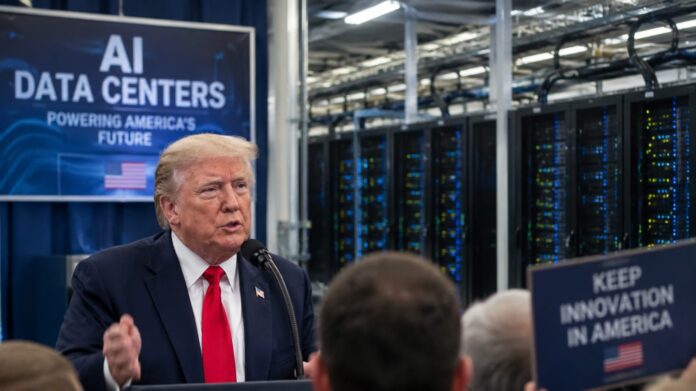
Story Highlights
- A growing number of Republicans are distancing themselves from President Trump’s push for AI data centers.
- Recent polls indicate that a significant majority of voters oppose new data centers in their communities.
- Concerns over rising energy costs and environmental impact are driving this shift in Republican strategy.
- Key Senate races are being affected as candidates navigate the backlash against data center construction.
What Happened
In a notable shift, several Republican candidates are stepping back from the ambitious vision for AI data centers championed by President Trump. This change comes in the wake of increasing voter backlash against the construction of new data centers, which many Americans view as detrimental to their communities. Recent polling data reveals that a staggering 70% of voters are opposed to the establishment of data centers in their neighborhoods, raising alarms among GOP strategists who previously supported the expansion of this burgeoning industry.
President Trump, a staunch advocate for data center development, recently took to social media to promote the benefits of such facilities, arguing that they could lead to economic prosperity, lower taxes, and job creation. He stated that communities should embrace the potential of data centers, suggesting that they are essential for success in the modern economy. However, as the political landscape evolves, many Republican candidates are now reconsidering their positions on this issue, reflecting a broader concern about the implications of data center construction.
- Seventy percent of voters oppose new data centers in their communities, according to a recent Fox News poll.
- Former Rep. Mike Rogers, the GOP Senate nominee in Michigan, has called for a one-year moratorium on data center construction.
- In Ohio, GOP Sen. Jon Husted faces backlash as Democrats leverage the data center issue against him.
- The National Republican Senatorial Committee has warned that data centers could jeopardize key Senate races.
Why It Matters
The distancing of Republican candidates from Trump’s data center vision is significant for several reasons. First, it highlights a growing disconnect between party leadership and the concerns of the electorate. As voters express their apprehensions about the environmental and economic impacts of data centers, candidates are forced to adapt their strategies to align with public sentiment. This shift could have far-reaching consequences for the GOP, particularly in battleground states where every vote counts.
Moreover, the backlash against data centers is not merely a local issue; it reflects broader national trends regarding energy consumption and environmental sustainability. As communities grapple with rising electricity costs and the potential strain on local resources, the political ramifications of supporting data center construction become increasingly complex. Candidates who fail to address these concerns risk alienating their voter base, which could ultimately impact their chances in upcoming elections.
- Republican candidates may lose support if they continue to back data center construction against voter wishes.
- Concerns over energy costs and environmental impact could reshape GOP policies moving forward.
- Key Senate races are at risk as candidates navigate the contentious issue of data centers.
- The backlash may lead to a reevaluation of the party’s stance on technology and infrastructure development.
Political and Public Context
The current situation surrounding data centers is not an isolated incident but rather part of a larger narrative regarding technology and its impact on society. Over the past few years, the rapid growth of artificial intelligence and data processing has prompted discussions about the infrastructure needed to support these advancements. While the Trump administration initially embraced the potential of data centers to drive economic growth, the recent voter backlash indicates a shift in public perception.
In addition to the concerns raised by voters, there are also significant implications for local economies. As communities weigh the benefits of job creation against the potential downsides of increased energy consumption and environmental degradation, the debate over data centers is likely to intensify. Furthermore, the political landscape is evolving, with candidates from both parties recognizing the need to address these issues head-on.
- Trump’s administration previously championed the growth of AI and data centers as a means of economic development.
- Voter concerns about energy costs and environmental impact are becoming central to political discourse.
- Local economies are grappling with the implications of data center construction on resources and infrastructure.
- The political landscape is shifting as candidates adapt to changing public sentiment regarding technology.
🔊 Texas Republicans are turning on the AI data centers they once championed. @Dawn_Kopecki tells the Reuters World News podcast, ‘this is a sea change for big tech' https://t.co/dKrsR2C5vI pic.twitter.com/FuGiwTFiha
— Reuters (@Reuters) September 4, 2026
What Happens Next
Looking ahead, the future of data center construction and its political implications remains uncertain. As Republican candidates continue to distance themselves from Trump’s vision, it will be crucial to monitor how this shift affects their campaigns and the broader party strategy. The GOP may need to recalibrate its approach to technology and infrastructure development to align with voter concerns, particularly in key battleground states.
Moreover, the ongoing debate over data centers could lead to new policy proposals aimed at addressing the concerns raised by voters. Candidates may seek to introduce legislation that prioritizes community input and environmental safeguards in the construction of data centers. As the political landscape evolves, it will be essential for both parties to engage with constituents and address their concerns regarding technology and its impact on local communities.
- Republican candidates may propose new policies to address voter concerns about data centers.
- The GOP could shift its focus to community engagement and environmental safeguards in technology development.
- Key Senate races will continue to be influenced by the data center debate.
- Future polling will provide insight into how voter sentiment evolves regarding technology and infrastructure.
