

Story Highlights
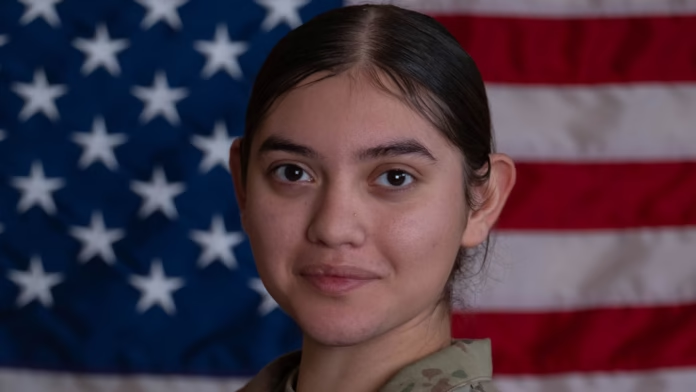
- The Pentagon identified 1st Lt. Tyler James Feehan, 25, and Pvt. Isabella Gonzales, 19, as the soldiers killed in an Iranian missile strike in Jordan
- A third American service member remains missing as officials examine unidentified remains recovered from the attack site
- President Donald Trump ordered renewed strikes against Iranian military targets after the attack shattered the interim ceasefire
What Happened
The Department of Defense has identified two American soldiers killed when an Iranian ballistic missile struck Muwaffaq Salti Air Base in Jordan on July 17.
The fallen service members were 1st Lt. Tyler James Feehan, 25, of Ewa Beach, Hawaii, and Pvt. Isabella Gonzales, 19, of Carrollton, Texas.
Gonzales died on the day of the attack, while Feehan died from his injuries the following day. Feehan served with the 32nd Army Air and Missile Defense Command at Fort Bragg, North Carolina. Gonzales was assigned to an air-defense unit based in Ansbach, Germany.
- Several additional American personnel were injured in the missile attack
- Four wounded service members required medical evacuation before being discharged
- One soldier remains missing, and recovered remains are undergoing examination
Iran’s Islamic Revolutionary Guard Corps claimed responsibility for the attack. U.S. officials said American air defenses intercepted most of the incoming missiles, but at least one projectile penetrated the defensive shield and struck the base.
Secretary of State Marco Rubio described the deaths as heartbreaking and offered condolences to the families of the soldiers who made the ultimate sacrifice.
The president also honored the fallen troops, describing their deaths as a deeply painful loss suffered in service to the country. American forces responded by launching another wave of strikes against Iranian military targets.
Why It Matters
The identification of Feehan and Gonzales places names and personal histories behind a conflict often discussed primarily through military strategy, diplomatic negotiations and political debate.
Both soldiers were young members of the armed forces serving at installations exposed to Iranian missile and drone attacks. Their deaths demonstrate the risks faced by American personnel stationed throughout the Middle East.
The incident also raises urgent questions about the defensive systems protecting U.S. bases. Officials said most of the incoming missiles were intercepted, suggesting the shield prevented a potentially much larger loss of life. However, the missile that penetrated those defenses proved deadly.
- Military commanders must determine how the missile passed through the defensive network
- Additional air-defense systems may be required at vulnerable regional bases
- Iran must understand that attacks killing American troops will bring consequences
Supporters of the administration’s response argue that failing to retaliate would invite further attacks. From that perspective, the renewed strikes are intended to degrade Iran’s capabilities and restore deterrence after the deadly breach of the ceasefire.
The challenge is ensuring that military pressure makes American personnel safer without drawing the United States into an indefinite conflict lacking a clear endpoint.
Political and Public Context
The attack has effectively ended the interim ceasefire negotiated by the Trump administration roughly one month earlier. Washington and Tehran had accused one another of repeated violations before the missile strike killed the two soldiers.
The White House can argue that it pursued diplomacy and gave Iran an opportunity to halt the fighting. Tehran’s decision to attack an American base now strengthens the administration’s case that renewed military action was a response to Iranian aggression rather than an abandonment of negotiations by Washington.
The president has maintained that Iran’s military capacity has suffered extensive damage. His administration must now demonstrate that continued pressure can prevent additional attacks and protect the thousands of American service members positioned across the region.
- Republicans are likely to support retaliation against those responsible for the attack
- Lawmakers may demand an explanation of the missile-defense failure
- Congressional debate over war powers and the campaign’s objectives will intensify
The deaths also increase pressure on Congress and the administration to provide military families with a clearer explanation of the mission, its objectives and the conditions required to end American combat operations.
What Happens Next
Military officials will continue searching for the missing service member while examining the unidentified remains recovered from the Jordan base. That process could lead the Pentagon to revise the confirmed casualty count.
U.S. Central Command is also expected to review how the Iranian missile penetrated the base’s defenses and whether additional interceptors, radar systems or protective measures should be deployed.
- American strikes against Iranian military infrastructure are likely to continue
- Force-protection measures will be strengthened at U.S. bases across the region
- Diplomatic channels may remain open despite the renewed fighting
The administration now faces a two-part responsibility: holding Iran accountable for the deaths of American soldiers while preserving a realistic path toward ending the conflict.
For the families of Feehan and Gonzales, the strategic debate is inseparable from personal loss. Their deaths will remain central to the national discussion over how the United States responds when its service members are targeted overseas.
Sources
