

Story Highlights
- The Missouri Supreme Court unanimously blocks GOP-backed congressional maps.
- Voter approval is now required for the new districts, complicating the GOP’s midterm strategy.
- Trump condemns the ruling as ‘ridiculous’ and unconstitutional.
- Missouri Attorney General plans to appeal to the U.S. Supreme Court.
What Happened
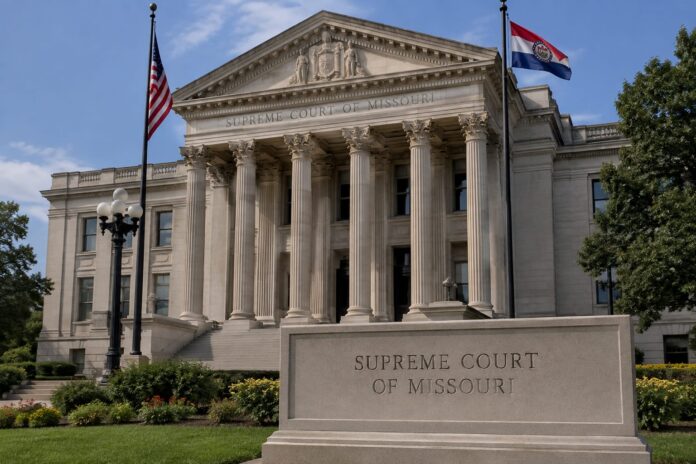
On Thursday, the Missouri Supreme Court delivered a significant blow to the Republican Party by unanimously blocking the newly enacted congressional districts that were designed to bolster their chances in the upcoming midterm elections. The court ruled that these districts cannot be implemented until they receive voter approval through a statewide referendum. This decision has ignited a firestorm of criticism from state Republicans and President Donald Trump, who argue that the ruling undermines electoral integrity and sets a dangerous precedent for future redistricting efforts.
The ruling comes at a critical time as the GOP aims to maintain its slim majority in the House of Representatives. The new congressional map was expected to provide the party with an additional seat, a crucial advantage in the highly competitive political landscape. However, the court’s decision has thrown a wrench into these plans, forcing the party to revert to the congressional map adopted after the 2020 census, which remains in effect until the general election in November 2026.
- The Missouri Supreme Court ruled unanimously against the GOP-backed congressional map.
- Over 300,000 signatures were submitted for a referendum petition opposing the new districts.
- Republican Secretary of State Denny Hoskins initially rejected the petition.
- Missouri Attorney General Catherine Hanaway plans to appeal to the U.S. Supreme Court.
Why It Matters
This ruling is not just a setback for the Missouri GOP; it represents a broader struggle over redistricting and electoral integrity in the United States. The decision has sparked outrage among Republicans, who view it as an encroachment by the judiciary into the political process. Trump’s condemnation of the ruling as ‘ridiculous’ underscores the frustration felt by many within the party regarding judicial interventions that they believe undermine their electoral strategies.
The implications of this ruling extend beyond Missouri. It raises questions about the role of state courts in redistricting and the extent to which voters can influence the process. If the courts can block congressional maps after they have been enacted, it could set a precedent that allows for increased judicial involvement in what has traditionally been a political process. This could lead to further complications in future elections, as parties may find their carefully crafted maps subject to legal challenges.
- The ruling could disenfranchise voters by delaying the implementation of new districts.
- It may embolden other states to challenge GOP redistricting efforts.
- Judicial involvement in redistricting could become more common, complicating future elections.
- The ruling may affect GOP fundraising and campaign strategies leading up to the midterms.
Political and Public Context
Missouri’s political landscape has shifted dramatically over the past two decades, moving from a swing state to a solidly Republican stronghold. This transformation has been fueled in part by the policies and leadership of President Trump, whose administration has resonated with many voters in the state. The GOP’s efforts to solidify their power through redistricting are seen as a natural extension of this trend. However, the recent ruling highlights the challenges they face in navigating the legal landscape surrounding electoral maps.
In a broader context, this ruling comes on the heels of similar legal battles in other states. For instance, the Virginia Supreme Court recently struck down a Democratic redistricting plan, which was celebrated by Republicans as a significant victory. This juxtaposition illustrates the contentious nature of redistricting in the current political climate, where both parties are fiercely contesting the boundaries that will define electoral districts for years to come.
- The Virginia Supreme Court recently overturned a Democratic redistricting plan.
- Missouri has shifted from a swing state to a Republican stronghold in recent years.
- Trump’s policies have significantly influenced voter sentiment in Missouri.
- Legal battles over redistricting are becoming increasingly common across the United States.
Missouri’s Supreme Court ruled Thursday the state can’t use redrawn congressional districts that could benefit Republicans in November’s midterm elections, and voters must decide whether to use them in future elections https://t.co/HOamkFdKuM
— The Wall Street Journal (@WSJ) September 4, 2026
What Happens Next
Looking ahead, the Missouri GOP is gearing up for a legal battle as Attorney General Catherine Hanaway prepares to appeal the state Supreme Court’s decision to the U.S. Supreme Court. This move could potentially alter the course of the upcoming elections, depending on how the higher court interprets the legal arguments surrounding the referendum process and its implications for congressional redistricting.
In the meantime, the GOP will need to reassess its strategy for the midterms. With the current congressional map remaining in effect, party leaders will have to focus on mobilizing their base and ensuring voter turnout, particularly in light of the uncertainty surrounding the new districts. The outcome of the appeal could also influence fundraising efforts and campaign messaging as the party seeks to navigate this unexpected hurdle.
- The Missouri GOP will appeal the ruling to the U.S. Supreme Court.
- Party leaders will need to reassess their midterm strategies.
- Fundraising efforts may be impacted by the uncertainty surrounding the congressional map.
- The outcome of the appeal could set a precedent for future redistricting battles.