

Story Highlights
- G7 host Emmanuel Macron said he would personally seek to persuade Trump to continue supporting Ukraine and increase pressure on Russia at the summit
- European Commission President Ursula von der Leyen stated that Europe is now providing “almost 100%” of military and financial aid to Ukraine
- Trump’s attention had shifted significantly toward the Iran conflict since February, effectively freezing U.S.-mediated Ukraine peace efforts for months
What Happened
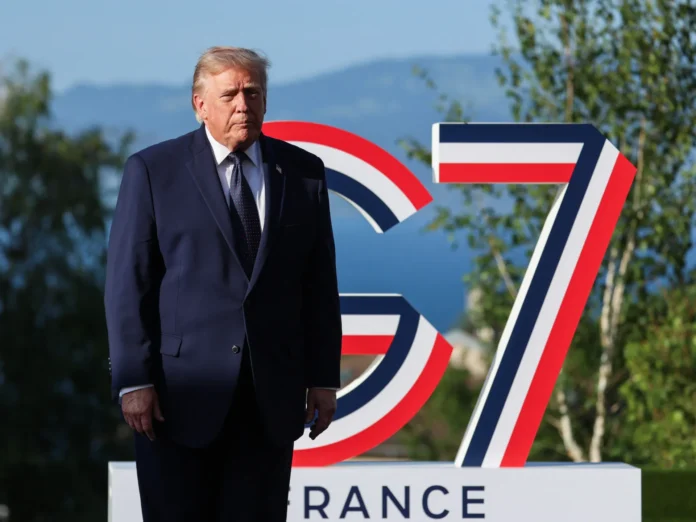
The 52nd G7 Summit opened Monday in Évian-les-Bains, France, with President Donald Trump arriving fresh from announcing a framework agreement with Iran — a diplomatic achievement that has consumed the administration’s foreign policy bandwidth for months. But the assembled leaders of the world’s seven largest democratic economies, along with the European Union, made clear from the outset that Ukraine’s war with Russia would be the other defining issue of the two-day gathering. French President Emmanuel Macron, serving as G7 host, framed the Ukraine question as urgent and unresolved, stating that the alliance’s credibility depended on its continued support for Kyiv.
In a press briefing ahead of the summit’s second day, Macron said that European allies are now providing nearly all the military and financial aid flowing to Ukraine, following the significant reduction in direct U.S. assistance that occurred earlier in the year. “Europeans are currently providing almost 100% of the aid to Ukraine,” he said, a formulation that underscores how dramatically the burden-sharing within the alliance has shifted under Trump’s second term. The French president said he would use bilateral discussions with Trump to make the case that American re-engagement is both strategically necessary and politically achievable.
Ursula von der Leyen, President of the European Commission, was equally direct. She posted on social media Tuesday that Russia’s “fatigue is openly showing” and argued that the moment calls for intensified, rather than reduced, Western support. “The tide is turning for Ukraine,” she wrote. “The situation in 2026 is very different from 2025. Ukraine is bravely holding the front line.” G7 nations also confirmed commitments to Kyiv on air defense reinforcements, winter preparedness packages, and continued financial assistance.
The backdrop for these discussions is a peace process that has effectively been on ice since February. U.S.-mediated talks between Ukraine and Russia stalled as the administration pivoted almost entirely to the Iran conflict. Both Ukrainian and American officials acknowledge that Iran dominated Washington’s diplomatic agenda in a way that left the Ukraine file without meaningful high-level attention for months. Zelenskyy’s appearance at the G7 on Tuesday was a calculated effort to reclaim that attention at a moment when the Iran situation appears to be stabilizing.
Trump’s responses during the summit were more positive on Ukraine than they had been in preceding months. He told reporters Russia “should make a deal” and pledged to do what he could to end the fighting. He also notably refrained from repeating earlier characterizations of Ukraine’s negotiating position as unrealistic. The shift in tone, while not accompanied by specific new commitments, was welcomed by European allies as at least a preliminary realignment.
Why It Matters
The G7’s effort to re-focus Trump on Ukraine matters because the trajectory of the war remains deeply consequential for European security architecture. If Russia is allowed to consolidate territorial gains while Washington remains distracted, it could embolden future aggression not just in Ukraine but elsewhere on NATO’s eastern flank. European leaders are acutely aware of this risk, which is why Macron and others have been so persistent in lobbying Trump even as the administration’s diplomatic bandwidth has been stretched.
For the transatlantic alliance more broadly, the question of burden-sharing has reached a critical juncture. European nations have stepped up significantly — both financially and militarily — to compensate for reduced U.S. involvement. But they lack the strategic weight and logistical capacity to substitute fully for American engagement, particularly in areas like intelligence sharing, satellite reconnaissance, and long-range weapons systems. Sustained American disengagement from Ukraine would create a gap that Europe cannot independently fill.
There is also a broader question about what the outcome of the Ukraine conflict signals to other authoritarian states watching the situation. American allies in Asia — particularly those concerned about Chinese ambitions toward Taiwan — are watching closely to see whether the democratic world’s commitment to territorial integrity holds, or whether great-power conflict can achieve territorial revision without ultimately paying a prohibitive strategic price.
Economic and Global Context
The economic consequences of the Russia-Ukraine war remain significant and interconnected with the broader global disruptions caused by the Iran conflict. Ukraine remains one of the world’s most important agricultural exporters, and the continuation of the war has kept global grain markets in a state of elevated uncertainty. Wheat prices in particular have remained volatile throughout the conflict, affecting food costs in developing nations most dependent on Ukrainian exports.
European economies have borne heavy costs from the war’s knock-on effects. Energy prices surged after Russia’s full-scale invasion and the subsequent Western sanctions on Russian energy exports, forcing expensive infrastructure pivots across the continent. While the energy situation has stabilized somewhat, industrial competitiveness in Germany and other manufacturing-heavy European economies remains constrained by higher baseline energy costs compared to pre-war levels.
From a U.S. economic standpoint, a prolonged Ukraine conflict without resolution creates systemic uncertainty that weighs on global financial markets, complicates trade policy, and forces continued expenditure in defense programs that might otherwise serve other fiscal priorities. A durable peace settlement in Ukraine, combined with the Iran deal, would represent one of the most significant improvements in the global geopolitical risk environment in years.
Implications
The G7 summit may prove to be an inflection point for American engagement on Ukraine, or it may be remembered as a moment of symbolic commitment without operational follow-through. The difference will depend heavily on what Trump actually does in the weeks following the summit. Commitments made in working sessions need to be converted into specific policy decisions: renewed weapons deliveries, sustained diplomatic engagement with both Kyiv and Moscow, and willingness to apply meaningful pressure on Russia through sanctions or other tools.
European leaders will be watching carefully. If Trump re-engages substantively on Ukraine following the summit, it would restore a degree of confidence in American leadership within the alliance that has been strained. If not, European nations will face difficult choices about how to sustain their Ukraine commitments independently — a burden that strains their own budgets and domestic political coalitions.
For Trump, the calculus involves balancing his desire to be seen as a dealmaker and peacemaker with the skepticism about foreign entanglements that characterizes a significant portion of his political base. His challenge is to frame any Ukraine engagement not as an open-ended commitment but as a defined diplomatic mission with a clear end goal — a peace deal on terms he can present to the American public as a win.
Sources
“G7 allies scramble to put Ukraine back atop Trump’s agenda as war drags on”
