

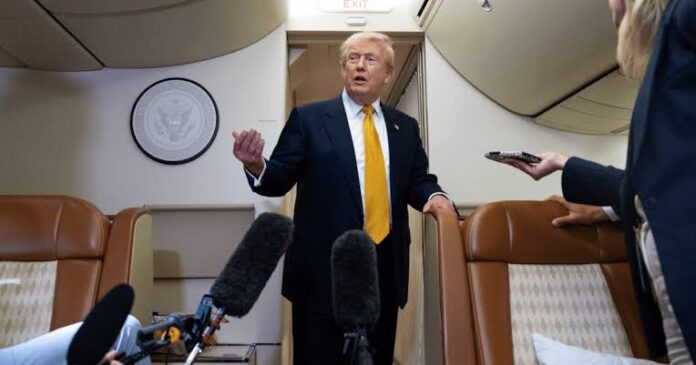
Story Highlights
- The Justice Department subpoenaed four reporters as part of a federal investigation into alleged unauthorized disclosures concerning Air Force One security.
- Officials maintain that the journalists are witnesses rather than criminal targets and that investigators are pursuing government employees who leaked protected information.
- The disputed reporting described alleged differences between the defensive capabilities of Trump’s new aircraft and the older presidential planes.
- The confrontation will test how far prosecutors may go when investigating national-security leaks involving journalists and confidential sources.
What Happened
The Trump administration issued federal grand jury subpoenas to four journalists who reported alleged security limitations involving President Donald Trump’s newly converted Air Force One.
Julian E. Barnes, Eric Lipton, Tyler Pager, and Eric Schmitt were directed to testify before a federal grand jury in Manhattan as investigators seek to determine who provided sensitive information concerning presidential aviation security.
Federal agents reportedly delivered some of the subpoenas directly to the reporters’ homes.
The Justice Department said the reporters are not criminal targets. Prosecutors maintain that the investigation is focused on government employees who may have disclosed classified or otherwise protected information without authorization.
- The reporting relied on anonymous government sources.
- It discussed alleged defensive capabilities and security procedures involving presidential aircraft.
- The FBI reportedly asked that publication be delayed because of national-security concerns.
- The news organization published the report and declined to identify its sources.
The disputed stories claimed that Trump used an older presidential aircraft for part of his return from a NATO summit because the newer Boeing 747-8 lacked certain advanced defensive countermeasures.
The White House rejected the suggestion that the new aircraft was unsafe and said it had been equipped with high-level security protocols.
Trump publicly explained that the aircraft change allowed American service members stationed in Britain to view the newer plane.
Why It Matters
The administration argues that revealing the capabilities or weaknesses of presidential aircraft could provide useful intelligence to hostile governments or terrorist organizations.
Air Force One is not simply a transportation aircraft. It serves as a secure airborne command center designed to protect the president, maintain communications, and preserve continuity of government during a national emergency.
Trump has also faced reported threats from Iran, making the disclosure of alleged aircraft vulnerabilities especially sensitive.
- Presidential-security information can affect the safety of the commander in chief.
- Foreign intelligence services closely study American defensive systems.
- Government employees entrusted with classified information are legally restricted from disclosing it.
- Investigating a leak does not automatically mean prosecuting the journalists who published it.
Supporters of the investigation argue that reporters should not become an automatic shield for officials who unlawfully disclose national secrets.
They contend that the First Amendment protects reporting but does not grant government employees permission to reveal classified information or prevent grand juries from investigating possible federal crimes.
Press advocates respond that compelling reporters to testify could expose confidential sources and discourage future whistleblowers from revealing genuine misconduct.
The legal dispute will therefore require courts to balance press freedom against the government’s responsibility to protect sensitive national-security information.
Political and Public Context
Trump has repeatedly promised to identify and remove unauthorized leakers inside the federal government.
His administration argues that previous presidents tolerated a culture in which officials could undermine elected leaders by selectively disclosing classified information to favored media organizations.
The Air Force One investigation fits that broader campaign to restore discipline and accountability within national-security agencies.
- The administration says leak investigations protect national security rather than suppress criticism.
- The Justice Department maintains that the reporters themselves are not targets.
- Trump officials argue that classified disclosures can endanger personnel and operations.
- Media organizations say aggressive subpoenas could intimidate legitimate reporting.
The aircraft itself has already generated political controversy because Qatar provided it to the United States before the military began an expensive security conversion.
Critics of Trump have used the subpoena dispute to revive questions concerning the aircraft’s cost, foreign origin, and readiness for presidential service.
The administration’s position is that those policy debates do not justify the unauthorized release of sensitive technical or security details.
FBI Director Kash Patel was reportedly involved in high-level discussions about the investigation before the subpoenas were issued, reflecting the importance the administration has placed on identifying the source.
What Happens Next
The news organization is expected to challenge the subpoenas in federal court.
Its lawyers may argue that prosecutors have not exhausted alternative methods for identifying the alleged leakers or that the demands are unnecessarily broad.
The Justice Department will likely respond that the investigation involves exceptional presidential-security concerns and that testimony from the journalists is necessary.
- A judge could enforce, narrow, delay, or quash the subpoenas.
- The reporters may invoke legal protections concerning confidential sources.
- Investigators will continue reviewing communications and access records inside the government.
- Officials identified as possible leakers could face disciplinary action or criminal charges.
The dispute could also influence congressional debates over a federal reporter shield law.
For Trump, the case reinforces a central second-term message: officials who disclose protected information cannot escape scrutiny merely because the information appears in a newspaper.
For the press, the central concern is whether the investigation remains narrowly directed at unlawful disclosures or becomes a broader effort to discourage aggressive reporting.
The courts will now determine whether the administration has demonstrated a sufficiently compelling need to require the four journalists to appear before the grand jury.
