

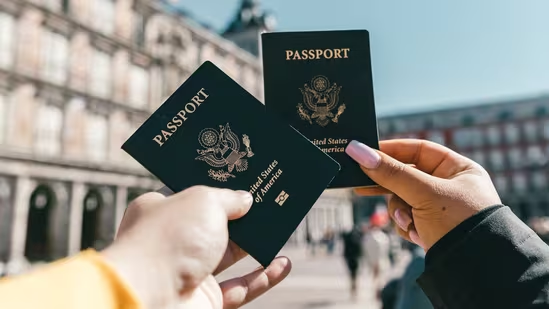
The Department of Homeland Security finalized a rule Thursday that ends decades of open-ended visa terms for foreign students, cultural exchange visitors and journalists, replacing them with fixed durations for the first time since the 1970s. International students and exchange visitors will now be capped at four years, while foreign journalists face a maximum stay of 240 days, or just 90 days for Chinese nationals. The change is part of the Trump administration’s broader immigration enforcement agenda and could affect hundreds of thousands of visa holders when it takes effect this fall.
Story Highlights
- F visas for students and J visas for exchange visitors will be capped at four years; I visas for journalists will be limited to 240 days, or 90 days for Chinese nationals
- The rule ends the “duration of status” system that has governed these visa categories since 1978
- It takes effect 60 days after publication in the Federal Register, pending congressional review, potentially affecting fall 2026 college enrollment
What Happened
The Department of Homeland Security announced Thursday a final rule imposing fixed time limits on three visa categories that have historically allowed holders to remain in the United States for as long as they were enrolled in school or employed on assignment. The rule affects F visas, used by international college and university students; J visas, which cover cultural and educational exchange participants including researchers, teachers and interns; and I visas, issued to foreign journalists and other media representatives.
Under the prior system, known as “duration of status” and in place since 1978, holders of these visas could remain in the country indefinitely as long as they stayed enrolled in their program or maintained their qualifying activity, without needing to reapply for extensions on a fixed schedule. DHS Secretary Markwayne Mullin said in a statement that the change was necessary because thousands of foreign students had allegedly exploited the system by “perpetually enrolling in courses to avoid having to leave” the country, becoming what he called “forever students.” The agency said the new fixed terms would restore its ability to properly screen, vet and monitor visa holders during their time in the U.S.
Under the new rule, F and J visa holders will generally be limited to four years, after which they must apply to U.S. Citizenship and Immigration Services for an extension or leave the country and reapply. Journalists on I visas will see a far steeper reduction, from terms that previously could last five years or more down to a maximum initial period of 240 days, with the option to apply for extensions. Chinese nationals working as journalists in the U.S. face an even tighter 90-day limit, a provision that singles out China specifically among visa-issuing categories. The rule also shortens the grace period foreign students have to leave the country or secure new employment after completing their studies, cutting it from 60 days to 30.
The regulation will take effect 60 days after its formal publication in the Federal Register, subject to congressional review, meaning it could be in place in time to affect student visa holders arriving for fall semester programs beginning in August and September. DHS noted that international student admissions reached more than 1.8 million in 2024, an 11 percent increase over the prior year, which officials cited as a factor motivating the new oversight measures. The rule was first proposed by the Trump administration in 2020 but withdrawn by the Biden administration in 2021 before being revived this year.
Why It Matters
The policy shift touches a wide cross-section of American higher education, media and the broader exchange-visitor ecosystem, all of which have relied for nearly half a century on the flexibility of indefinite status. Universities, many of which depend heavily on international student tuition revenue, will need to build new compliance systems to track visa expiration dates and help students navigate extension applications, adding administrative burden and potential uncertainty for prospective enrollees choosing where to study.
For journalism, the rule carries particular significance. News organizations that rely on foreign correspondents stationed in the U.S. for extended assignments, particularly wire services and international broadcasters, will now need to manage far more frequent visa renewals, and the singling out of Chinese nationals for a shorter 90-day window adds a geopolitical dimension that press freedom advocates are likely to scrutinize closely.
Immigration policy experts have also raised concerns about the practical execution of the rule, given chronic backlogs at U.S. Citizenship and Immigration Services. According to agency data cited by immigration analysts, the median processing time for the type of extension application students and journalists would now be required to file stood at 3.3 months as of May, raising the possibility that visa holders could fall out of status through no fault of their own while waiting on government processing.
Economic and Global Context
International education is a significant economic contributor to the United States, with foreign students supporting jobs and spending across university towns and contributing billions of dollars annually to the broader economy through tuition, housing and living expenses. A decline in international enrollment, something already observed with 52,000 fewer international students and exchange visitors recorded in June 2026 compared to June 2025, could compound financial pressure on universities already grappling with broader enrollment challenges.
Globally, the rule adds to a pattern of tightening immigration policy under the Trump administration that has included stricter vetting, expanded enforcement operations and changes to other visa categories such as H-1B specialty worker visas. Other countries actively competing for international student enrollment, including Canada, the United Kingdom and Australia, may benefit if prospective students view the new U.S. rules as an added barrier or source of uncertainty relative to more stable alternatives abroad.
The distinct treatment of Chinese journalists also lands amid broader U.S.-China tensions that have touched trade, technology and, as seen in Trump’s recent election security address, allegations of election interference. Beijing has not yet issued a formal response to the visa rule specifically, but the singling out of Chinese nationals is likely to draw diplomatic criticism.
Implications
In the near term, universities and exchange programs will need to notify current visa holders about the new fixed terms and begin preparing guidance for extension applications well in advance of expiration dates. Some institutions may see a dip in international applications for fall 2026 and beyond if prospective students or their families view the policy as adding cost or risk to a U.S. education.
For journalists and news organizations, the shortened I-visa terms will require more frequent renewal filings, and organizations employing Chinese nationals will face the tightest timelines of any group covered by the rule. Newsroom leaders may need to reassess staffing models for U.S.-based foreign correspondents.
The rule is subject to congressional review before taking full effect, giving lawmakers an opportunity to weigh in, though with Republicans controlling both chambers, significant legislative pushback appears unlikely. Advocacy groups representing international students and press freedom organizations are expected to closely monitor implementation and could pursue legal challenges if USCIS processing delays result in visa holders losing status through administrative backlogs rather than any violation of their own.
Sources
“Trump limits length of visas for students, exchange visitors, journalists”
