

Story Highlights
- Republicans face challenges in maintaining House majority amid strong Democratic momentum.
- Trump’s involvement in midterm campaigns remains a double-edged sword for GOP candidates.
- Democrats are currently leading in generic ballot polls, indicating potential gains.
- Upcoming events and spending strategies will shape the electoral landscape.
What Happened
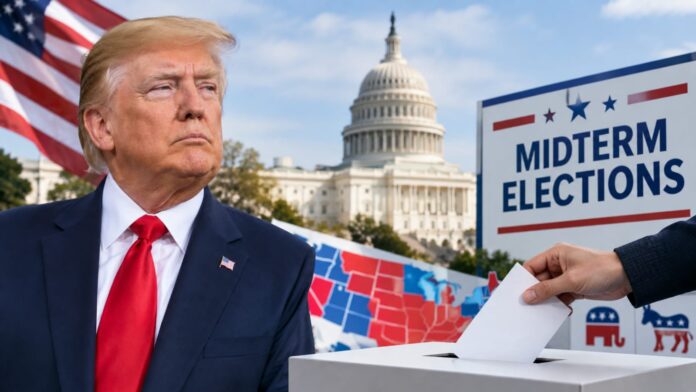
The midterm elections are fast approaching, and the political landscape is shifting in ways that could significantly impact the balance of power in Congress. Despite the Republican Party’s efforts to secure a majority in the House of Representatives through strategic redistricting, recent analyses suggest that Democrats are gaining momentum that could lead to a substantial electoral victory. The former president, who has been a pivotal figure in Republican politics, finds himself at the center of this unfolding drama, as his influence continues to loom large over the electoral process.
In the lead-up to the midterms, the administration initiated a national redistricting effort aimed at bolstering Republican representation. This initiative began last year when Trump urged Texas to redraw its political maps to gain five additional seats for the GOP. Other Republican-led states followed suit, attempting to create favorable conditions for their candidates. However, even with these efforts, the Democrats have managed to maintain a competitive edge, leading to a situation where the Republican advantage may not be sufficient to secure a majority come November.
- Trump’s push for redistricting in Texas aimed to gain five additional seats for Republicans.
- Democrats currently lead by 6 points on a generic ballot, indicating a potential majority.
- Special elections have shown Democrats outperforming their expected metrics.
- Trump is scheduled to speak at a major GOP convention, aiming to energize his base.
Why It Matters
The implications of these developments are significant, not only for the Republican Party but also for the broader political landscape in the United States. If Democrats succeed in flipping the House, it could lead to a substantial shift in legislative priorities and governance. The current analysis from Axios indicates that Democrats could potentially secure a majority of 230-205 if they maintain their current lead. This would allow them to push forward their agenda, which could include policies that diverge sharply from those championed by the previous administration.
Moreover, the declining approval ratings of the former president are a cause for concern among Republican candidates. Many are grappling with the challenge of aligning themselves with Trump while also appealing to a broader electorate that may be disillusioned with his leadership. This precarious balancing act could determine the fate of numerous campaigns across the country. Candidates in competitive races are particularly vulnerable, as they must navigate the complexities of Trump’s influence without alienating potential voters.
- A Democratic majority could shift legislative priorities significantly.
- Republican candidates face challenges in aligning with Trump amid declining approval ratings.
- Vulnerable Republicans may be affected by their proximity to the president.
- Trump’s involvement in campaigning could energize or hinder GOP efforts.
Political and Public Context
Understanding the context of these midterm elections requires a look at the broader political environment. The 2022 elections are not occurring in a vacuum; they are influenced by a series of events and trends that have shaped public opinion and voter sentiment. The ongoing fallout from the previous presidency, including controversies surrounding policies and actions, continues to resonate with voters. Additionally, the economic landscape, characterized by inflation and other challenges, has further complicated the political calculus for both parties.
Furthermore, the Democratic Party has been actively working to capitalize on these dynamics. With a focus on mobilizing voters and addressing key issues such as healthcare, education, and economic recovery, they are positioning themselves as a viable alternative to the Republican agenda. The success of these efforts will depend on their ability to maintain momentum and effectively communicate their message to the electorate.
- The political environment is shaped by the ongoing fallout from the previous presidency.
- Economic challenges, including inflation, are influencing voter sentiment.
- Democrats are focusing on key issues to mobilize voters.
- Public opinion is fluid and could shift as the elections approach.
President Trump's support for data centers puts many Republicans in a bind: they want to satisfy their increasingly angry constituents but they don’t want to draw the president’s wrath. Here's what to know https://t.co/PDIF1G9oX5
— Bloomberg (@business) September 9, 2026
What Happens Next
As the midterm elections draw closer, several key developments will shape the electoral landscape. The upcoming GOP convention in Dallas, where Trump is set to speak, will be a critical moment for the party. His ability to energize the base could play a significant role in determining voter turnout and enthusiasm. However, the decision of many GOP lawmakers to skip the convention raises questions about the party’s unity and strategy moving forward.
Additionally, Trump’s spending strategy will be closely watched. With a substantial war chest at his disposal, the decisions regarding campaign financing could have far-reaching implications for Republican candidates. If he chooses to allocate funds to support his own political ambitions or personal projects, it could leave candidates in a precarious position as they seek to secure their own electoral victories.
- The GOP convention will be a pivotal moment for party unity and voter enthusiasm.
- Trump’s spending decisions will impact Republican campaign financing.
- Candidates must navigate the complexities of aligning with Trump while appealing to voters.
- Public opinion may shift as the elections approach, influencing outcomes.