

Story Highlights
- President Donald J. Trump signed a new National Security Presidential Memorandum on space transportation.
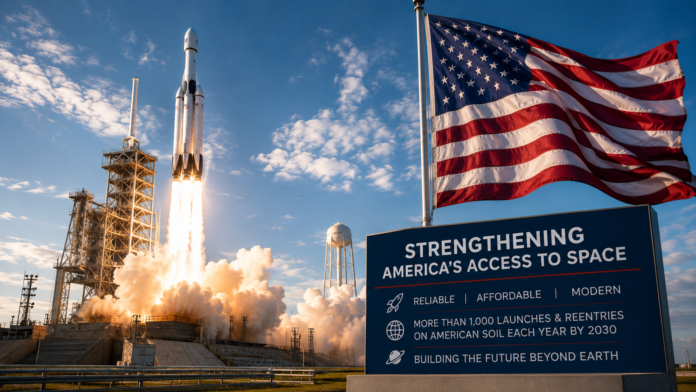
- The administration aims to support more than 1,000 U.S. launches and reentries annually by 2030.
- The policy emphasizes private-sector investment, faster permitting and expanded launch infrastructure.
- NASA is directed to advance commercial transportation to the Moon and explore commercial access to Mars.
What Happened
President Donald J. Trump signed a National Security Presidential Memorandum on Aug. 20 aimed at strengthening America’s space transportation industry and expanding access to space. The memorandum replaces an older national space transportation policy with an approach focused on reliable, affordable and modernized transportation services. It directs federal agencies to work with private companies on infrastructure, accelerate permitting and environmental reviews, improve launch-range scheduling and identify additional locations for launches and reentries.
The policy sets a goal of more than 1,000 launches and reentries on American soil each year by 2030. It also directs the administration to develop a broader space transportation industrial strategy, expand market access for U.S. companies and modernize airspace arrangements around launch corridors. NASA is instructed to facilitate commercial transportation to and from the Moon, support robotic access to Mars and examine commercial options for future human missions to Mars.
- The memorandum replaces the previous national space transportation policy.
- Federal agencies will pursue additional launch and reentry locations.
- Commercial partners will have a larger role in space transportation infrastructure.
- NASA will support commercial lunar and Martian transportation efforts.
Why It Matters
The administration is presenting expanded space transportation as both an economic and national-security priority. The White House says stronger commercial space capabilities can support aerospace manufacturing, create high-paying jobs and reduce the cost of developing and deploying space systems. It also links next-generation space transportation with services Americans already rely on, including satellite communications, navigation and timing, precision agriculture and weather forecasting.
The policy also reflects the growing importance of private companies in America’s space ambitions. By encouraging public-private infrastructure development and streamlining regulatory processes, the administration is seeking to make the United States a more competitive environment for commercial launches and related industries. The White House argues that expanding domestic space capabilities will strengthen American technological leadership while supporting broader economic activity.
- Space transportation is being treated as an economic priority.
- Aerospace manufacturing could benefit from expanded launch activity.
- Satellite-dependent services could gain from stronger space infrastructure.
- Private companies are expected to play a larger role in the sector.
Political and Public Context
The memorandum fits into the administration’s broader America First approach to space policy. The White House has emphasized maintaining U.S. leadership in space exploration, security and commerce while responding to challenges from foreign competitors. The new policy builds on actions taken during Trump’s first administration, including the creation of the Space Force and policy changes intended to encourage commercial space development.
The administration has also continued to emphasize commercial participation in space during Trump’s current term. It points to a 2025 executive order encouraging competition in the commercial space industry, another order establishing an America First space policy, and a July 2026 Federal Aviation Administration proposal aimed at reducing regulatory barriers for launch infrastructure. The new memorandum brings those efforts together under a broader transportation strategy.
- The policy builds on Trump’s previous space initiatives.
- The administration links space leadership with national security.
- Commercial competition remains central to the strategy.
- Regulatory reform is a major part of the space agenda.
What Happens Next
Federal agencies now face a series of implementation tasks under the memorandum. The Transportation and Interior departments, working with the Department of War and NASA, are directed to identify potential future space transportation infrastructure sites. Agencies must also work on launch-corridor airspace priorities, range scheduling, permitting and environmental-review processes.
The longer-term benchmark will be whether the United States can move toward the administration’s target of more than 1,000 launches and reentries annually by 2030. Progress will depend on infrastructure expansion, private-sector participation, regulatory changes and the government’s ability to develop the workforce and industrial capacity needed to support a larger space transportation market.
- Watch for new launch and reentry site proposals.
- Watch changes to permitting and environmental reviews.
- Watch private-sector investment in space infrastructure.
- Watch progress toward the 2030 launch target.
