

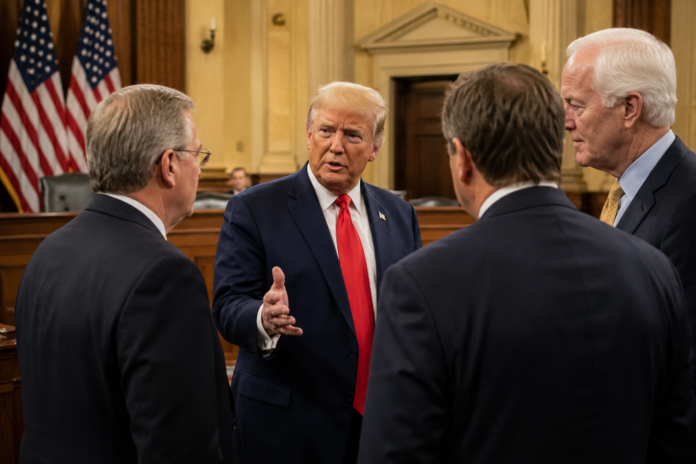
Acting Attorney General Todd Blanche’s path to Senate confirmation has hit a serious roadblock, as Republican Senators John Cornyn and Thom Tillis continue withholding support over unresolved questions tied to President Trump’s controversial IRS settlement. The Senate Judiciary Committee was forced to postpone a scheduled vote to advance Blanche’s nomination, throwing his confirmation into uncertainty just days before the Senate breaks for its lengthy August recess. The standoff represents an unusual instance of intraparty resistance to one of Trump’s most consequential appointments.
Story Highlights
- The Senate Judiciary Committee postponed its vote on advancing Blanche’s nomination after Cornyn and Tillis said they lacked written DOJ assurances on the IRS settlement
- Both senators want written limits on the tax-audit immunity the deal would extend to Trump and his family
- Neither Cornyn nor Tillis faces reelection in November, reducing the political pressure typically used to secure GOP unity
- Blanche has broad institutional backing, including support cited from law enforcement groups and DOJ veterans
What Happened
Todd Blanche, who has served as acting attorney general since April 2026 following his earlier confirmation as deputy attorney general, was scheduled to have his nomination for the permanent position advanced by the Senate Judiciary Committee in a markup vote late last week. That vote was postponed after Republican Senators John Cornyn of Texas and Thom Tillis of North Carolina said they had not received the written assurances they were seeking from the Justice Department regarding the settlement between Trump and the IRS. Committee Chairman Chuck Grassley of Iowa confirmed the delay, telling reporters “we are working on getting a solution” while declining to specify when the vote might be rescheduled.
Cornyn told reporters that Blanche’s team had failed to provide written proposals addressing his concerns about the document-release terms of the tax settlement, stating, “I haven’t seen a single piece of writing that is responsive to what I’ve requested.” Both senators are seeking formal, written commitments from the department limiting the scope of tax-audit immunity the settlement would extend to Trump, his family members and Trump Organization entities, along with clarity on whether the disputed $1.77 billion “anti-weaponization” fund remains formally dead or could be revived. Cornyn, notably, lost his Republican primary earlier this year to Trump-endorsed Texas Attorney General Ken Paxton, and pushed back on suggestions that his holdout reflects retaliation for Trump’s lack of endorsement, calling that theory “a convenient excuse for not cooperating.”
The postponement came just weeks after Blanche’s confirmation hearing on July 15, during which he faced hours of pointed questioning from both Democrats and Republicans on the Judiciary Committee, primarily focused on the Justice Department’s handling of the Jeffrey Epstein files and its pursuit of the IRS fund. Senate Judiciary Committee ranking Democrat Dick Durbin pressed Blanche to commit to personally meeting with Epstein victims within 30 days; Blanche ultimately said the department has always been open to such meetings but stopped short of committing to a personal meeting, citing the fact that the victims are represented by counsel, a rationale one senator on the committee dismissed as “utter nonsense.”
Despite the roadblock from Cornyn and Tillis, Blanche has amassed substantial institutional backing for his confirmation. The Senate Judiciary Committee’s own materials cite support from more than 670,000 sworn law enforcement officers, roughly 300 families of crime victims, and around 100 bipartisan former U.S. attorneys and Justice Department officials spanning eight presidential administrations. Grassley and other Republican committee members have continued publicly urging Blanche’s confirmation, describing him as highly qualified for the role despite the ongoing dispute.
Why It Matters
The standoff illustrates a rare and consequential split within the Republican Senate majority over an issue tied directly to presidential accountability. Cornyn and Tillis, both of whom have previously clashed with Trump on other matters, are effectively using their leverage over a high-profile nomination to extract concrete written commitments on a controversial settlement that has already drawn bipartisan criticism as a taxpayer-funded “slush fund.” Their willingness to hold up the process, even at the cost of delaying confirmation of the nation’s chief law enforcement officer, signals that institutional friction over the IRS deal has not been fully resolved simply because the administration says the compensation fund is dead.
For the Justice Department, prolonged uncertainty over its top leadership carries real operational consequences. Blanche has been serving in an acting capacity since April, and an extended delay in permanent confirmation could complicate the department’s ability to fill out its senior leadership team and pursue longer-term policy priorities, particularly as it continues to face scrutiny over its handling of the Epstein files and other high-profile matters.
The dispute also has broader implications for how Congress approaches presidential nominees more generally. If Cornyn and Tillis succeed in extracting binding written commitments as a condition of confirmation, it could establish a template for future Senate leverage over executive branch nominees tied to unresolved policy disputes, a precedent of interest to lawmakers in both parties regardless of which administration is in office.
For Trump himself, the delay represents a rare setback in a Republican-controlled Congress that has otherwise moved quickly to confirm his nominees. With a pivotal midterm election just three months away, prolonged intraparty friction over his handling of the IRS matter adds to a broader narrative of legal and political complications trailing the administration.
Economic and Global Context
While the Blanche nomination fight is primarily a domestic governance matter, it is directly intertwined with the fiscal questions raised by the underlying IRS settlement, an arrangement that would have directed nearly $1.8 billion in taxpayer funds toward a compensation pool and shielded the president’s family businesses from standard tax enforcement. Government accountability organizations have noted that resolving the ambiguity around that provision matters for maintaining public confidence in the IRS’s independence from political interference, an issue with implications for tax compliance and revenue collection nationally.
The Justice Department’s leadership vacancy at the confirmed level also arrives at a moment when the department is managing several high-profile, resource-intensive matters simultaneously, including ongoing immigration enforcement priorities, cartel and transnational gang prosecutions, and continued fallout from the Epstein files controversy. Extended uncertainty at the top of the department could affect the pace and consistency of policy execution across these fronts.
There is no significant direct market impact tied to the nomination delay itself, though continued political turbulence around the administration’s handling of tax and financial matters has fed into broader narratives, echoed in both domestic and international commentary, about institutional strain within the current government. Foreign observers, including some European outlets, have cited the Blanche standoff alongside the IRS litigation as evidence of unusual friction between Trump and members of his own party in Congress.
Implications
The most immediate question is whether Grassley can broker a written agreement between Cornyn, Tillis and the Justice Department before the Senate departs for its August recess around August 10. If no deal is reached, Blanche’s confirmation could stall until the fall, extending his acting tenure and leaving the permanent attorney general position unresolved for months longer than the administration had planned.
For Cornyn and Tillis, continued insistence on written commitments carries some political risk, given the extensive institutional support Blanche has garnered from law enforcement organizations and bipartisan former officials. Both senators will need to weigh the value of their leverage against the potential for their own party to view the delay as an unnecessary obstruction of a broadly popular nominee.
For Democrats on the Judiciary Committee, the internal Republican dispute offers an opportunity to further highlight unresolved concerns about the IRS settlement and the department’s handling of the Epstein files, even though committee Democrats have already indicated they intend to oppose Blanche’s confirmation regardless of the outcome of the Cornyn-Tillis negotiations. Should Blanche eventually win confirmation, the written assurances demanded by Cornyn and Tillis could become an important, closely scrutinized document shaping how the audit-immunity dispute is handled going forward.
Sources
