

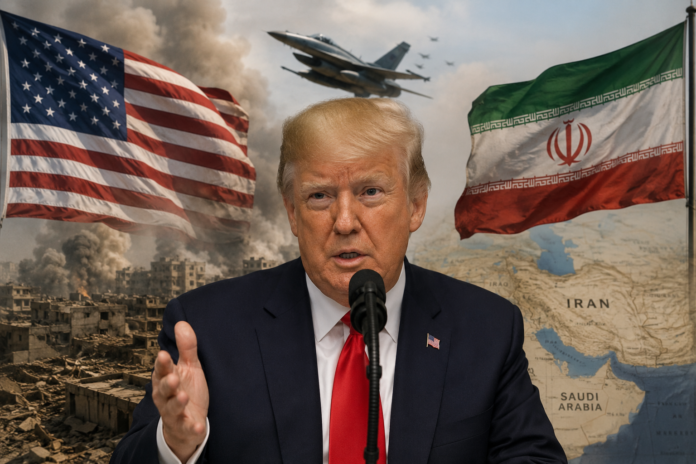
President Trump said Friday that the United States and Iran remain in contact even as he considers what he has described as the biggest offensive of the war, following thirteen consecutive nights of American airstrikes against Iranian targets. The escalation has driven global oil prices above $100 a barrel and drawn in regional players including Saudi Arabia and Yemen’s Houthi rebels. With dozens killed on both sides and American service members among the dead, the conflict shows no clear sign of resolution.
Story Highlights
- U.S. airstrikes on Iran have continued for 13 consecutive nights after a June ceasefire collapsed
- Trump told Axios he is “considering a massive attack, bigger than ever before” and is “close to making a decision”
- At least four U.S. service members and 59 people in Iran have been killed since June 27, according to Iranian health officials and the Pentagon
- Global oil prices spiked above $100 a barrel amid the fighting and Houthi attacks on Saudi tankers in the Red Sea
What Happened
The conflict between the United States and Iran has entered its third week of active strikes, with President Trump signaling Friday that he is weighing a dramatically larger military operation while simultaneously insisting that diplomatic talks with Tehran continue. Speaking to reporters, Trump said Iran is “getting more serious” about negotiations, even as U.S. bombers carried out a thirteenth consecutive night of strikes against Iranian military and infrastructure targets.
The current round of fighting traces back to a ceasefire agreement Trump and Iranian officials signed in mid-June, which was meant to open a 60-day window for broader peace negotiations addressing control of the Strait of Hormuz and the future of Iran’s nuclear program. That truce unraveled after Iran resumed attacks on commercial vessels in the strait despite a reimposed U.S. naval blockade, prompting Trump to declare the ceasefire “OVER” and order renewed strikes on Iranian bases and infrastructure.
In an interview with Axios published Thursday, Trump said he was “considering a massive attack. Bigger than ever before. I am close to making a decision.” He added that Israel “would join in two minutes if I ask them to,” while maintaining that the United States does not require Israeli involvement to carry out a larger operation. Iran, for its part, has continued retaliatory strikes, including drone attacks on U.S. military facilities in Bahrain and Jordan.
The human toll has continued to climb. According to Hossein Kermanpour, a spokesperson for Iran’s health ministry, 59 people have been killed and 666 injured inside Iran since fighting resumed on June 27. The Pentagon has confirmed at least four American service members killed in the most recent wave of Iranian strikes. Iran has disputed reporting that it rejected a ceasefire proposal presented by Iraqi Prime Minister Ali al-Zaidi, instead accusing the Trump administration of violating the original memorandum of understanding.
Regional spillover has intensified as well. The U.S. military said it disabled a tanker attempting to bypass its blockade of Iranian ports, while Saudi Arabia launched strikes against Yemen’s Iran-backed Houthi rebels after the group attacked a Saudi vessel in the Red Sea, further complicating an already volatile shipping environment through one of the world’s most critical oil corridors.
Why It Matters
The prospect of a larger American military operation against Iran represents one of the most consequential foreign policy decisions of Trump’s second term. A “massive attack,” in the president’s own words, would mark a significant escalation beyond the nightly strikes that have characterized the conflict since the ceasefire collapsed, with potential consequences for American troops stationed throughout the Middle East, global energy markets, and the broader stability of the region.
For American families, the war carries a direct economic dimension. Rising oil prices have pushed average U.S. gas prices well above $4 a gallon, a tangible cost felt at the pump that could influence inflation figures and household budgets heading into the second half of the year. Continued escalation risks further price spikes if shipping through the Strait of Hormuz becomes more constrained or if additional countries are drawn into the conflict.
For policymakers, the situation raises pressing questions about congressional oversight of an extended military campaign that has now stretched well beyond its original ceasefire framework. Lawmakers from both parties have periodically pressed the administration for clarity on the legal basis and endgame for continued strikes, though no formal war powers resolution has forced a definitive answer.
The conflict also tests the durability of Trump’s broader Middle East strategy, which has relied heavily on personal diplomacy and periodic ceasefire agreements that have proven fragile. The collapse of the June memorandum of understanding, following an earlier ceasefire brokered in 2025, suggests that durable de-escalation with Tehran remains elusive despite repeated attempts at negotiated pauses.
Economic and Global Context
Global oil prices have been among the most visible economic indicators tied to the conflict, briefly surpassing $100 a barrel for the first time in two months before dipping slightly amid reports that Pakistan was working to restart stalled peace talks. That report alone was enough to send stocks higher and oil prices lower, illustrating how sensitive markets remain to any sign of diplomatic progress or its absence.
The closure risk surrounding the Strait of Hormuz, through which a substantial share of the world’s seaborne oil trade passes, continues to weigh on energy markets. Houthi attacks on Saudi tankers in the Red Sea have added a second front of maritime uncertainty, compounding disruptions to global shipping routes that were already strained by the broader conflict.
Regional actors beyond Iran and the United States have also become more directly involved. Saudi Arabia’s strikes against Houthi targets in Yemen reflect growing concern in Gulf capitals that the conflict could spill further into their own waters and energy infrastructure. Iraq’s prime minister has taken on a mediating role, while Pakistan has reportedly sought to reopen backchannel negotiations, underscoring the wide diplomatic footprint the conflict has generated.
Israel’s posture remains a significant variable. Trump’s suggestion that Israel would join a larger operation “in two minutes” if asked keeps open the possibility of a wider regional war, even as Israel’s own ongoing tensions with Hezbollah in Lebanon complicate the broader ceasefire framework Iran has cited as a source of continued grievance.
Implications
In the coming days, the central question is whether Trump moves forward with the larger military operation he described to Axios or whether renewed diplomatic contact, potentially facilitated by Iraq or Pakistan, produces another pause in hostilities. Either path carries significant risk: further escalation could deepen American military commitments and casualties, while another fragile ceasefire could simply set the stage for a future collapse similar to the one that unraveled in recent weeks.
For American consumers, continued volatility in oil markets will likely keep gas prices elevated, with the potential for sharper spikes if the conflict widens further or if shipping through the Strait of Hormuz faces additional disruption. Businesses reliant on global shipping and energy costs will be watching closely for signs of either escalation or resolution.
For U.S. allies in the Gulf, the coming weeks will test the durability of security cooperation arrangements as Saudi Arabia and other regional partners weigh their own exposure to Houthi and Iranian retaliation. Continued instability could also complicate broader American diplomatic priorities in the region, including efforts tied to Israeli-Lebanese tensions.
Congress, meanwhile, faces its own decision point on whether to seek greater input into the administration’s next steps, particularly if Trump proceeds with a strike operation he has characterized as larger than anything seen so far in the conflict.
Sources
Trump threatens a major escalation in Iran after 13 straight nights of strikes
